

Hyperautomation Strategy: Beyond RPA in 2026
Hyperautomation is a business framework that combines robotic process automation with artificial intelligence, machine learning, process mining, and intelligent document processing to automate complete end-to-end business processes.
Unlike standalone RPA implementations that handle individual repetitive tasks, hyperautomation orchestrates multiple technologies to transform entire workflows, reduce operational costs by 30% when paired with redesigned processes, and deliver what organizations report as productivity improvements between 26-55%.
The distinction matters now more than ever. The global hyperautomation market reached USD 68.2 billion in 2026 and is projected to expand to USD 278.3 billion by 2035 at a 16.9% compound annual growth rate.
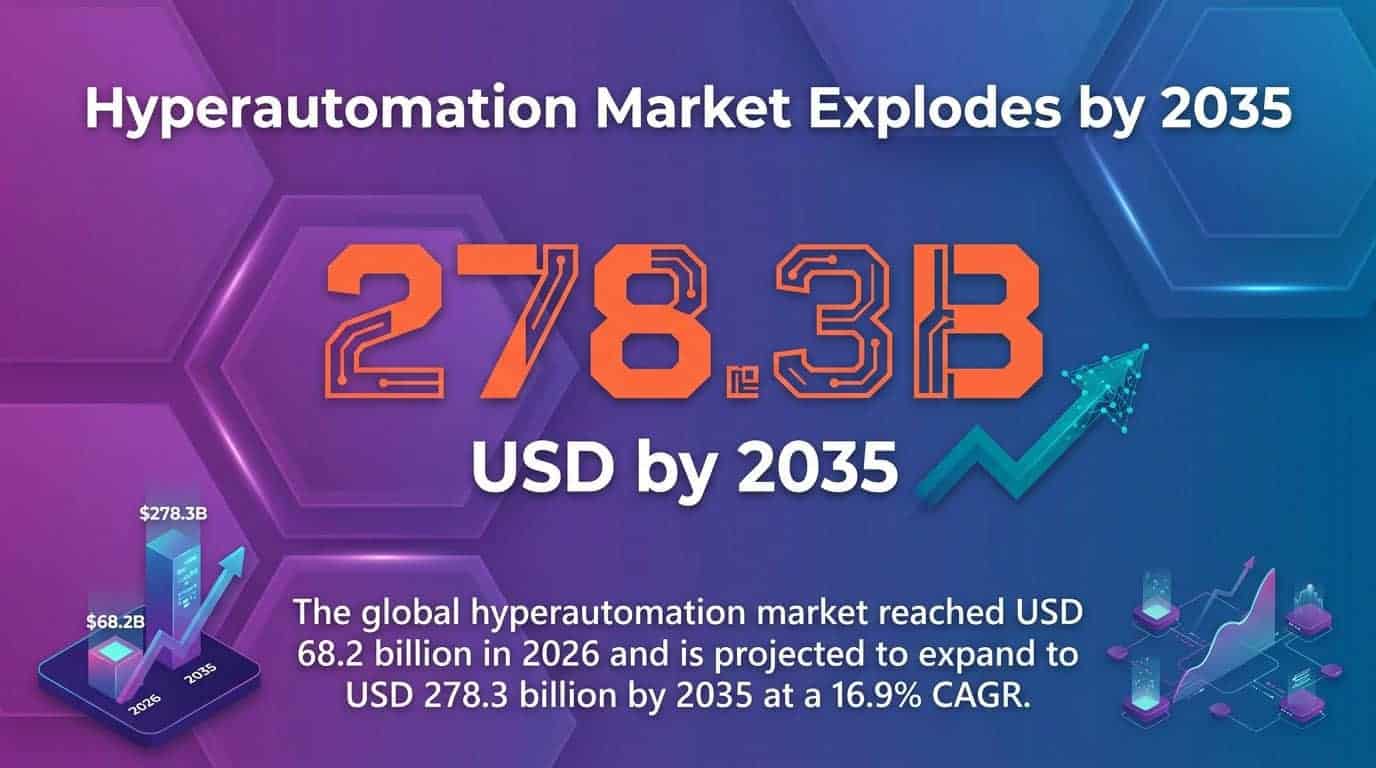
Hyperautomation market growth: $68.2B in 2026, forecast to $278.3B by 2035 at 16.9% CAGR.
The shift happen across industries in 2025 -organizations moved from experimenting with isolated automation to depending on integrated hyperautomation strategies. Teams discovered that real transformation required orchestrating AI, ML, and RPA into cohesive systems that could handle complex business processes from start to finish.
This strategic shift brings measurable business value. Organizations implementing hyperautomation don’t just automate faster. They redesign processes, eliminate bottlenecks, and create digitally connected enterprises that outpace competition through operational maturity. The technology stack you choose and how you integrate it determines whether you achieve incremental efficiency gains or fundamental business transformation.
This guide examines what hyperautomation actually means in 2026, how it differs from traditional automation and RPA, which technologies power modern implementations, and how to build a strategy that delivers production-ready results rather than endless pilots.
What Hyperautomation Means in Practice
Hyperautomation extends beyond automating individual tasks to orchestrating entire business processes. The difference is in how work flows through your organization.
Traditional automation handles specific, repetitive tasks. An RPA bot, for example, might extract data from emails and enter it into a database. That bot performs one function well but stops there.
Hyperautomation connects that data extraction to document processing, decision-making, and downstream systems. The same invoice doesn’t just get entered into a database. AI reads and classifies it, ML validates it against historical patterns, RPA routes it through approval workflows, and analytics track the entire process for optimization opportunities.
The operational difference is scale and scope. A bank using RPA might automate loan data entry. That same bank using hyperautomation combines RPA for data handling, AI for fraud detection, ML for credit scoring, and process mining to optimize the complete workflow. Manual intervention drops by 80% because the system handles exceptions, not just standard cases.
Process mining reveals another distinction. Hyperautomation discovers inefficiencies, maps actual workflows against ideal states, and identifies automation opportunities you didn’t know existed.
| Capability | Traditional RPA | Hyperautomation |
|---|---|---|
| Process Scope | Individual tasks | End-to-end workflows |
| Decision Making | Rule-based only | AI-powered with learning |
| Exception Handling | Requires human intervention | Intelligent routing and resolution |
| Process Discovery | Manual analysis | Automated process mining |
| Optimization | Static workflows | Continuous improvement through analytics |
Organizations that treat hyperautomation as “RPA plus AI” miss the strategic point. The technology stack matters less than how you orchestrate it. Successful implementations blend automation with operational discipline, domain expertise, and real-time data access.
This foundation leads to a question organizations ask constantly: how does hyperautomation actually differ from the RPA initiatives they’ve already attempted?
How Hyperautomation Differs from RPA and Basic Automation
The confusion between RPA, automation, and hyperautomation slows strategic planning. Organizations invest in the wrong technology because they misunderstand what each approach actually delivers.
Automation Handles Predetermined Tasks
Basic automation executes pre-programmed actions. Your email filter automatically sorts messages into folders. It follows fixed rules and can’t adapt when conditions change.
Manufacturing lines use automation to repeat identical motions. Financial systems use automation to run scheduled reports.
The pattern stays consistent: if this happens, then do that.
RPA Adds Software Robots to the Mix
Robotic process automation deploys software bots that mimic human actions. The RPA market is projected to grow from $27.22 billion in 2026 to $110.06 billion by 2034 at a 19% CAGR.
RPA bots log into applications, copy data between systems, and complete forms. They work faster than humans for repetitive tasks and don’t make transcription errors. But they follow rigid scripts and break when screen layouts change or exceptions appear. This is exactly why we lean on enterprise-grade platforms like UiPath and Microsoft Power Automate rather than treating RPA as a tactical tool — production resilience requires the right foundation.
The limitation becomes clear in production environments. RPA handles the happy path brilliantly. Introduce an unexpected data format or system timeout, and the bot fails. Human workers spend time managing bot exceptions rather than strategic work.
Hyperautomation Orchestrates the Complete Process
Hyperautomation combines RPA with AI, ML, process mining, and intelligent document processing into integrated systems. 90% of large organizations treat hyperautomation as strategically critical because it transforms how work gets done.
Consider accounts payable processing. RPA extracts invoice data and enters it into your ERP system. Hyperautomation adds AI to read unstructured invoices, ML to validate amounts against historical patterns, process mining to identify bottlenecks, and intelligent routing to handle exceptions.
The system learns from each invoice. It recognizes vendor patterns, flags anomalies, and optimizes approval workflows based on actual processing data. Exception handling becomes part of the automated process, not a failure mode.
| Aspect | Basic Automation | RPA | Hyperautomation |
|---|---|---|---|
| Intelligence Level | Rule-based only | Script-based mimicry | AI-powered decision making |
| Adaptability | Fixed workflows | Brittle scripts | Self-optimizing processes |
| Scope | Single actions | Task sequences | Complete business processes |
| Technology Stack | Single tool | RPA platform | Integrated AI, ML, RPA, analytics |
Understanding these distinctions changes how you build your automation roadmap. Organizations need the right digital operations toolbox, not just more bots, which shifts the question from “what can we automate?” to “how do we transform this entire process?“.
Core Technologies That Power Hyperautomation
Hyperautomation integrates specific technologies into production-ready systems. Each component serves a distinct purpose in the automation stack.
Artificial Intelligence Provides Decision-Making Capability
AI analyzes unstructured data, makes predictions, and handles complex decision trees. In hyperautomation implementations, AI determines which invoices need human review, routes customer inquiries to appropriate teams, and flags compliance risks in real-time.
Natural language processing enables AI to understand customer emails, extract intent, and generate appropriate responses. Computer vision reads documents regardless of format variations. These capabilities let automated systems handle the variability that breaks pure RPA implementations. Tools like SmartbridgeGPT and Microsoft Copilot Studio bring this AI layer into the orchestration without requiring teams to build everything from scratch.
Machine Learning Enables Continuous Improvement
ML models learn from historical data to improve accuracy over time. A credit approval system using ML gets better at predicting default risk with each loan processed. Fraud detection models adapt to new attack patterns without manual rule updates.
The learning happens during normal operations. Systems don’t just execute processes. They optimize based on outcomes, identify patterns in exceptions, and surface insights that drive process redesign.
Process Mining Discovers Hidden Inefficiencies
Process mining analyzes event logs from your existing systems to map actual workflows. You discover how work really flows through your organization, not how you think it flows.
The technology identifies bottlenecks, deviation patterns, and automation opportunities that manual analysis misses. Teams implementing hyperautomation use process mining to decide what to automate and validate that automation delivers expected results.
Intelligent Document Processing Handles Unstructured Content
IDP combines optical character recognition, AI, and ML to extract meaning from documents. Unlike template-based extraction, IDP adapts to format variations, handwriting, and poor scan quality. Platforms like Hyperscience have become a core part of our hyperautomation stack precisely because they solve the messy reality of document variability.
This capability matters for real-world business processes. Invoices arrive in dozens of formats. Purchase orders include handwritten notes. Intelligent automation requires systems that handle this variability without constant human intervention.
Low-Code Platforms Accelerate Development
These platforms let business analysts build automation workflows without extensive coding. Development cycles compress from months to weeks. Citizen developers can automate departmental processes while IT focuses on enterprise integration. Microsoft Power Apps has become a workhorse here for line-of-business teams who want to ship without waiting on a development queue.
Low-code doesn’t mean no-code governance. Production implementations still require proper testing, security reviews, and integration architecture. The platforms just shift who can build the initial automation logic.
Business Process Management Orchestrates Everything
BPM platforms coordinate all these technologies into cohesive workflows. They define process logic, manage exceptions, track performance, and provide the integration layer that connects RPA bots to AI services to legacy systems.
BPM acts as the conductor for your hyperautomation orchestra. Individual technologies perform specific functions. BPM ensures they work together to execute complete business processes from trigger to completion.
Selecting technologies is the easy part. Building them into systems that deliver measurable business value requires understanding what hyperautomation actually achieves in production environments.
Business Benefits That Drive Adoption
Operational Efficiency Reaches New Levels
Many automation service providers are seeing their clients achieve productivity improvements between 26-55% with hyperautomation implementations.
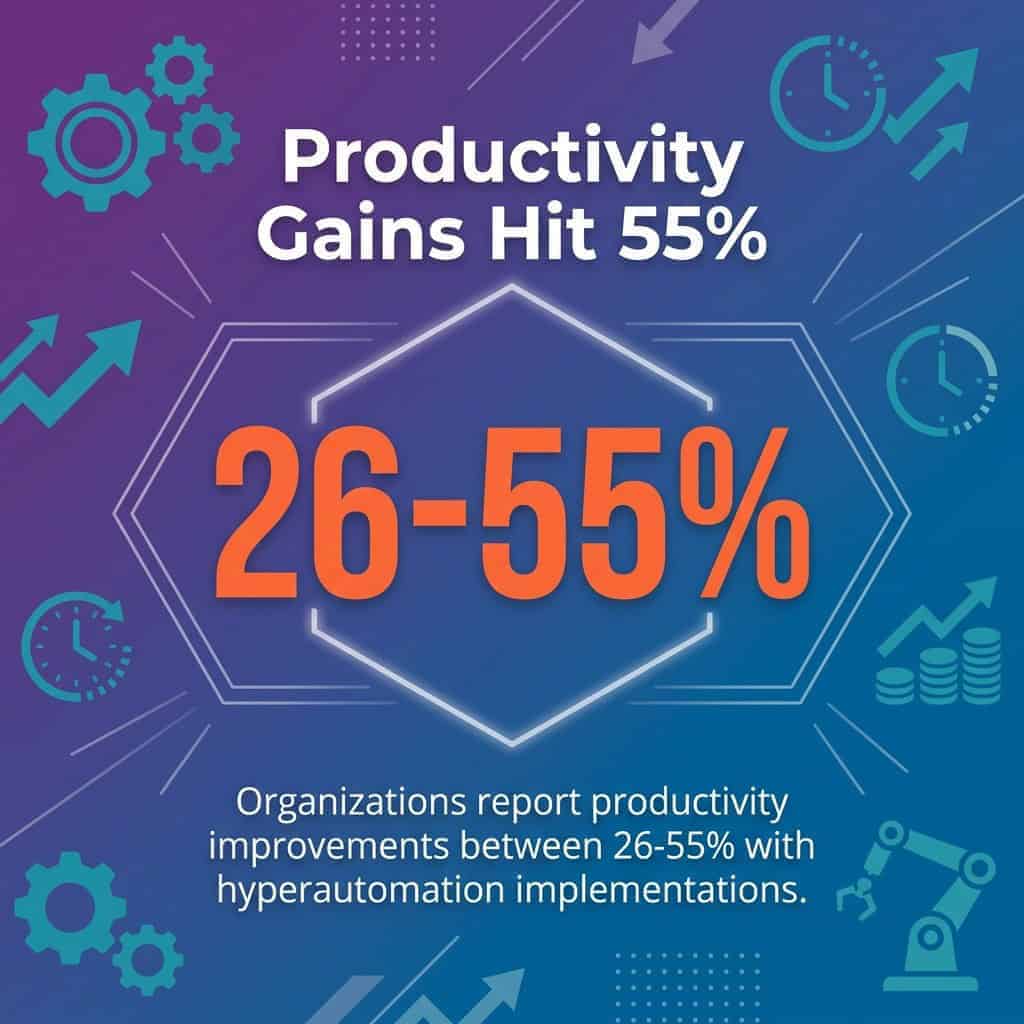
Productivity gains from hyperautomation commonly range between 26–55%
The gains come from eliminating handoffs, reducing errors, and accelerating process cycle times. Work that required days of human coordination completes in hours. Tasks that needed multiple system logins and data transfers happen automatically.
Cost Reduction Extends Beyond Labor
Automation service providers are also seeing hyperautomation reduce operational costs by 30% when combining technology with redesigned processes.
The savings accumulate across multiple areas. Labor costs drop as automation handles routine work. Error correction costs disappear as AI prevents mistakes rather than fixing them. Compliance costs decrease when systems automatically enforce policies and maintain audit trails.
Infrastructure costs often decrease too. Cloud-based hyperautomation platforms — particularly those built on Azure — eliminate on-premises software licensing and maintenance. Integration becomes configuration rather than custom development.
Accuracy Improves Across Processes
Human error rates in data entry range from 1-5% depending on complexity. Automated data extraction achieves 95-99% accuracy with proper training data. The difference compounds across high-volume processes.
Financial reconciliation, regulatory reporting, and customer data management all benefit from improved accuracy. Organizations spend less time correcting errors and more time using accurate data for decision-making.
Deutsche Telekom Services Europe provides a concrete example. The organization achieved an 80% increase in HR efficiency through hyperautomation.
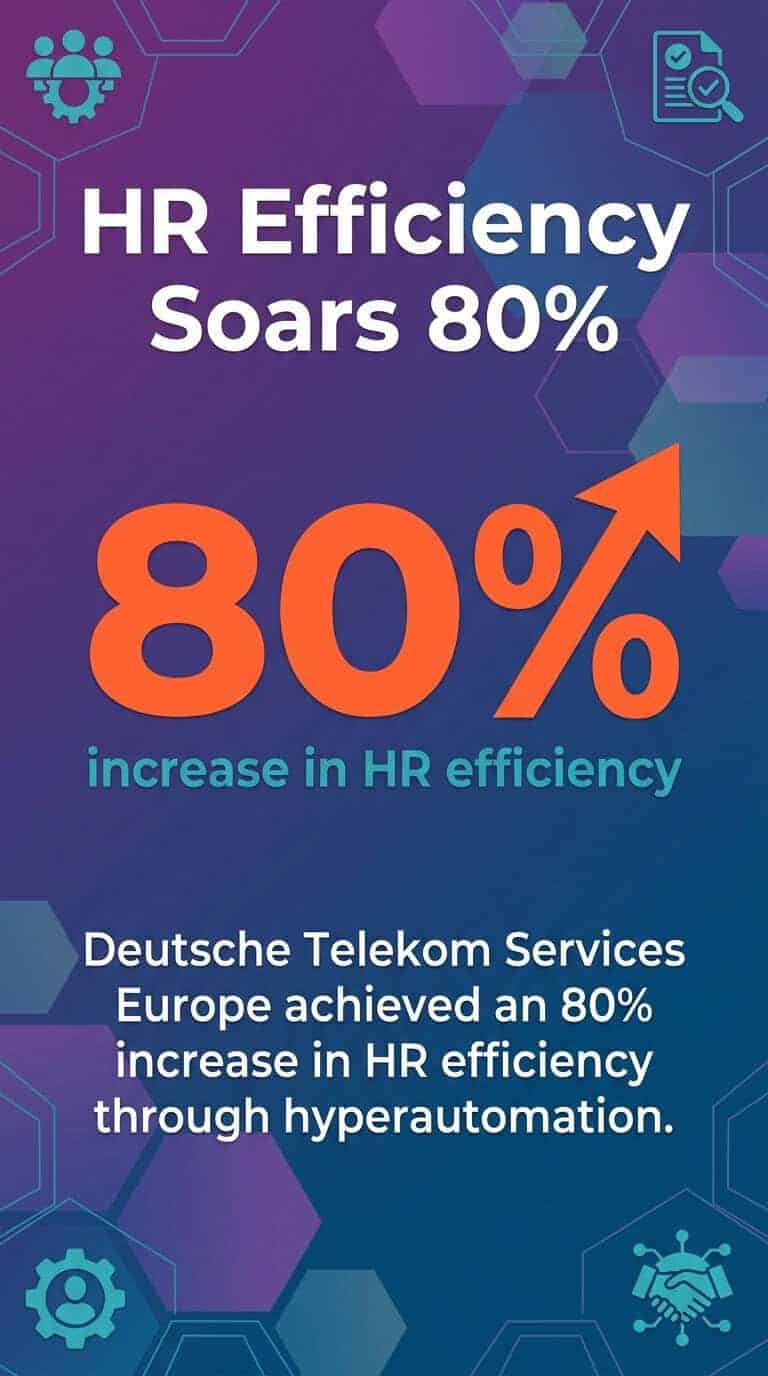
Case example: Deutsche Telekom Services Europe increased HR efficiency by 80% using hyperautomation.
Scalability Becomes Elastic
Hyperautomation scales instantly to handle volume spikes. Month-end close doesn’t require overtime. Product launches don’t need temporary staff. Systems process 10x volume using the same automation infrastructure.
This elasticity matters for growth. Organizations can enter new markets, launch products, and handle seasonal demand without proportional increases in operational staff.
Employee Experience Shifts to Higher-Value Work
Teams stop spending time on data entry, invoice matching, and status checks. They focus on customer relationships, process improvement, and strategic initiatives that automation can’t handle.
The shift requires change management. Workers need training on new responsibilities. But organizations that handle the transition well report improved employee satisfaction alongside efficiency gains.
Customer Experience Improves Through Speed and Consistency
Loan approvals that took days complete in hours. Customer inquiries get routed to the right specialist immediately. Order status updates happen in real-time without customer service calls.
Consistency matters as much as speed, and every customer gets the same service level. Processes execute the same way regardless of time, staff availability, or workload.
These benefits explain why adoption accelerates, but implementing hyperautomation brings challenges that organizations must address to achieve production success.
Implementation Challenges You’ll Face
Integration Complexity Slows Progress
Hyperautomation requires connecting RPA platforms, AI services, process mining tools, legacy systems, cloud applications, and data warehouses. Each integration point introduces technical complexity.
But APIs don’t always exist and data formats don’t match. Security requirements conflict with integration needs and organizations spend months on integration work that proof-of-concept demos glossed over.
The solution requires dedicated integration architecture. Build an integration layer rather than point-to-point connections and use enterprise service buses or iPaaS platforms to manage the complexity centrally.
Data Quality Issues Surface Quickly
AI and ML models depend on clean, consistent data. Hyperautomation exposes data quality problems that manual processes accommodated through human judgment. This is why our data & analytics work almost always precedes — or runs alongside — automation initiatives.
Customer records have duplicate entries. Product codes lack standardization. And historical data contains errors that humans recognized and corrected on the fly. Automated systems can’t make those judgment calls without proper data governance.
Organizations discover they need data cleansing, master data management, and ongoing data quality monitoring. The work takes longer than anticipated and requires business stakeholder involvement, not just IT effort.


Change Management Requires Executive Commitment
Hyperautomation changes how people work. Roles shift. Responsibilities transfer from humans to systems. Some positions become redundant while new roles emerge.
Workers resist changes they perceive as threats. Departments protect turf when processes cross functional boundaries. Middle managers fear losing authority over automated processes.
Successful implementations treat change management as seriously as technical implementation. Executive sponsors must communicate vision, celebrate early wins, and address workforce concerns directly.
Skills Gaps Limit Execution Speed
Hyperautomation requires expertise in AI, ML, process mining, RPA development, and integration architecture. Most organizations lack sufficient internal talent across all these areas.
Hiring is difficult because demand exceeds supply. Training takes time. External consultants provide expertise but don’t build internal capability.
Organizations need workforce development strategies that combine selective hiring, targeted training, and partnership with implementation specialists who transfer knowledge during projects.
Automated systems access sensitive data, make financial decisions, and interact with customers. Governance frameworks must define appropriate use, risk tolerances, and approval workflows for automation expansion.
Security requirements multiply with system integration. Each connection point requires authentication, encryption, and access controls. RPA bots need credential management. AI models need protection against data poisoning.
Compliance becomes more complex when systems span jurisdictions with different regulatory requirements. Automated processes must enforce controls consistently while maintaining audit trails that satisfy regulators.
ROI Measurement Proves Difficult
Organizations struggle to measure hyperautomation ROI accurately. Labor savings seem obvious but prove hard to quantify when automation shifts work rather than eliminating positions.
Soft benefits like improved customer satisfaction and employee morale resist quantification. Long-term strategic benefits don’t show up in quarter-one financial reports.
Successful organizations define measurement frameworks before implementation begins. They track leading indicators like process cycle time alongside lagging indicators like cost reduction. Regular reporting maintains executive support through the implementation journey.
Understanding these challenges shapes realistic implementation strategies. Organizations succeed when they plan for obstacles rather than assuming smooth execution.
Industry Applications Driving Growth
Hyperautomation delivers value across industries, but specific sectors show particularly strong adoption driven by clear business needs.
Energy, Oil & Gas Operationalize Field Data
Energy operators sit on enormous volumes of field data, regulatory reporting requirements, and asset-tracking processes that have historically demanded significant manual effort. Hyperautomation in oil & gas, utilities, and renewables targets exactly these pain points — joint interest billing, lease administration, production reporting, and HSE compliance workflows.
ML models combined with sensor data drive predictive maintenance on critical equipment. Process mining surfaces inefficiencies in capital project workflows. RPA bots handle the volume of data movement between SCADA systems, ERPs, and reporting platforms that would otherwise consume entire back-office teams.
The sustainability angle matters too. Automated emissions reporting and optimized routing for field operations reduce both compliance risk and operational footprint.

Life Sciences and MedTech Transform Patient and Device Workflows
Life sciences and MedTech organizations use hyperautomation to reduce administrative burden, accelerate device tracking, and improve patient experiences. Insurance verification, appointment scheduling, and medical records management consume significant staff time while adding no clinical value.
Hyperautomation handles prior authorization requests by reading clinical notes, checking insurance requirements, and submitting documentation automatically. Systems that previously took days complete in hours.
For MedTech specifically, end-of-service device communications and global shipment tracking are natural fits — automation orchestrates the data flow between manufacturing, regulatory, and customer-facing systems while maintaining the audit trails that FDA and EU MDR require.
Patient billing improves through automated coding validation. AI reviews clinical documentation, suggests appropriate codes, and flags potential compliance issues before claims submission. Claim denial rates drop while staff focus on complex cases requiring human expertise.
Lab result processing exemplifies end-to-end automation. Results arrive electronically, AI flags abnormal values, systems route alerts to appropriate providers, and patient portals update automatically. The entire workflow executes without manual intervention unless clinical judgment is required.

Restaurants and Food Service Turn Operational Data into Insight
Restaurant and food service operators face thin margins, distributed locations, and a constant flood of operational data — guest surveys, POS transactions, labor scheduling, supply chain signals. Hyperautomation pulls these threads together.
Generative AI applied to guest survey data turns millions of unstructured comments into actionable trends across menu, service, and location performance. RPA bots handle daily-sales reconciliation across hundreds of locations. ML models forecast demand at the store level to drive labor and inventory decisions.
The pattern repeats across multi-unit operators: the value isn’t in any single automation, it’s in the orchestration that turns previously siloed operational data into a coherent management layer.

Banking and Finance Automate Compliance
Financial institutions face mounting regulatory requirements while managing high transaction volumes. Hyperautomation addresses both challenges simultaneously.
Know Your Customer processes combine document verification, identity validation, and risk assessment. Hyperautomation orchestrates these steps by extracting data from submitted documents, validating information against external databases, assessing risk using ML models, and routing applications based on risk scores.
Anti-money laundering monitoring analyzes transaction patterns in real-time. ML models identify suspicious activities that rule-based systems miss. Process mining reveals new laundering techniques by analyzing investigation outcomes.
Loan processing shows the efficiency gains possible. Applications submitted online trigger automated credit checks, income verification, collateral valuation, and risk assessment. Decision engines apply lending policies consistently. Approvals that required three days complete in three hours for standard applications.
Supply Chain Operations Gain Visibility
Supply chain complexity makes hyperautomation particularly valuable. Organizations track inventory across multiple locations, coordinate with dozens of suppliers, and manage logistics through third-party providers.
Purchase order processing demonstrates the orchestration benefits. Systems monitor inventory levels, predict future demand using ML, generate purchase orders automatically, route them for approval based on business rules, and track delivery status through supplier portals.
Invoice reconciliation matches received goods against purchase orders and invoices automatically. Discrepancies get flagged for investigation. Valid invoices flow through approval workflows and payment processing without manual touchpoints.
Demand forecasting improves when hyperautomation combines point-of-sale data, seasonal patterns, promotion calendars, and external factors like weather or economic indicators. Inventory optimization algorithms adjust stock levels across the supply chain automatically.
Manufacturing Achieves Quality and Efficiency
Manufacturing environments generate massive data volumes from sensors, quality systems, and production equipment. Hyperautomation turns this data into operational improvements.
Quality control processes use computer vision to inspect products at speeds humans can’t match. ML models learn defect patterns and improve detection accuracy continuously. Defective items get routed automatically while trend analysis identifies root causes.
Maintenance scheduling shifts from calendar-based to condition-based. Sensors monitor equipment performance, ML models predict failure probability, and systems automatically schedule maintenance during planned downtime. Unplanned outages decrease while maintenance costs optimize.
Production planning incorporates real-time data from shop floors, supply chains, and order management systems. Schedules adjust automatically to material delays, equipment issues, or demand changes.
These industry applications share common patterns. Organizations achieve the greatest value when hyperautomation addresses high-volume processes with clear business rules but enough complexity to benefit from intelligent orchestration.
Building Your Hyperautomation Strategy
Successful hyperautomation requires deliberate strategy, not tactical technology deployment. Organizations that treat it as a technology purchase rather than business transformation struggle to achieve production scale.
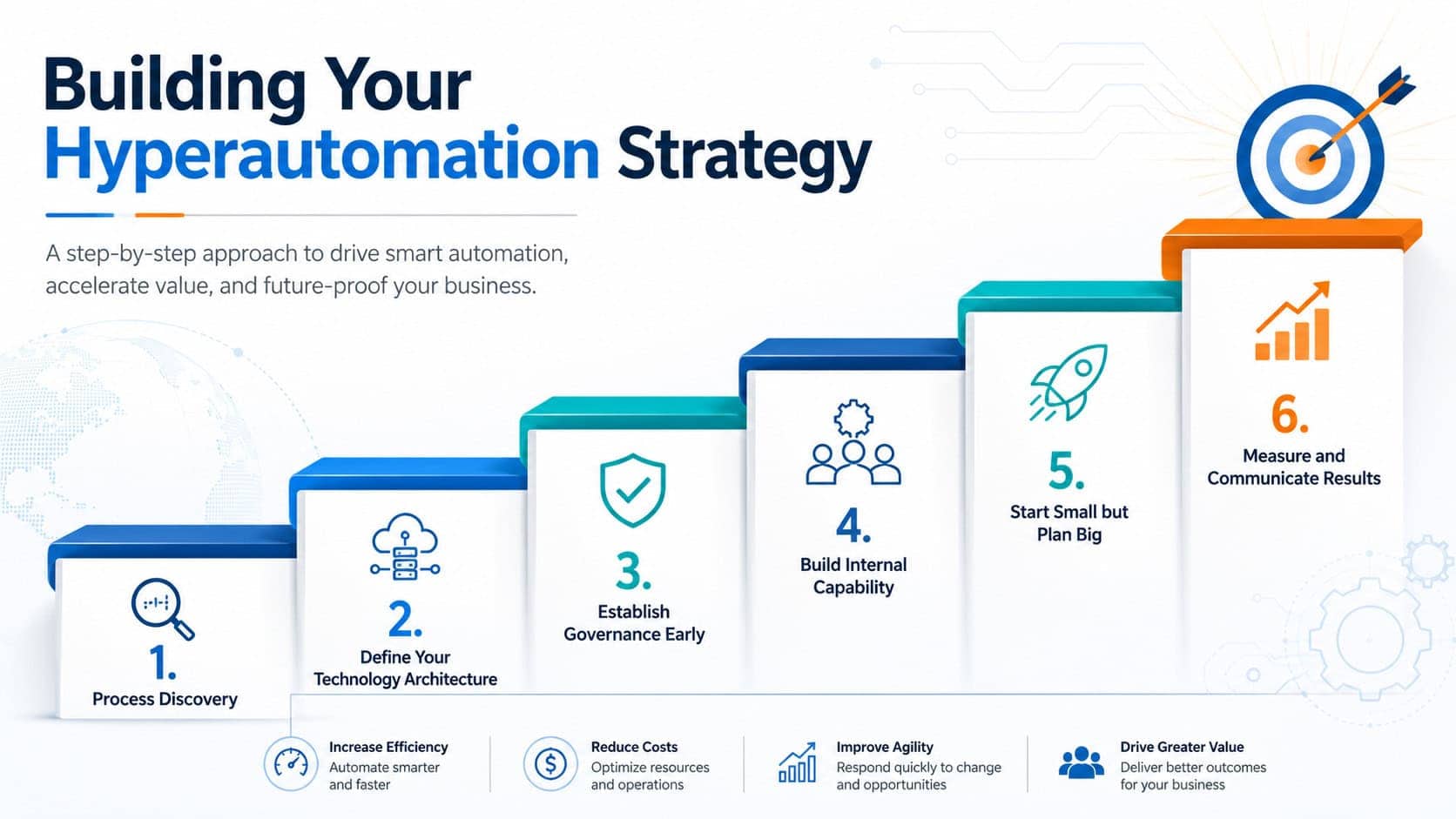
1. Start with Process Discovery
Process mining reveals how work actually flows through your organization. Deploy process mining tools on existing systems to capture event logs. Analyze the data to identify bottlenecks, variations, and automation opportunities.
Don’t automate broken processes. The discovered workflows often reveal inefficiencies that process redesign should address before automation. Fix the process first, then automate the improved workflow.
Prioritize processes based on volume, frequency, rule-clarity, and business impact. High-volume, rules-based processes with clear business value make ideal initial targets. Complex, judgment-intensive processes require different approaches.
2. Define Your Technology Architecture
Select platforms that integrate rather than best-of-breed tools that require custom integration. Evaluate how RPA, AI, process mining, and BPM platforms work together in your target architecture. For most of the implementations we see succeed, that means a coordinated stack across Microsoft (Azure, Power Platform, Copilot) and Salesforce (Agentforce, Data 360, industry clouds), with specialist tools like UiPath and Hyperscience filling specific gaps.
Cloud-native platforms typically offer better integration and scalability than on-premises deployments. But data residency requirements, security policies, and existing infrastructure investments may influence deployment models.
Plan for a composable architecture. Build integration layers that let you swap components as technology evolves. Avoid vendor lock-in that limits future flexibility.
3. Establish Governance Early
Create a center of excellence that defines automation standards, approves projects, and shares best practices across the organization. Central governance prevents automation sprawl while enabling distributed execution.
Define clear criteria for automation candidates. Not every process deserves automation. Establish thresholds for volume, complexity, and ROI that justify investment.
Implement security and compliance frameworks before production deployment. Define data access policies, credential management approaches, and audit logging requirements. Build these controls into automation from the start rather than retrofitting them later.
4. Build Internal Capability
Invest in training programs that develop automation skills across IT and business teams. Citizen developers enable departmental automation while specialists handle enterprise integration.
Partner with implementation specialists for initial projects, but require knowledge transfer. Build internal expertise through doing rather than just observing external consultants. Our managed services approach is built around exactly this principle — sustained capability rather than dependency.
Create career paths for automation professionals. Retention matters because trained staff become increasingly valuable as implementations scale.
5. Start Small but Plan Big
Begin with pilot projects that deliver quick wins and build organizational confidence. Select processes with clear business value, manageable complexity, and supportive stakeholders.
Document lessons learned from pilots. Capture what worked, what didn’t, and what you’d do differently on the next project. Build institutional knowledge systematically.
Scale successful pilots to production while starting new pilots in different process areas. Expand scope gradually rather than attempting enterprise-wide transformation immediately.
6. Measure and Communicate Results
Track both quantitative and qualitative metrics. Process cycle time, cost per transaction, error rates, and throughput provide quantitative evidence. Customer satisfaction, employee experience, and competitive positioning matter equally.
Report results regularly to executive sponsors and organizational stakeholders. Celebrate wins, acknowledge challenges, and maintain transparency about progress toward strategic objectives.
Use metrics to guide investment decisions. Double down on successful automation patterns. Adjust or abandon approaches that underperform despite reasonable implementation efforts.
Strategic planning establishes the foundation. Execution determines whether strategy translates into production results that justify continued investment.
Hyperautomation in 2026 and Forward
The hyperautomation market continues maturing as organizations move from pilots to production implementations. Growth projections to USD 278.3 billion by 2035 reflect this shift from experimentation to operational dependency.
Several patterns emerged as we watched the industry through 2025 and into 2026. These developments show where enterprise automation is actually heading.
AI Agents Automate Decision-Making
AI agents move beyond task automation to autonomous decision-making within defined parameters. These agents go beyond executing workflows to determine which workflows to execute based on context, priority, and business rules. Platforms like Salesforce Agentforce and Microsoft Copilot Studio have brought this capability into the mainstream enterprise stack.
Customer service agents analyze inquiry complexity and route requests appropriately. Supply chain agents adjust inventory policies based on demand signals. Financial agents approve routine transactions while escalating exceptions.
This reduces human oversight requirements for routine decisions while maintaining control over strategic choices and exceptions that require judgment.
Generative AI Enhances Process Automation
Generative AI capabilities integrate into hyperautomation platforms. Content generation, code development, and process documentation become automated components of larger workflows.
Customer communications personalize automatically based on interaction history and preference data. System documentation updates itself as processes evolve. Development accelerates as GenAI generates initial automation logic from natural language process descriptions.
Edge Computing Enables Real-Time Processing
It’s estimated that now in 2026 approximately 30% of enterprises will have automated over half their network operations.
Edge deployments process data locally rather than routing everything through centralized systems. Manufacturing facilities analyze sensor data in real-time for immediate process adjustments. Retail locations optimize inventory decisions based on local demand patterns.
This distributed approach reduces latency, improves reliability, and enables automation in environments with limited connectivity.
Industry-Specific Solutions Mature
Generic hyperautomation platforms give way to industry-specific solutions that embed domain expertise. Healthcare automation platforms understand clinical workflows and regulatory requirements. Financial services platforms incorporate compliance rules and risk management frameworks. Salesforce’s Life Sciences Cloud and Health Cloud are good examples — they embed regulatory and clinical workflow knowledge directly into the platform.
These specialized solutions reduce implementation complexity and accelerate time-to-value. Organizations adopt proven workflows rather than building everything from scratch.
Sustainability Becomes a Design Criterion
Organizations evaluate hyperautomation investments partly on environmental impact. Energy-efficient processing, optimized resource utilization, and reduced physical infrastructure contribute to sustainability goals.
Automation that reduces paper consumption, optimizes delivery routes, or minimizes waste generation receives prioritization. ROI calculations include environmental benefits alongside financial returns.
Citizen Development Expands
Low-code platforms democratize automation development. Business analysts build departmental automations without extensive technical training. IT focuses on enterprise integration, governance, and complex use cases.
The expansion requires strong governance to prevent sprawl and security risks. But organizations that balance enablement with control achieve faster automation adoption across business units.
These trends reinforce the strategic nature of hyperautomation. Organizations building capabilities now position themselves to capitalize on maturing technologies and expanding use cases.
Making Hyperautomation Operational
Strategy and pilots prove feasibility. Production deployment at scale determines whether hyperautomation delivers promised business value. Moving from experimental RPA to operational hyperautomation requires different capabilities and mindsets.
Organizations succeed when they treat hyperautomation as an operational discipline rather than a technology project. Build capabilities that sustain and expand automation over time.
Operationalize Governance
Governance can’t remain a committee that meets monthly. Production hyperautomation requires operational governance that monitors performance daily, resolves issues quickly, and approves changes systematically.
Implement automated monitoring that tracks bot performance, exception rates, process cycle times, and business outcomes. Alert appropriate teams when metrics deviate from acceptable ranges.
Establish clear escalation paths for different issue types. Technical failures route to IT support. Business rule questions escalate to process owners. Security concerns trigger immediate response protocols.
Build Continuous Improvement Processes
Hyperautomation generates data about process performance that manual operations never captured. Use this data systematically to improve processes rather than just monitoring them.
Review exception patterns monthly to identify opportunities for automation enhancement. If specific exceptions occur frequently, determine whether rule updates could handle them automatically.
Analyze process mining data to discover new automation opportunities. Successful automation in one department often reveals similar opportunities elsewhere.
Manage the Automation Portfolio
Track all automation assets centrally. Document what each automation does, which systems it touches, who maintains it, and how it integrates with other automations.
Retire automations that no longer deliver value. Process changes, system updates, and business evolution make some automations obsolete. Maintaining unused automations wastes resources and creates technical debt.
Prioritize automation updates and enhancements based on business value. Resources are limited. Focus investment where it generates the greatest return.
Develop Your Automation Workforce
Create career paths for automation professionals that reward growing expertise. Retain institutional knowledge by making automation development and maintenance attractive career options.
Cross-train staff across multiple automation technologies. Specialists in RPA, AI, and process mining should understand how these technologies integrate even if they don’t code in all of them.
Rotate staff between projects to spread knowledge and prevent single points of failure. No automation should depend on one person’s expertise.
Plan for Technology Evolution
Hyperautomation platforms evolve rapidly. New capabilities emerge. Vendors consolidate. Cloud services expand.
Build architecture that accommodates change rather than locking you into specific vendors or approaches. Use standard integration patterns. Avoid proprietary extensions that create migration barriers.
Evaluate new capabilities systematically but adopt them deliberately. Early adoption brings competitive advantage but also implementation risk. Balance innovation with stability based on your organization’s risk tolerance.
Production hyperautomation requires operational maturity. Organizations that build sustainable capabilities outperform those that chase technology trends without building operational foundations.
Regional Growth Patterns Shape Strategy
Hyperautomation adoption varies globally based on labor costs, digital infrastructure, regulatory environments, and industry composition.
North American organizations focus on efficiency and customer experience improvements. Labor costs drive ROI calculations. Regulatory compliance in healthcare and financial services accelerates adoption. From our offices in Houston, San Antonio, Austin, Portland, and now Calgary, we see this pattern playing out across energy, life sciences, and food service sectors particularly strongly.
European implementations emphasize regulatory compliance and sustainability. GDPR requirements, environmental regulations, and labor protections shape automation priorities differently than in other regions.
Asia Pacific adoption accelerates across manufacturing, financial services, and telecommunications. Rapid digital transformation and government support for automation create favorable conditions for hyperautomation investment.
Latin American organizations use hyperautomation to overcome infrastructure limitations and process inefficiencies. Banking and government services show particular interest in automation that improves service delivery.
Regional differences affect vendor selection, implementation approaches, and expected benefits. Global organizations must adapt hyperautomation strategies to local conditions rather than deploying uniform approaches everywhere.
Quick Answers to Common Questions
What is an example of hyperautomation?
A bank using RPA bots to automate loan processing, combined with AI for fraud detection, ML for credit scoring, and process mining to optimize workflows end-to-end demonstrates hyperautomation. This integrated approach reduces manual intervention by 80% by handling both standard processes and exceptions automatically.
What is the difference between AI and hyperautomation?
AI focuses on machine intelligence for tasks like prediction and natural language processing. Hyperautomation orchestrates AI with RPA, process mining, and low-code tools to automate entire end-to-end business processes at scale. AI is a component technology that hyperautomation integrates with other tools to achieve broader operational transformation.
What are the disadvantages of hyperautomation?
Key disadvantages include high initial implementation costs, complexity in integrating multiple tools, potential job displacement, data privacy risks, and dependency on skilled talent for maintenance and optimization. These challenges require careful planning, realistic budgets, and sustained executive commitment to address successfully.
Building with Purpose
Hyperautomation represents a fundamental shift in how organizations approach operational efficiency. The technology stack matters less than how you orchestrate it to deliver measurable business value.
Organizations succeed when they build with purpose rather than accumulating automation tools without strategic direction. Understanding RPA limitations and barriers helps you recognize when hyperautomation’s integrated approach delivers superior outcomes.
Start with clear business objectives. Define which processes hyperautomation should transform and what success looks like. Invest in process discovery to understand current state before designing future state.
Build operational capabilities that sustain automation at scale. Governance, continuous improvement, and workforce development matter as much as technology selection. Production implementations require different skills than proof-of-concept pilots.
Measure results systematically and adjust based on evidence. The journey from experimentation to operational dependency requires learning, adaptation, and commitment to building automation capabilities that deliver long-term competitive advantage.
Digital maturity through hyperautomation empowers organizations to outpace competition by creating long-term efficiencies while delivering exceptional customer experiences. The technology enables transformation, but strategic execution determines who achieves it. If you’re ready to map your own roadmap, our team is happy to listen and consult.