Building Practical AI Solutions Across Industries with Microsoft, Claude, and Salesforce
Six Smartbridge teams tackle real business challenges and build practical AI solutions across industries using today’s leading tools in our 2026 hackathon.
At Smartbridge, we are continuing our focus on building AI solutions that solve real problems and helping organization innovate.
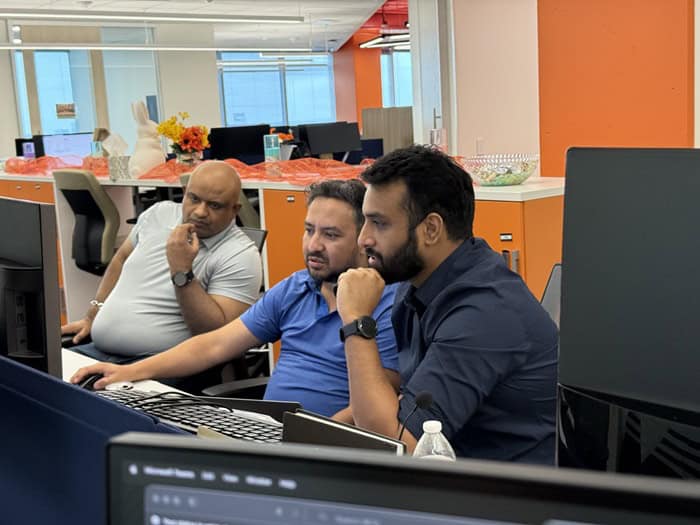
Each year, our entire company comes together for a 1.5-day hackathon designed to push the boundaries of what’s possible with technology.
Our latest hackathon brought together six teams to address challenges across restaurants, oil and gas, and enterprise operations. Each team worked hands-on with technologies like Microsoft Fabric, Azure DevOps, Claude, Copilot Studio, Power BI, and Salesforce to design and prototype AI-driven solutions. The topics ranged from sales forecasting and labor optimization in restaurants to chemical injection optimization for oil assets. One team also included a client participant, bringing direct business context into the process.
Here’s a quick high-level look at what our teams built:
1. AI-Driven Sales Forecasting and Labor Optimization for Restaurants
This Smartbridge team along with one of our client created a machine learning-powered solution for sales forecasting and labor optimization in restaurant operations. The team took data such as historical sales, labor schedules, weather, and promotional events, ran it through a Fabric ML solution they built to predict sales and labor, and used Power BI and conversational agents to showcase the outputs. The outcomes of this project include:
2. Proactive Ops Agent – AI-Powered Restaurant Operations Platform
The main goal for this team was to create a Profit & Loss (P&L) Intelligence. They also had a stretch goal of Inventory Forecasting. The P&L agent has three layers, all running on one Fabric foundation. The first is reactive monthly P&L analysis. When the P&L lands, an AI agent compares it to an SOP playbook, flags anomalies, and pushes the specific corrective action to the right manager tier. The second is a daily operational early warning. The agent catches problems mid-period before they become month-end surprises. The third is predictive. It’s a machine learning model that forecasts tomorrow’s inventory need per store, per SKU. The solution uses Fabric, Claude, and Prophet ML. Outputs are displayed in personalized emails and updated live in Power BI dashboards.
After completing the P&L Intelligence, the team completed the stretch goal by creating a next-day inventory forecasting engine using Meta’s Prophet ML model which is integrated directly into the existing Fabric pipeline. Each morning, managers receive a pick-list email with:
3. AI-Driven Chemical Injection Optimization for Oil & Gas
The team’s goal was to build a single, end-to-end prototype for AI-driven chemical injection optimization. Using Claude to accelerate development, the team built an AI-driven platform with four ML modules (Corrosion, Asphaltene, Scale, Demulsifier), a unified Power BI Command Center via Microsoft Fabric, and Copilot Studio advisory flows with human-in-the-loop disposition (Accept/Hold/Override). The outcomes of this project include:

4. Protecting and Enhancing Data Pipelines with Agentic AI
This team set out to improve data engineering using agentic AI. Engineers lose hours investigating and fixing failures, sometimes a single data issue can block the entire team for half a day. The solution the team created was an autonomous AI agent that detects failures in the pipeline using Fabric Monitor, finds the root cause, generates a code fix, and notifies & reports via Teams. Technology utilized by the team includes Fabric, Python, Azure DevOps, and Claude.
With this solution, engineers can know failures instantly and before it can wreak more havoc in downstream processes. The agent eliminates time wasted searching for the bug by providing information on the root cause and generating a fix upon detection.
5. Rebuilding Life Sciences E-Configurator App with Agentic AI
Smartbridge previously created a web application to configure equipment visually for use in a life sciences assembly line/manufacturing environment. However, there were some pain points such as new libraries would have to be built from scratch, the manual labor it took to develop and test the application, and setting up Azure DevOps CI/CD pipelines would take a skilled resource two days.
The teams split into two teams to test the best way of building the same application using AI-assisted coding. The teams used the following tools along with Claude Code and Azure DevOps:
Team A Tools
Team A Tools
Overall, this experiment showed that using AI brought the usual time it takes to decide on the tech stack and architecture (2-3 Days) down to 20-30 minutes and the application development time (2-3 weeks) down to 4 hours.
6. Salesforce and Claude Integration
Our Salesforce team wanted to know if a Salesforce Admin can integrate Claude into their Salesforce environment to assist with org intelligence, development acceleration, and technical documentation. To test Claude’s capabilities within Salesforce, the team built an end-to-end customer portal. Claude was successful in completing the following:
The result of this is faster delivery, higher quality output, and significant time savings. For org intelligence, they were able to answer questions about processes and objects, giving visibility into an unfamiliar org which in turn increases safety when introducing new functionalities. Development acceleration speaks for itself. The time it takes to create custom components is done in a fraction of the time previously and the same can be said for technical documentation.
The most notable outcome of this hackathon was how quickly teams moved from ideas to working solutions. In a short time, each group produced something that could be expanded into a real production scenario. That speed matters. AI can be applied today across finance, operations, engineering, and customer platforms as well as industries like oil and gas, restaurants, and medtech. This hackathon showed that with a strong data foundation, the right tools, and a clear problem, teams can start proving value in days instead of months.
Some closing remarks from our Innovation & Analytics Director and Hackathon leader, Rajeev Aluru, “Remember this day, because it will become real on client projects. The way Smartbridge does business, runs projects, and delivers work is about to change fundamentally.”
Want help facilitating a hackathon like this at your organization? Or maybe even implementing one of our solutions above?
Contact Smartbridge to start a conversation.