
Databricks vs Snowflake: Which Data Platform Fits Your Enterprise in 2026?
Databricks or Snowflake? In 2026 it’s less a feature fight and more an architecture bet that’ll shape your data strategy for years. We break down where each platform actually wins (ETL and ML training vs. SQL analytics and BI) and how to match the platform to your dominant workload instead of chasing parity.
Databricks and Snowflake are the two dominant data platforms in enterprise technology today, but they serve fundamentally different primary purposes: Databricks is a data lakehouse built on open-source Apache Spark, designed for data engineering, machine learning, and AI workloads, while Snowflake is a cloud-native data warehouse optimized for SQL analytics, BI reporting, and structured data at scale. Databricks hit $6.9B in annualized revenue in June 2026, up from $5.4B in January 2026, while Snowflake’s full fiscal year 2026 revenue reached $4.68 billion, a 29% increase year-over-year. Both platforms are aggressively expanding into each other’s territory, making the choice more nuanced than it was even two years ago.
As Smartbridge has watched the enterprise data space evolve, we noticed something worth flagging: most organizations don’t actually have to choose just one. But when budgets require focus and architecture requires clarity, the wrong pick creates years of friction. This comparison covers what the data actually shows, where each platform genuinely leads, and how to match the right tool to your specific workload mix.


Databricks vs Snowflake: Quick Comparison at a Glance
Databricks and Snowflake differ most sharply on architecture philosophy, storage format, and primary workload strength, making the at-a-glance comparison a useful starting point before examining the details.
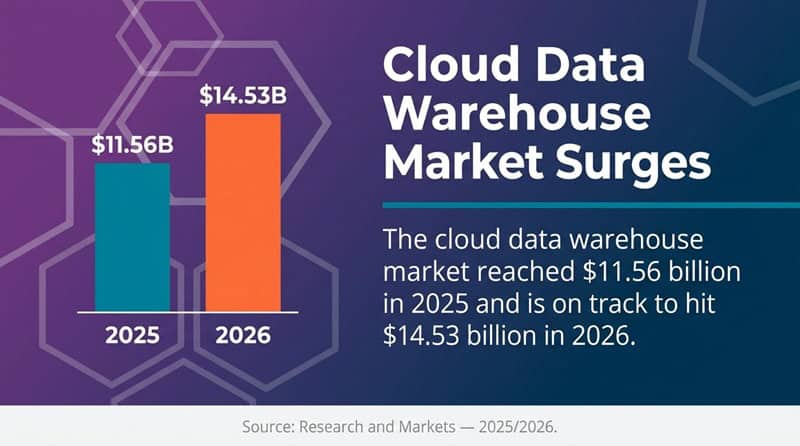
The cloud data warehouse market reached $11.56 billion in 2025 and is on track to hit $14.53 billion in 2026. Both platforms are fighting for the same budget dollars, but they’re doing it from very different architectural positions. Databricks leans open while Snowflake leans managed.
| Dimension | Databricks | Snowflake |
|---|---|---|
| Architecture | Data lakehouse (open format) | Cloud data warehouse (proprietary storage) |
| Primary strength | AI/ML, data engineering, ETL | SQL analytics, BI, structured data |
| Storage format | Delta Lake (Apache Parquet, open) | Proprietary columnar (micro-partitioning) |
| Processing engine | Apache Spark, Photon engine | Virtual warehouse (Snowflake-native) |
| ML/AI native | Yes (MLflow, GPU clusters, model training) | Yes (Cortex AI, LLM inference in-platform) |
| Open source | Strong (Apache Spark, Delta Lake, MLflow) | Limited (Apache Iceberg support added) |
| Ease of use for SQL teams | Improving, but steeper learning curve | High, SQL-first from day one |
| Vendor lock-in risk | Lower (open formats, multi-engine) | Higher (proprietary storage, compute) |
| Streaming support | Native (Structured Streaming) | Available, but less native |
| Governance | Unity Catalog | Snowflake Horizon |
More than 15,000 organizations worldwide, including over 60% of the Fortune 500, rely on the Databricks Data Intelligence Platform. Snowflake’s committed revenue pipeline tells its own story: remaining performance obligations reached $9.77 billion at the end of Q4 FY2026, up 42% year-over-year. Both platforms have serious enterprise momentum. The question is which momentum matches your architecture goals.
Architecture: Data Lakehouse vs Cloud Data Warehouse
Databricks and Snowflake are built on fundamentally different storage-and-compute philosophies, and that architectural difference cascades into nearly every capability comparison that follows.
The architecture decision matters more than most teams realize upfront. You can layer tools on top of either platform, but changing the underlying architecture later is expensive. Pick the wrong foundation and suddenly you’re having to migrate your entire data estate.
Databricks: The Data Lakehouse Model
Databricks was founded in 2013 by the original creators of Apache Spark, and the platform reflects that origin. The data lakehouse architecture combines the flexibility of a data lake with the reliability of a data warehouse, storing data in open-format Apache Parquet files via Delta Lake, adding ACID transactions and schema enforcement on top of object storage like S3 or ADLS.
The practical implication of storage and compute separation is significant. Your data sits in your own cloud storage bucket. You own it. Any engine that reads Apache Parquet or Apache Iceberg can query it without going through Databricks. That’s a real architectural advantage for organizations nervous about vendor lock-in.
Apache Spark reached two billion downloads and launched Apache Spark 4.0 in mid-2025, according to Databricks’ official announcement. That scale of adoption means the underlying engine powering Databricks is one of the most battle-tested distributed computing frameworks in existence.
Snowflake: The Cloud Data Warehouse Model
Snowflake built its architecture around a multi-cluster shared data model with complete storage and compute separation. Data is stored in Snowflake’s proprietary columnar format using micro-partitioning, and compute is handled by independently scalable virtual warehouses. You spin up a virtual warehouse for a workload, it runs, and you pay only for active runtime.
The proprietary storage format is both Snowflake’s strength and its constraint. The strength: Snowflake can optimize query performance deeply because it controls the entire stack from storage format to query planner. The constraint: your data isn’t easily portable to other engines without an export step. Snowflake has responded to this concern by adding Apache Iceberg table support, letting organizations store data in open formats while still using Snowflake’s compute layer for queries.
For SQL analytics teams and business intelligence workloads, the managed nature of Snowflake’s architecture is a genuine advantage. There’s no cluster configuration, no Spark tuning, no infrastructure overhead. You write SQL and Snowflake handles the rest.
Want more depth on the data lakehouse architecture specifically? Our enterprise guide to the Databricks Data Intelligence Platform covers the architectural foundations that make the lakehouse model work at enterprise scale.
Performance Benchmarks: What the Data Actually Shows
Databricks and Snowflake perform differently depending on workload type, and neither platform dominates across all benchmark categories, which is exactly why workload profiling should precede platform selection.
Both vendors publish benchmark results that favor their own platform which is expected. But, the more useful signal comes from independent workload testing and from understanding what the benchmark is actually measuring before drawing conclusions from it.
SQL Query Performance
Snowflake’s query optimizer and micro-partitioning approach deliver strong performance on standard SQL analytics workloads, particularly ad-hoc queries against large structured datasets. The Photon engine on Databricks has narrowed this gap considerably for SQL workloads, with vectorized execution that can outperform standard Snowflake virtual warehouses on certain query patterns.
Photon rewrites the execution layer in C++ rather than JVM-based Java/Scala, which means significantly lower overhead for columnar processing. Organizations running both platforms in production report that Photon-enabled Databricks SQL is competitive with Snowflake on most standard BI query patterns
Data Engineering and ETL Throughput
For ETL workloads, complex data transformations, and streaming pipelines, Databricks and Apache Spark have a clear performance advantage. Snowflake can run ETL via SQL-based transformation, but it wasn’t built for the kind of distributed, stateful, multi-stage processing that data engineering teams need at scale.
The TPC-DI benchmark, which tests data integration workloads rather than query-only scenarios, consistently favors Databricks for end-to-end data engineering throughput. That’s the benchmark that matters most for teams whose primary use case is building and maintaining data pipelines.
Concurrency and Multi-Team Workloads
Snowflake’s virtual warehouse architecture shines at concurrency. Each team or workload gets its own compute cluster with no resource contention. A hundred analysts running queries simultaneously don’t slow each other down, because each virtual warehouse is isolated.
Databricks handles concurrency differently. Serverless SQL warehouses on Databricks scale automatically, but the architecture is not as inherently isolated as Snowflake’s virtual warehouse model. For organizations with large, diverse SQL user populations, this distinction affects day-to-day query experience.
For a broader view of how these platforms compare to Azure-native alternatives, our Azure Synapse vs Snowflake comparison covers the data warehouse performance considerations in more detail.
AI and Machine Learning Capabilities
Databricks and Snowflake have both made AI and machine learning core to their platform strategies, but they approach it from different starting points and serve different stages of the machine learning lifecycle.
This is the section that has changed the most in the past 18 months. Both platforms have moved fast. And both have legitimate AI stories now, which wasn’t entirely true two years ago. But they’re still very different in how deep that AI capability goes.
Databricks: AI and ML From the Ground Up
Databricks’ AI and machine learning story starts with its origin. The platform was purpose-built for data science and machine learning workflows running on Apache Spark. MLflow, the open-source platform for managing the machine learning lifecycle, was created by Databricks and is now an Apache project with massive adoption. It handles experiment tracking, model registry, model serving, and deployment, all within the Databricks environment.
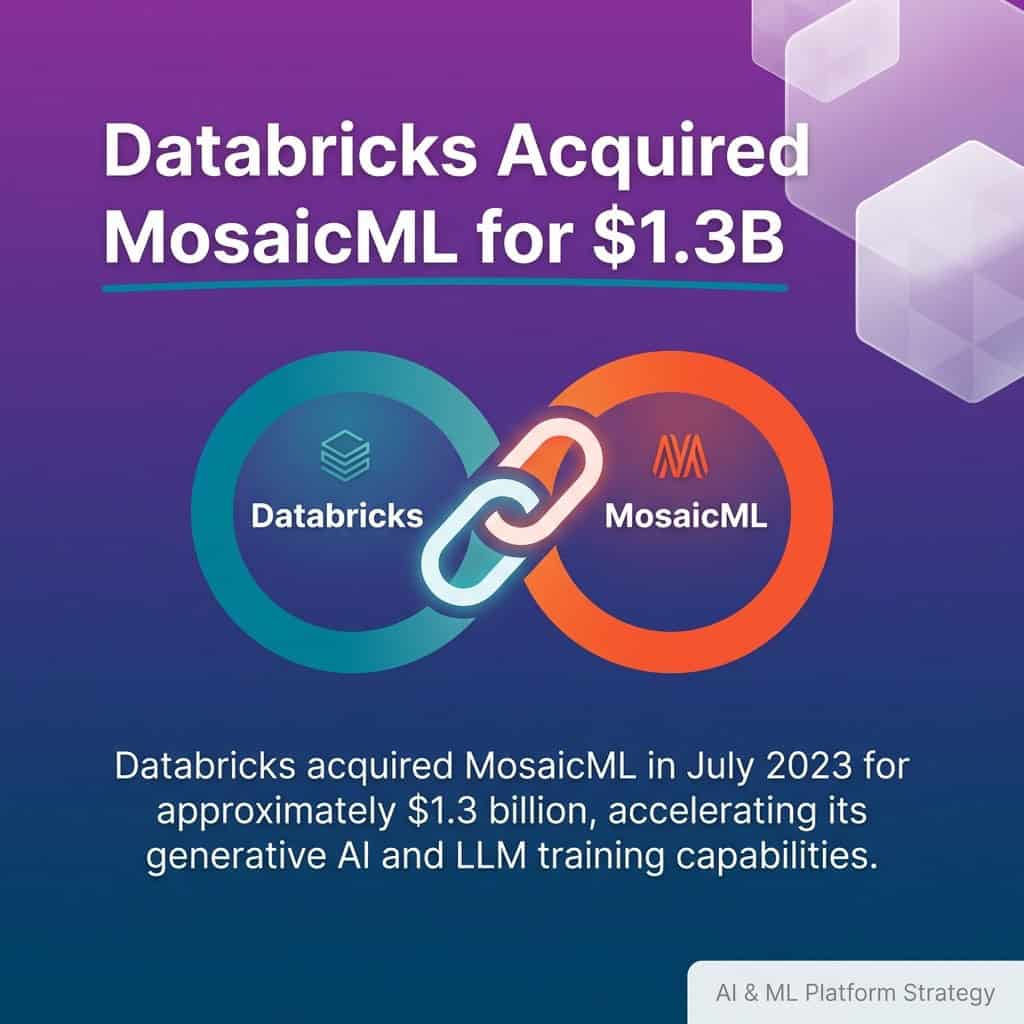
Databricks acquired MosaicML in July 2023 for approximately $1.3 billion, bringing in a team specialized in large language model training and optimization. That acquisition accelerated Databricks’ generative AI and LLM training capabilities significantly. Teams doing serious model training, including fine-tuning foundation models on proprietary data, have access to GPU clusters, optimized training frameworks, and MLflow for experiment management in one integrated environment.
The data lakehouse architecture also matters for machine learning. Because training data sits in open-format Delta Lake tables, data scientists can access raw data, run feature engineering in Apache Spark, train models on GPU clusters, track experiments in MLflow, and deploy via model serving, all without moving data between systems. That end-to-end integration reduces friction substantially.
Snowflake: Cortex AI and In-Platform Inference
Snowflake’s machine learning approach centers on bringing AI to the data, rather than asking you to move data to a training platform. Snowflake Cortex AI runs LLM inference directly on data inside Snowflake, eliminating data movement, and supports models from OpenAI, Anthropic, and Meta.
For SQL-oriented data teams who want to run LLM-powered analysis without building a separate machine learning infrastructure, Cortex AI is genuinely compelling. You can call a model directly from a SQL query, classify text at scale, extract entities, or generate summaries without leaving Snowflake’s environment.
Where Snowflake’s machine learning story is thinner is in model training. Snowflake’s ML functions handle inference and simpler model types well, but organizations training large models on proprietary data will find Databricks’ GPU cluster access and MLflow integration significantly more capable for that use case.
Which Platform Wins for AI Workloads
For teams doing full MLOps, including model training, experimentation, deployment, and monitoring, Databricks is the stronger platform. For teams wanting to add AI-powered analysis to existing SQL workflows without building a machine learning infrastructure, Snowflake Cortex AI is the faster path to production.
The most successful organizations we observe blend strong operational discipline with the right tool for each AI workload type. That often means Databricks for model development and training, Snowflake for serving AI-enriched analytics to BI consumers.
Curious about where Databricks is heading specifically on the agentic AI front? Our piece on the Databricks state of AI agents in 2026 covers the platform’s approach to AI agent development in detail.
Data Engineering, ETL, and Streaming Workloads
Databricks has a structural advantage over Snowflake for data engineering, ETL pipelines, and real-time streaming workloads, because the platform was designed around those use cases from its founding.
This is probably the clearest-cut section in the entire comparison. Data engineers who have used both platforms regularly vote with their feet. They build on Databricks. That’s not a knock on Snowflake; it’s just an accurate description of where each platform’s depth lives.
Databricks for Data Engineering
Apache Spark is the workhorse behind Databricks’ data engineering capabilities. PySpark, the Python API for Spark, is the de facto standard for large-scale ETL across most enterprise data teams. Databricks wraps Spark with Delta Live Tables, a declarative pipeline framework for building and managing ETL workflows with automatic data quality enforcement, dependency tracking, and incremental processing.
Structured Streaming on Databricks handles real-time data processing natively. A streaming pipeline and a batch pipeline share the same API, which means data engineers can build once and run against both real-time and historical data. That unified batch-and-streaming model reduces code duplication and simplifies operations.
Databricks stated it serves more than 12,000 customers as of March 2025, up from 10,000 in 2024, according to published data. The growth reflects enterprise adoption of Databricks not just for analytics but specifically for production data engineering pipelines.
Snowflake for Data Engineering
Snowflake handles data engineering primarily through SQL-based transformation, often paired with dbt for model management and transformation orchestration. The Snowpark API adds Python and Java support, allowing data engineers to write transformation logic in languages beyond SQL while still executing within Snowflake’s virtual warehouse compute.
For structured data transformation at scale, Snowflake’s SQL-first approach is powerful and simple. Where it shows limits is in complex, stateful streaming, nested data structures, and workloads that require the full distributed computing flexibility of Apache Spark. Teams managing these workloads in Snowflake often find themselves working around the platform’s SQL-centric model rather than with it.
Streaming and Real-Time Processing
Snowflake added Snowpipe Streaming and dynamic tables to address real-time ingestion needs. These features work well for continuous data loading and incremental refresh scenarios. But for true event-driven streaming pipelines with stateful aggregations, windowing functions, and low-latency processing requirements, Databricks Structured Streaming on Apache Spark remains the more capable choice.
For teams moving from experimentation with streaming architectures to production-scale pipelines, Databricks’ native Spark integration means less architectural compromise. The data engineering foundation is there from day one.
SQL Analytics, BI, and Ease of Use
Snowflake has a meaningful ease-of-use advantage over Databricks for SQL analytics and business intelligence workloads, particularly for organizations whose data teams are SQL-first rather than Python or Spark-first.
If your team lives in SQL and BI tools, and doesn’t have data engineers writing PySpark, Snowflake will feel like the right fit almost immediately. Databricks has improved significantly for SQL teams, but the platform’s roots show.
Snowflake for SQL Teams and BI
Snowflake’s interface, governance model, and query experience are built around SQL analysts. Virtual warehouse sizing is straightforward. Query history, resource monitoring, and access controls are accessible without deep platform expertise. Major BI tools, including Tableau, Power BI, Looker, and Qlik, all have native Snowflake connectors that are well-tested and performant.
The learning curve for Snowflake is genuinely shallow for SQL practitioners. A competent SQL analyst can be productive in Snowflake within hours. That matters for organizations where time-to-insight is a real business constraint.
Databricks for SQL Workloads
Databricks SQL and the Photon engine have made Databricks substantially more capable for SQL analytics than it was three years ago. The serverless SQL warehouse option removed much of the cluster management complexity that historically made Databricks SQL a harder sell to pure SQL teams.
But the platform’s primary persona is still the data engineer or data scientist. The SQL experience is good. It’s not as frictionless as Snowflake’s for pure SQL workloads. Teams that need both data engineering and SQL analytics in one platform will find Databricks’ breadth valuable. Teams that need only SQL analytics will likely find Snowflake’s focus more productive.
Our guide to modern data warehousing with Snowflake covers the SQL analytics architecture in practical detail for teams evaluating Snowflake’s BI capabilities.
Data Governance, Security, and Openness
Both Databricks and Snowflake have invested heavily in enterprise-grade data governance, but Unity Catalog and Snowflake Horizon take meaningfully different approaches to data lineage, access control, and multi-engine interoperability.
Governance is the part of the platform decision that bites organizations two years after go-live, not at launch. It’s worth spending serious time here before committing to either platform’s model.
Unity Catalog vs Snowflake Horizon
Unity Catalog is Databricks’ unified governance layer that manages access control, data lineage, and auditing across the entire Databricks platform, including notebooks, SQL warehouses, machine learning models, and Delta Lake tables. Critically, Unity Catalog governs data access at the storage level, not just at the query layer, which means that access policies apply even when data is accessed by external engines reading Delta Lake directly.
Snowflake Horizon is Snowflake’s governance framework covering data classification, access policies, data lineage, and cross-cloud data sharing. Snowflake Horizon is tightly integrated with the Snowflake platform and works seamlessly within Snowflake’s managed environment. The limitation is that governance policies don’t extend to access outside of Snowflake’s compute layer, because the data is in Snowflake’s proprietary format.
For organizations with a multi-engine data architecture, Unity Catalog’s governance coverage is broader. For organizations running entirely within Snowflake, Snowflake Horizon’s integration depth within the platform is excellent.
Open Data Formats and Vendor Lock-In
The vendor lock-in consideration deserves a clear-eyed view. Databricks stores data in Delta Lake tables, which are Apache Parquet files with a transaction log.
Any engine that reads Parquet can read your data. Apache Iceberg, the competing open table format that Snowflake now supports, provides similar portability guarantees. The key difference: Snowflake’s native storage format is proprietary, meaning data in Snowflake-managed tables requires export before other engines can read it.
Snowflake’s Iceberg table support partially addresses this. Organizations can configure Snowflake to store data in open-format Iceberg tables on their own cloud storage, using Snowflake’s compute for queries.
Both platforms support AWS, Microsoft Azure, and Google Cloud Platform. Neither is exclusively tied to a single cloud provider, which matters for organizations with multi-cloud strategies.
Security and Compliance
Both platforms meet enterprise security standards including SOC 2 Type II, HIPAA, and PCI DSS compliance. Snowflake’s managed architecture makes it operationally simpler to maintain compliance configurations, since Snowflake handles infrastructure security directly. Databricks offers equivalent security controls, but the open architecture means organizations have more configuration responsibility, particularly around object storage bucket access policies and network isolation.
For understanding the architectural foundations that underpin these governance decisions, our overview of cloud data warehouses and data lakes provides useful context on the data storage models each platform relies on.
Apache Iceberg, Delta Lake, and the Open Format Battle
The competition between Delta Lake and Apache Iceberg has become one of the most strategically important technology choices in enterprise data architecture, and both Databricks and Snowflake have taken clear positions on open data format support.
A year ago, this was a developer debate. Now it’s an enterprise architecture decision with multi-year implications. The format you commit to affects which engines can read your data, how you manage schema evolution, and how exposed you are to any single vendor’s pricing decisions.
Delta Lake: Databricks’ Open Format Foundation
Delta Lake is the foundational storage layer of the Databricks data lakehouse architecture. It adds ACID transactions, schema enforcement, time travel, and Z-order clustering on top of Apache Parquet files. Delta Lake is open source and part of the Linux Foundation, meaning it’s not controlled exclusively by Databricks.
Engines beyond Databricks can read Delta Lake tables. Trino, PrestoDB, and Apache Hive all have Delta Lake compatibility. Delta Sharing, also open-source, enables secure data sharing across organizations without data copying, and it works across clouds and platforms.
Apache Iceberg: The Competing Open Standard
Apache Iceberg was originally developed at Netflix and is now an Apache project. Snowflake added Iceberg table support to reduce the vendor lock-in concern that enterprise architects consistently raised. With Iceberg tables, Snowflake can query data stored in open-format files on the customer’s own object storage, using Snowflake as the compute engine without locking data into Snowflake’s proprietary format.
Databricks also added Apache Iceberg read and write support, recognizing that many organizations have data in Iceberg format from other systems. Both platforms can now work with both major open table formats, which is a win for enterprise data teams managing heterogeneous environments.
What Open Format Support Actually Means for Your Organization
The practical implication is this: if your data sits in Delta Lake or Apache Iceberg, you have negotiating power with your cloud vendors that you don’t have if your data is in Snowflake’s proprietary micro-partitioned format. That’s not a reason to avoid Snowflake, but a reason to understand the portability constraints before you’re five years and petabytes in.
When to Choose Databricks vs Snowflake: Decision Guide
The Databricks vs Snowflake decision maps directly to your dominant workload type, your team’s technical profile, and your organization’s appetite for open architecture vs managed simplicity.
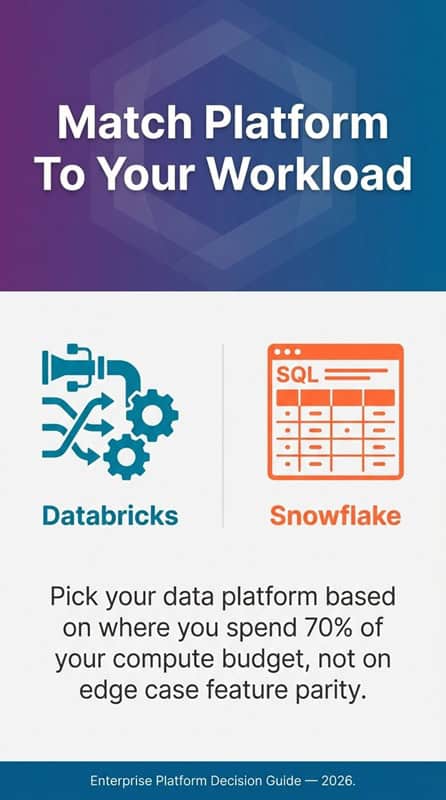
We’re going to be direct about this, because most vendor comparison guides hedge too much here. Both platforms have expanded into each other’s territory. But each still has a home field where it genuinely outperforms. Pick based on where you spend 70% of your compute budget, not on edge case feature parity.
Choose Databricks When
Choose Snowflake When
Choose Both When
Many mature enterprise data organizations run Databricks for data engineering and model development, with Snowflake serving as the SQL analytics layer for BI consumers. This isn’t the most budget-efficient approach, but it reflects how the platforms actually complement each other when workload types genuinely differ across teams.
The organizations that struggle most are those that pick one platform and try to force all workloads through it. Databricks for BI-only workloads creates unnecessary complexity. Snowflake for serious ML development creates serious architectural limits. Build with purpose, not patchwork.
The digital innovation journey here is not a race to pick a winner. It’s a deliberate exercise in matching tool to workload. If you’re evaluating this decision alongside Azure-native options, our complete data warehousing guide covering Azure Synapse Analytics adds another reference point for enterprise architects doing a full platform evaluation.
Databricks vs Snowflake: The Smartbridge Perspective
The Databricks vs Snowflake decision in 2026 is an architecture philosophy decision that will shape your data strategy for the next several years.
As Smartbridge has watched this space, we keep noticing the same pattern. Organizations that frame this as “which platform is better” tend to land in a frustrating place. Organizations that frame it as “which platform fits our dominant workload and team profile” make faster, cleaner decisions and get to production outcomes sooner.
The platforms will keep converging. Databricks will keep improving its SQL experience. Snowflake will keep building out its ML capabilities. But the core architectural DNA of each platform, open lakehouse vs managed warehouse, will persist for years. That DNA should drive your selection more than any individual feature announcement.
Both platforms are serious technology investments with serious enterprise momentum. Neither is a wrong answer for the right workload. The common thread, as always, is data. Get the architecture right, build the governance foundation, and the platform choice becomes much more tractable.
If you want to talk through your specific data architecture needs and how Databricks or Snowflake might fit your organization’s roadmap, the Smartbridge team works through exactly these kinds of decisions with enterprise data leaders every day. Reach out to speak with an expert.