
What is Databricks? The Enterprise Guide to the Data Intelligence Platform
Databricks brings data, analytics, and AI into one platform—but what does that mean for your business? This guide breaks down the Data Intelligence Platform, how it works, and where it can create value across the enterprise.
Databricks is a cloud-based data intelligence platform that unifies data engineering, machine learning, analytics, and generative AI workloads into a single collaborative environment, built on the lakehouse architecture and powered by Apache Spark. Founded in 2013 by seven researchers from UC Berkeley’s AMPLab, Databricks runs on AWS, Azure, and GCP, and more than 20,000 organizations worldwide rely on it today, including over 60% of the Fortune 500. Its reach across enterprise data and AI makes it one of the most consequential platforms in modern data infrastructure.
As Smartbridge watches enterprise data strategy across industries, one pattern keeps catching our attention: organizations investing in Databricks aren’t just replacing old tools. They’re consolidating fragmented data estates into something that actually works together.
And if you’re evaluating Databricks or trying to explain it to stakeholders, this guide covers what you need.


More than 20,000 organizations rely on Databricks, including 60% of the Fortune 500.
What Is Databricks? A Simple Definition
Databricks is a data intelligence platform that brings together data lakes, data warehouses, machine learning, and AI on one unified foundation, replacing the patchwork of disconnected tools most enterprises have accumulated over the years.
The clearest way to understand it: most organizations have data sitting in one place, analytics running somewhere else, and machine learning happening in yet another system. Those silos slow everything down. Databricks eliminates the hand-offs. Data engineers, data scientists, business analysts, and ML engineers all work in the same platform, against the same data, under the same governance layer.
At its core, Databricks runs on Apache Spark for distributed computing, stores data in open formats through Delta Lake, governs everything through Unity Catalog, and tracks machine learning experiments with MLflow. Those four components, plus Databricks SQL for business intelligence workloads, form the engine underneath the platform.
Databricks describes itself as a data intelligence platform, a term that signals its direction: not just storing and processing data, but applying AI to make that data useful across the entire organization.
The Origins of Databricks: From UC Berkeley to the Enterprise
Databricks was founded on June 10, 2013, by seven researchers from UC Berkeley’s AMPLab who had built Apache Spark as an open-source project and wanted to bring it to enterprise scale. Their founding thesis was that the future of data belonged to open, unified platforms, not proprietary silos.
That bet paid off. Apache Spark became the industry standard for large-scale data processing. Databricks built the commercial platform around it and kept pushing the open-source community forward simultaneously. That dual commitment to open source and enterprise capability is still a defining feature of how the company operates.
The lakehouse architecture itself came from Databricks research published in 2020. It was a direct response to the limitations organizations were hitting by trying to run both data lakes and data warehouses in parallel. Databricks pioneered the architecture, then commercialized it through Delta Lake and the platform.

The acquisition of MosaicML in June 2023 for approximately $1.3 billion accelerated Databricks’ generative AI capabilities significantly, bringing enterprise-grade large language model training and deployment into the platform.
By February 2026, Databricks confirmed annualized revenue exceeding $5.4 billion, up 65% year over year. That growth rate, at that revenue scale, tells you something about enterprise adoption momentum.

Annualized revenue surpassed $5.4B (+65% YoY) by Feb 2026.
What Is the Lakehouse Architecture?
The lakehouse architecture combines the low-cost, flexible storage of a data lake with the performance, reliability, and governance of a data warehouse, giving organizations a single system that handles both analytical and AI workloads without duplication.
Before the lakehouse, most enterprises ran two systems in parallel. A data lake stored raw, unstructured data cheaply but lacked the reliability and query performance needed for business reporting. A data warehouse delivered fast, structured analytics but was expensive, rigid, and disconnected from the raw data pipelines feeding machine learning models. Maintaining both meant double the cost, double the engineering effort, and perpetual synchronization headaches.
The lakehouse architecture solves this by introducing a structured metadata and transaction layer on top of open-format storage. Delta Lake is that layer in Databricks. It adds ACID transactions, schema enforcement, time travel, and indexing to files sitting in cloud object storage. The data stays in open formats that any tool can read. But it gains the reliability guarantees that data warehouses are known for.
The result is one platform where a data engineer can build ETL pipelines, a data scientist can train machine learning models, and a business analyst can run SQL queries, all against the same data, with no movement or duplication required.
According to Dremio’s State of the Data Lakehouse 2024 survey, 65% of respondents were already running the majority of their analytics on data lakehouses. No longer a forward-looking architecture, it’s where most serious data organizations have landed.

Dremio 2024: 65% run most analytics on lakehouses.
Data Lake vs. Data Warehouse vs. Data Lakehouse: Key Differences
The data lake, data warehouse, and data lakehouse each solve different problems, and choosing the wrong architecture for your workload creates the kind of technical debt that takes years to unwind.
A data lake stores raw data at scale and at low cost. It handles unstructured and semi-structured data well, and it’s ideal for data science and machine learning work that needs raw, unprocessed inputs. The problem: data lakes lack built-in governance, query performance is inconsistent, and without discipline they become data swamps that nobody trusts.
A data warehouse delivers fast, reliable SQL analytics on structured data. It’s purpose-built for business intelligence and reporting. The trade-off: data warehouses are expensive, they require data to be transformed and loaded before it’s useful, and they weren’t designed to support machine learning workflows or unstructured data types.
The data lakehouse architecture bridges both. Open storage formats keep costs manageable. Delta Lake’s ACID transaction layer adds reliability. A unified compute engine, Apache Spark in Databricks’ case, handles both SQL analytics and machine learning in the same environment. Governance travels with the data through Unity Catalog rather than living in a separate system.
| Architecture | Best For | Key Limitation |
|---|---|---|
| Data Lake | Raw storage, ML training data, unstructured data | No ACID guarantees, weak governance, inconsistent performance |
| Data Warehouse | Structured SQL analytics, business reporting | Expensive, rigid schema, poor ML support |
| Data Lakehouse | Unified analytics, ML, and AI workloads | More complex to implement and govern initially |
The full comparison of cloud data warehouses and data lakes at Smartbridge breaks down the architectural trade-offs in more depth, including cost and governance considerations that matter at enterprise scale.
For organizations still running a data lake and a data warehouse in parallel, the lakehouse architecture typically eliminates that duplication. More than a minor efficiency gain, this changes how data teams operate.
Core Components and Features of Databricks
Databricks is built on five core components that each solve a distinct problem, and together they form a platform that covers the full spectrum from raw data ingestion to production AI deployment.
Delta Lake: The Open Storage Foundation
Delta Lake is the open-source storage layer that sits underneath all Databricks workloads. It adds ACID transactions, schema enforcement, and data versioning to files stored in cloud object storage, making data lakes reliable enough to serve as a source of truth for both analytics and machine learning.
Being open-source means that Delta Lake is not proprietary, and organizations using it avoid the vendor lock-in that comes with closed data formats. Data stored in Delta Lake is readable by other tools, which is a meaningful architectural safeguard for enterprises that operate across multiple platforms.
Unity Catalog: Data Governance Across the Platform
Unity Catalog is Databricks’ unified data governance layer, providing access control, data lineage, discovery, and compliance management across all data and AI assets in a single catalog. It governs tables, machine learning models, files, and AI agents under one consistent policy framework.
With Unity Catalog, a data governance team doesn’t manage separate policies for data engineering, analytics, and machine learning. One catalog, one set of rules, applied consistently. This helps organizations move from pilots to production AI.
Apache Spark: The Distributed Computing Engine
Apache Spark is the distributed computing engine at the core of Databricks, enabling large-scale data processing across thousands of nodes for ETL pipelines, batch jobs, streaming analytics, and machine learning workloads. Databricks optimized Spark heavily for cloud environments, adding performance improvements that significantly outpace the open-source version.
Data engineers writing Python, SQL, Scala, or R all work with Spark under the hood. Most don’t need to think about it directly, but its presence means Databricks scales to data volumes that would collapse most other platforms.
MLflow: Machine Learning Lifecycle Management
MLflow is the open-source platform for managing the full machine learning lifecycle within Databricks, covering experiment tracking, model versioning, deployment, and monitoring. It gives data science teams a structured way to reproduce results, compare experiments, and move models from development to production without losing track of what changed.
Without MLflow, machine learning teams typically resort to spreadsheets or ad-hoc documentation to track experiments. That approach breaks down fast at scale. MLflow brings the operational discipline that machine learning work actually requires.
Databricks SQL and Lakeflow: Analytics and Data Engineering
Databricks SQL provides a serverless data warehousing experience for business intelligence teams, enabling analysts to run SQL queries directly against lakehouse data without requiring knowledge of Spark or Python. Lakeflow handles ETL pipelines, data ingestion, and streaming workloads, connecting data from any source into the lakehouse through both code-based and low-code interfaces.
Together, Databricks SQL and Lakeflow close the loop between data engineering and business analytics, making it practical for analysts to self-serve on data that data engineers have prepared, governed, and made reliable through Delta Lake.
What Is Databricks Used For? Key Use Cases
Databricks handles four distinct workload categories that most enterprises previously spread across separate tools, and the value comes from running all four on the same data without moving it between systems.
Data Engineering and ETL Pipelines
Data engineering is the foundational use case for Databricks, covering ETL pipeline development, batch processing, streaming data ingestion, and data quality management at scale. Data engineers use Databricks to build and orchestrate the pipelines that feed every downstream analytics and AI use case.
In our experience working with enterprise data teams, ETL fragmentation is one of the most common problems. Data moves through five tools before it reaches an analyst. Each hand-off introduces latency, errors, and governance gaps. Databricks consolidates that pipeline into one environment, and the difference in operational clarity is significant.
In healthcare, Databricks’ lakehouse architecture has enabled organizations to process and consolidate large volumes of health record data. Austin Health, for example, used Delta Lake to reduce complexity when integrating with their electronic health record system, achieving an 85% reduction in COVID-19 risk through next-best-action capabilities built on that foundation.
Machine Learning and Generative AI
Databricks provides a complete machine learning environment covering model development, experiment tracking through MLflow, large language model fine-tuning, and AI agent deployment, all governed through Unity Catalog and connected to the same lakehouse data that feeds analytics workloads.
The generative AI capabilities are particularly worth noting. Following the MosaicML acquisition, Databricks built enterprise-grade tooling for training and deploying large language models on proprietary data. That matters for organizations in regulated industries where sending data to a third-party AI service isn’t an option. Life sciences teams at organizations like AstraZeneca have used Databricks’ Agent Bricks to parse through more than 400,000 clinical trial documents and extract structured data points without writing code.
Gartner named Databricks a Leader in the 2025 Gartner Magic Quadrant for Data Science and Machine Learning Platforms, reflecting the maturity of its machine learning capabilities at enterprise scale.
Business Intelligence and Analytics
Databricks SQL enables business analysts and BI developers to run SQL-based analytics directly against lakehouse data, with performance comparable to dedicated data warehouses and integration with tools like Tableau, Power BI, and Looker through standard connectors.
The Genie capability within Databricks takes this further. It allows business users to ask questions in natural language and receive answers backed by governed data, without requiring SQL skills or waiting for the data team to build a report. That’s the kind of self-service capability that actually reduces the reporting backlog every data team carries.
Streaming Analytics and Real-Time Workloads
Databricks processes both batch and streaming data in the same platform, enabling real-time analytics, event-driven pipelines, and operational intelligence without requiring a separate streaming infrastructure. Apache Spark’s structured streaming engine handles high-volume event streams at scale.
Providence used Databricks to parse and score streaming messages from Epic Systems electronic health records in real time, eliminating manual bed tracking for tens of ED staff across more than 50 hospitals and improving NEDOCS scores. The problem was real-time data. The outcome was operational clarity at scale. That pattern repeats across industries.
Who Uses Databricks?
Databricks serves four primary user groups within enterprise organizations, and its value comes precisely from the fact that all four can work in the same platform against the same data.
Data engineers use Databricks to build ETL pipelines, manage data quality, and orchestrate data movement at scale using Python, SQL, Scala, or R through collaborative notebooks and Lakeflow’s pipeline tooling.
Data scientists use it to develop and train machine learning models, track experiments with MLflow, and access governed training data directly from the lakehouse without requesting data extracts from engineering teams.
Business analysts use Databricks SQL to run queries and build dashboards against production lakehouse data, with Unity Catalog ensuring they only access data they’re authorized to see.
ML engineers use Databricks to operationalize models, manage deployment pipelines, monitor model performance, and build AI agents that act on enterprise data at production scale.
The platform’s strength is that it doesn’t require these teams to work in separate systems. A machine learning model trained by a data scientist pulls training data from the same Delta Lake tables a business analyst queries for monthly reporting. That’s not an obvious thing to achieve. Most enterprise data stacks make it genuinely hard.
More than 20,000 organizations currently rely on Databricks, with over 60% of the Fortune 500 among them. In healthcare and life sciences specifically, Databricks supports 13 of the 15 largest global pharma companies, 8 of the 10 largest US health insurers, and 17 of the 25 largest Integrated Delivery Networks in the US.
If you’re comparing Databricks against other enterprise data platforms, the Smartbridge comparison of Azure Synapse Analytics vs. Snowflake provides useful context on how the major platforms differentiate, and where Databricks fits in that competitive field.
Key Benefits of Using Databricks
Databricks delivers four concrete advantages that matter at enterprise scale: platform consolidation, open architecture, AI-native design, and multi-cloud flexibility.
Platform consolidation is the most immediate benefit for most organizations. DATAVERSITY’s 2024 Trends in Data Management survey found that 68% of respondents cited data silos as their top concern. Databricks directly addresses that. One platform for data engineering, analytics, and machine learning means fewer integration points, fewer governance gaps, and fewer hand-offs where data quality breaks down.
Open architecture prevents vendor lock-in. Delta Lake stores data in open formats. MLflow is open source. The platform runs on whatever cloud infrastructure the organization already operates on. AWS, Azure, and GCP all supported. That flexibility matters when enterprise infrastructure strategies shift, and they always do eventually.
AI-native design is where Databricks separates from traditional data warehouse platforms. Databricks wasn’t retrofitted for machine learning. It was built with ML workflows as a first-class concern. The lakehouse architecture means training data, feature engineering, model tracking, and deployment all happen in one environment without data movement between systems.
Multi-cloud and separation of compute from storage gives enterprises genuine flexibility in how they scale and what they pay. Compute scales independently of storage, which means organizations don’t pay for capacity they don’t need at any given moment.
The global data lakehouse market was valued at USD 12.20 billion in 2024 and is projected to reach USD 41.63 billion by 2030. Organizations building on lakehouse architecture now are building on the platform that the market is consolidating toward.
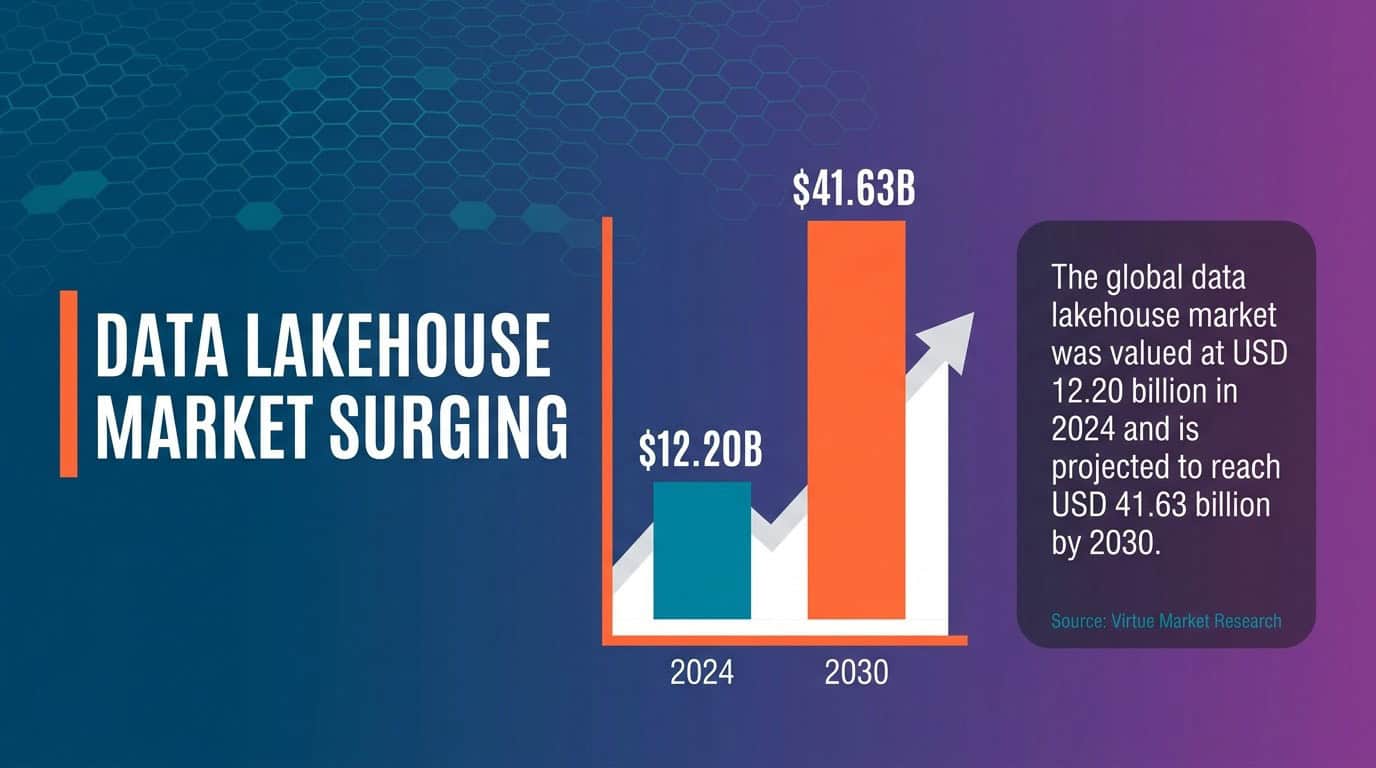
Data lakehouse market projected to reach $41.63B by 2030.
For enterprises specifically evaluating generative AI and its implications for data strategy, the Smartbridge guide on generative AI for enterprises covers the foundational considerations that need to be in place before scaling AI on any platform, including Databricks.
Getting Started with Databricks
Databricks is where enterprise data strategy is heading. Not because it’s new or because the marketing is convincing, but because the architecture solves a real problem that most enterprises have been working around for years: data, analytics, and AI running in separate systems that don’t talk to each other cleanly.
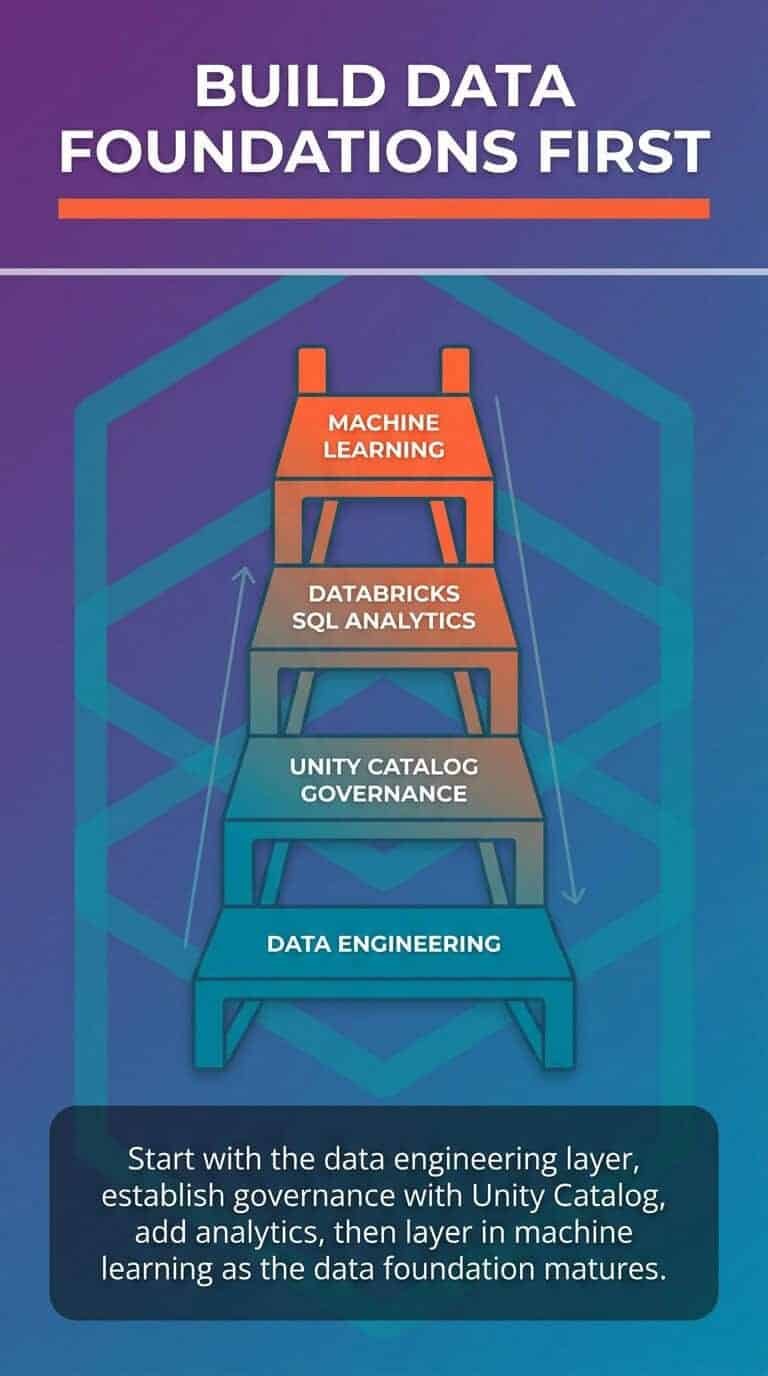
The common thread we see across the organizations getting real value from Databricks is the same one we see everywhere else in enterprise AI adoption. Data foundations come first. Unity Catalog governance, Delta Lake reliability, clean ETL pipelines through Lakeflow. Get those right, and the machine learning and generative AI capabilities build on something solid. Skip them, and you get a more expensive version of the same fragmented problem you started with.
Digital innovation is a journey, not a race. Databricks is a platform that rewards purposeful, incremental investment over rushed implementations. Start with the data engineering layer. Establish governance with Unity Catalog. Add analytics with Databricks SQL. Layer in machine learning as the data foundation matures.
If you’re mapping out how Databricks fits alongside your existing data warehouse investments, the Smartbridge guide to Azure Synapse Analytics provides useful grounding on the enterprise data warehousing context Databricks increasingly operates within. We’ll work with you to create the best roadmap for your destination. Speak to an expert at Smartbridge to discuss where Databricks fits in your data intelligence journey.