

The State of AI Agents in 2026: What Enterprise Leaders Should Take From the Databricks Report
Explore key insights from the Databricks State of AI Agents 2026 report, including multi-agent systems, governance, evaluation and enterprise AI adoption.
As many people have noticed by now, enterprise AI is moving beyond the chatbot.
The first wave of generative AI gave employees faster ways to search for information, summarize documents and create content. Those capabilities still matter, but the next stage for businesses is more operational. Organizations are building AI agents that can interpret a request, access company data, coordinate tools, and complete defined parts of a workflow.
Databricks’ State of AI Agents 2026 report offers a useful look at how this shift is unfolding. Its findings are based on aggregated, anonymized activity from more than 20,000 organizations, including over 60% of the Fortune 500. The report shows rapid growth in multi-agent systems, multi-model strategies and real-time AI applications. It also makes something else clear: companies getting AI into production are investing heavily in governance and evaluation.
The technology is advancing quickly, but the bigger story is how enterprises are learning to use it. Successful AI agent programs are becoming more focused, more connected to business operations, and more disciplined about quality.

Multi-Agent Systems Are Replacing the Standalone Chatbot
Databricks reports that the use of multi-agent workflows grew 327% in only four months. Its Supervisor Agent, which coordinates specialized agents and tools across a workflow, became the company’s most-used Agent Bricks capability shortly after its release. This signals an important change in how companies are approaching AI.
A general-purpose assistant may answer a question or generate a response. A multi-agent system divides a larger process into smaller responsibilities. One agent may classify a request. Another may retrieve supporting records. A third may apply business rules, and a supervising agent may coordinate the sequence and determine what happens next.
That approach better reflects how enterprise work is actually performed. Most important processes are not one-step activities. They depend on several systems, decisions, and approvals.
The opportunity is significant, but adding more agents does not automatically create more value. A poorly defined multi-agent workflow can introduce unnecessary complexity, make errors harder to trace and increase operating costs. Organizations should begin with the workflow itself. Once the business rules, handoffs, and desired outcomes are clear, they can determine where specialized agents offer a practical advantage.
The strongest systems will not be the ones with the most agents, but the ones that use the right amount of autonomy for a clearly defined job.
Practical Use Cases Are Leading Enterprise Adoption
Despite the attention surrounding autonomous AI, the report shows that businesses are taking a grounded approach. Many of the leading use cases focus on routine but necessary work, including information extraction, customer support routing, onboarding, reporting, and document summarization. 40% of the categorized use cases relate to customer experience and engagement.
The most common applications also vary by industry. Predictive maintenance represented the leading use case in energy and utilities, accounting for 33% of usage in that category. Medical literature synthesis led healthcare and life sciences at 23%. Predictive maintenance also topped manufacturing and automotive at 35%.
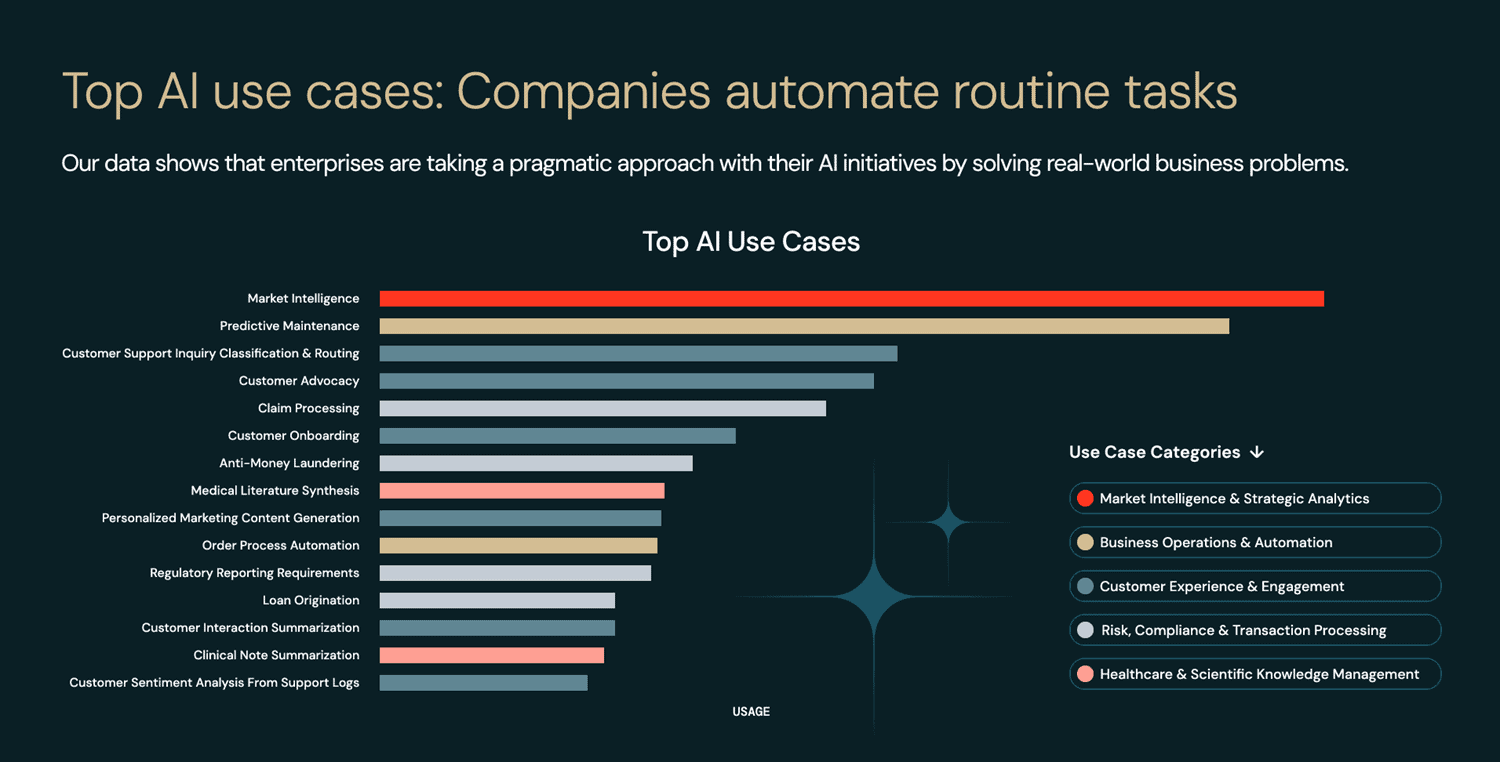
These findings reinforce a lesson that often gets lost during AI planning: a use case does not need to look futuristic to produce meaningful value.
In energy, an agent could review asset data and maintenance history to help teams prioritize inspections or investigate abnormal equipment behavior. In life sciences, an agent could organize scientific literature or support a controlled review process without replacing the subject-matter expert. In restaurant and food service operations, agents could help managers investigate sales variances, prepare store-level summaries, or route operational issues to the right team.
These are useful starting points because the work already exists. The organization understands its cost, frequency, and pain points. That creates a clearer baseline for measuring the effect of AI.
A strong first use case should have a specific owner, accessible data and a measurable operational result. “Increase AI adoption” is not an outcome. Reducing the time required to review a service ticket, improving maintenance prioritization, or accelerating a compliance review can be measured.
Information Extraction Is Becoming a Foundation for Agentic Workflows
Information extraction represented 31% of Databricks Agent Bricks usage, making it the second-most-common agent capability in the report. These agents turn unstructured documents into organized, usable data. This may not sound as ambitious as a fully autonomous agent, but it solves one of the biggest barriers to enterprise AI.
Many important decisions depend on information trapped in reports, contracts, maintenance notes, emails, manuals, and regulatory documents. Before an agent can act on that information, it must be able to find the relevant content and interpret it consistently.
Document and language intelligence can provide that connection. It gives agents structured context from materials that were previously difficult to include in automated processes.
The challenge is not simply extracting words from a page. The system must preserve meaning, recognize the document’s structure, and connect the information to the correct business entity. A value taken from the wrong table, asset record, or contract version may look technically accurate while producing the wrong decision.
Organizations should treat extraction as part of the data foundation, not as a standalone feature. Validation, document lineage, and exception handling become especially important when extracted information feeds an automated action. We say it time and again, but garbage in is garbage out.
AI Agents Are Changing the Infrastructure Beneath Enterprise Applications
One of the report’s most striking findings comes from Neon, the serverless Postgres technology behind Databricks Lakebase. According to its telemetry, AI agents created 80% of databases and 97% of database branches by October 2025. Two years earlier, both figures stood at only 0.1%.
These numbers reflect activity within a specific technology environment, so they should not be interpreted as a measure of all enterprise databases. They still illustrate the scale and speed at which agents can create development environments, test configurations, and support application experimentation.
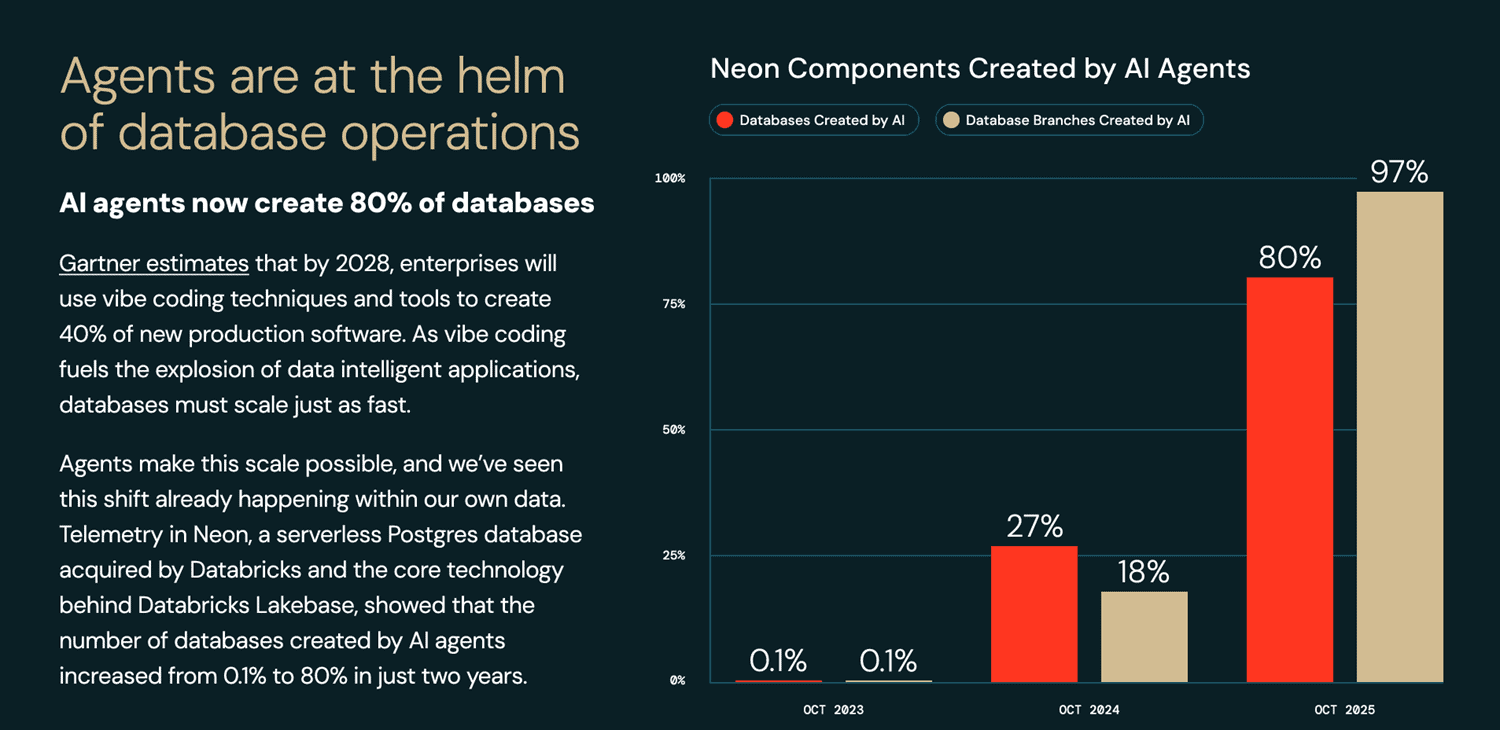
Traditional infrastructure processes were designed around human activity. Agents can generate continuous read and write requests, create temporary environments, and run multistep operations at a pace that manual provisioning was never expected to support. Now, this changes the architecture conversation.
Companies planning agentic applications must consider concurrency, latency, observability, and cost control earlier than they did with smaller generative AI pilots. They also need clear policies governing what agents can create, modify, and remove.
Speed without controls can lead to duplicated resources, unpredictable costs, and a sprawling collection of AI-generated applications. The answer is to build an operating model capable of managing that speed.
Business Users Will Build More AI Applications, but Production Still Requires Engineering Discipline
Databricks reports that more than 50,000 data and AI applications were created following the public preview of Databricks Apps, with creation growing 250% over six months. The report connects this growth to “vibe coding,” in which a person describes an application in natural language and AI generates much of the underlying code.
This gives business users a much larger role in innovation. A subject-matter expert can create a prototype without waiting for a traditional development cycle to begin. The person closest to the problem can communicate the requirement directly and test ideas faster.
Still, a working prototype is not the same as a production application. Once a solution touches sensitive data, influences a business decision, or becomes part of a critical workflow, it needs stronger engineering support. Security, performance, integration, testing, and lifecycle management still matter.
The most effective model will be collaborative. Business teams can rapidly shape the first version, while data, technology, and governance teams provide the structure needed for scale. This preserves the speed of AI-assisted development without allowing an unmanaged application landscape to take hold.
A Multi-Model Strategy Is Becoming the Norm
As of October 2025, 78% of the companies studied by Databricks were using two or more large language model families. The percentage using at least three model families rose from 36% to 59% within three months.
This suggests that enterprises are moving away from the idea that one model will support every AI need.
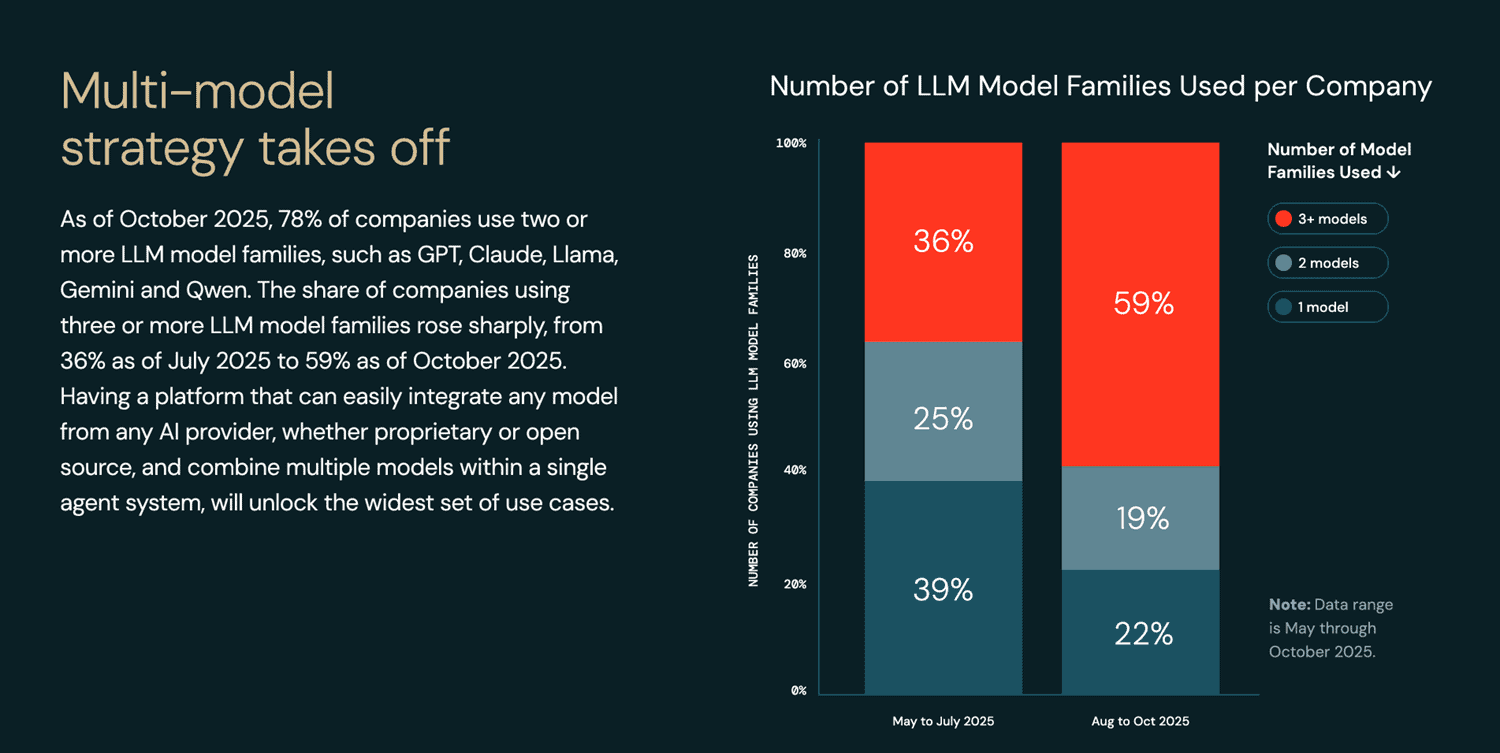
Different models may offer different advantages in reasoning, speed, cost, context length, or support for a particular type of content. An organization may use one model for a customer-facing interaction and another for an internal research task. A smaller model may be sufficient for classification, while a more capable model handles complex analysis.
Model flexibility can also reduce dependency on a single provider. But a multi-model environment requires more than access to several APIs. Teams need a consistent way to manage security, monitor usage, and evaluate outputs across providers.
The decision should remain use-case driven. Selecting more models than the business needs can add cost and operational burden. The goal is to route each task to an option that meets its quality, performance, and risk requirements.
Real-Time AI Is Becoming an Operational Requirement
The report found that 96% of model-serving requests were processed in real time rather than in batches. This included interactive experiences such as copilots, support assistants, and personalization applications.
That matters because expectations change once AI becomes part of an active workflow. A delayed response may be acceptable for a scheduled report, but it is far less useful to a technician diagnosing an equipment problem, a service representative assisting a customer, or a manager responding to an operational issue.
Real-time AI depends on the supporting data being current and available. An agent cannot provide reliable operational guidance when it is working from yesterday’s data or waiting on a disconnected system.
Organizations should evaluate the entire response path. Data ingestion, retrieval, model processing, system integration, and human approval all contribute to the final experience. Improving only the model may not solve the real performance constraint.
Governance Is Emerging as an Accelerator, Not an Obstacle
Databricks reports that usage of its AI governance solution increased sevenfold beginning in January 2025. More importantly, companies actively using AI governance put 12 times more AI projects into production than those that did not. This counters the idea that governance slows innovation.
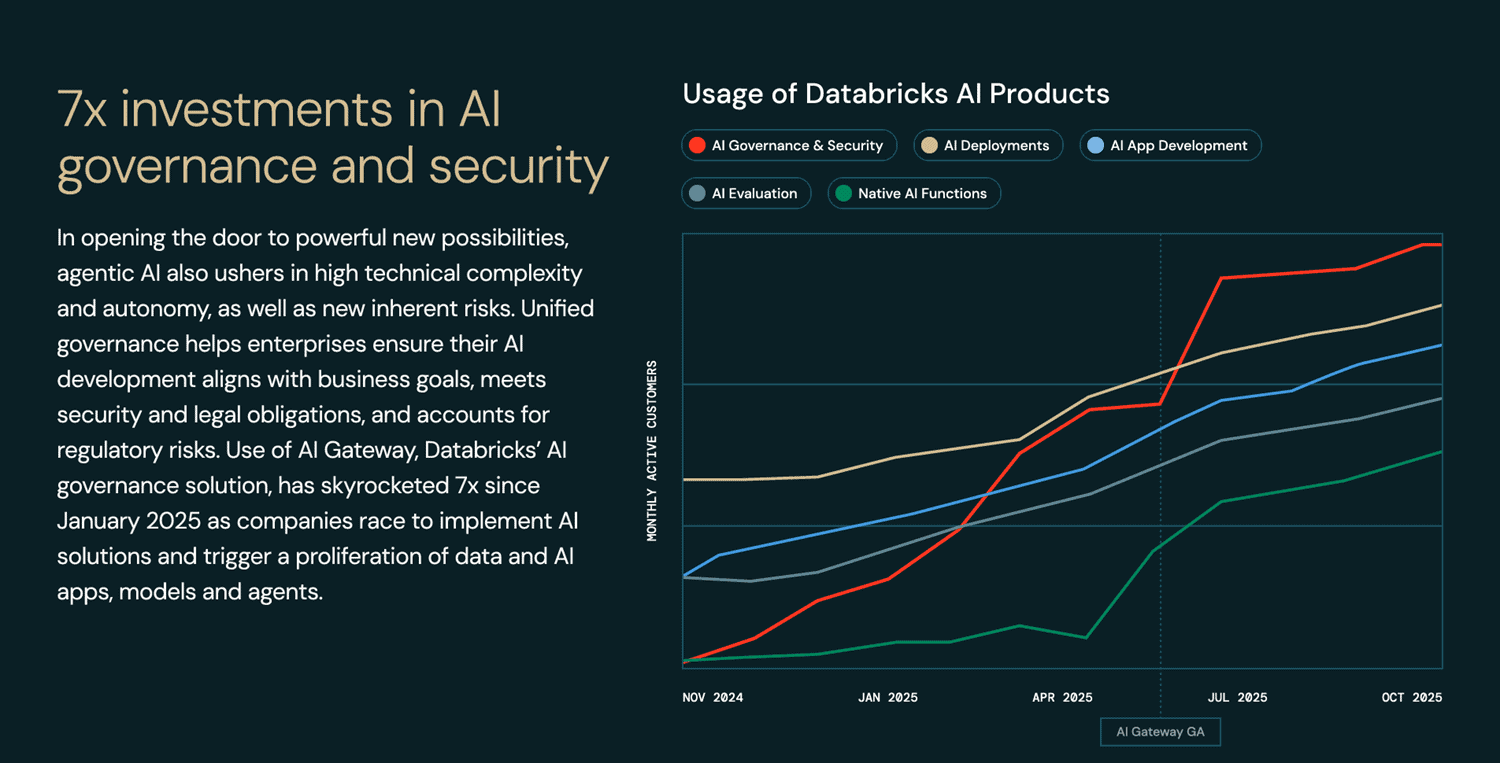
When governance is absent, teams often remain uncertain about which data can be used, who is accountable, and what level of autonomy is acceptable. Those questions tend to surface late, delaying deployment, or stopping a promising pilot altogether.
A defined governance framework gives teams a path forward. It establishes ownership, access controls, and approval requirements before the system reaches production. It also makes the acceptable boundaries of agent behavior visible.
Agentic AI raises the stakes because the system may retrieve restricted information, initiate a workflow, or update a business system rather than just simply generating text. Governance must therefore cover actions as well as outputs. Agent governance needs to remain active throughout the solution’s lifecycle as models, data sources, and workflows change.
Evaluation Connects AI Performance to Business Results
Organizations actively using AI evaluation tools put nearly six times more projects into production, according to the report. Databricks describes evaluation as an ongoing process that measures accuracy, safety, fairness, and compliance against benchmarks specific to the company’s data and intended task.
General model benchmarks can help with early technology selection, but they do not tell a company whether an agent can perform its particular job. An agent used for maintenance support should be tested against maintenance scenarios. An agent assisting with quality records should be measured on the accuracy and traceability required by that process.
Evaluation also needs to extend beyond technical scores. Business measures should be included from the beginning. Does the system reduce review time? Does it improve resolution quality? Are employees accepting its recommendations? How often does the agent require human intervention?
Without those measures, teams may optimize an agent for a benchmark that has little connection to the outcome the business needs.
Continuous evaluation also helps organizations move beyond the “demo effect.” A solution can appear impressive during a controlled presentation and still perform inconsistently across real users, unusual inputs, and changing data. Production readiness comes from testing those conditions deliberately.
Moving From Agent Experiments to Enterprise Results
The Databricks report shows that AI agents are becoming part of enterprise workflows, application development, and data operations. Multi-agent systems are growing quickly, model portfolios are expanding and real-time AI is becoming standard.
The organizations moving AI into production are starting with practical problems. They are grounding agents in enterprise data and choosing models based on the work at hand. They are also building governance and evaluation into the solution rather than adding them after development is complete.
For business leaders, the next step is to identify where coordinated AI can improve a process that matters. Start with a bounded workflow, define the result, and decide where human judgment should remain. Then build the data, controls and evaluation process needed to support that system over time.
AI agents may change how work gets done, but lasting value will still depend on clear priorities, sound architecture, and disciplined execution.
If you’d like to get started on your multi-agent journey, feel free to request a chat with our AI experts.