

Predictive Maintenance in Energy: AI Implementation Guide
Explore how AI-powered predictive maintenance helps energy companies reduce downtime, improve reliability, and make smarter asset management decisions.
Predictive maintenance in energy is a condition-based strategy that uses IoT sensors, machine learning, and real-time monitoring to detect equipment failure before it occurs, replacing reactive repairs and rigid preventive maintenance schedules with data-driven decisions that reduce unplanned downtime and lower maintenance costs across wind turbines, solar panels, battery storage systems, and hydropower assets.
The energy sector’s predictive maintenance market was valued at USD 2.25 billion in 2025 and is forecast to reach USD 7.08 billion by 2030, according to Mordor Intelligence’s energy sector predictive maintenance analysis. That growth rate, 25.77% CAGR, is not hype. It reflects what energy operators are actually deploying at scale.

As Smartbridge has watched asset-intensive industries work through their AI journeys, one pattern keeps appearing in energy. The organizations that move from pilot to production are not the ones with the most sensors. They are the ones that built the data foundations first, then let machine learning do the pattern recognition work their engineers never had bandwidth to do manually. This guide covers the full picture: what predictive maintenance actually is, how it differs from the maintenance approaches you are likely running today, the core technologies powering it, and a step-by-step path to implementation. Build with purpose, not patchwork.
What Predictive Maintenance in Energy Actually Means
Predictive maintenance in energy is the practice of continuously monitoring asset health through sensor data and applying artificial intelligence and data analytics to forecast equipment failure before it disrupts operations, enabling maintenance teams to act on condition rather than on calendar schedules or crisis events.
Most energy operators are still running one of two approaches. Reactive maintenance waits for equipment to fail, then repairs it. Preventive maintenance schedules service at fixed intervals, regardless of actual asset condition. Both have real costs. Reactive maintenance causes the unplanned downtime events that ripple through grid reliability and revenue. Preventive maintenance leads to servicing components that have useful life remaining, spending money that does not need to be spent.
Predictive maintenance sits above both. IoT sensors stream real-time data from rotating components, thermal systems, and electrical circuits. Machine learning models identify anomaly patterns in that stream, often weeks before a failure would become visible to a human inspector. The maintenance decision comes from the data, not the calendar.
The financial stakes are not abstract. According to Siemens’ 2024 cost of downtime analysis, the 500 biggest companies globally lose approximately $1.4 trillion annually due to unplanned downtime, equivalent to 11% of their total revenues. That is not a maintenance problem. That is a strategic problem with a known solution.
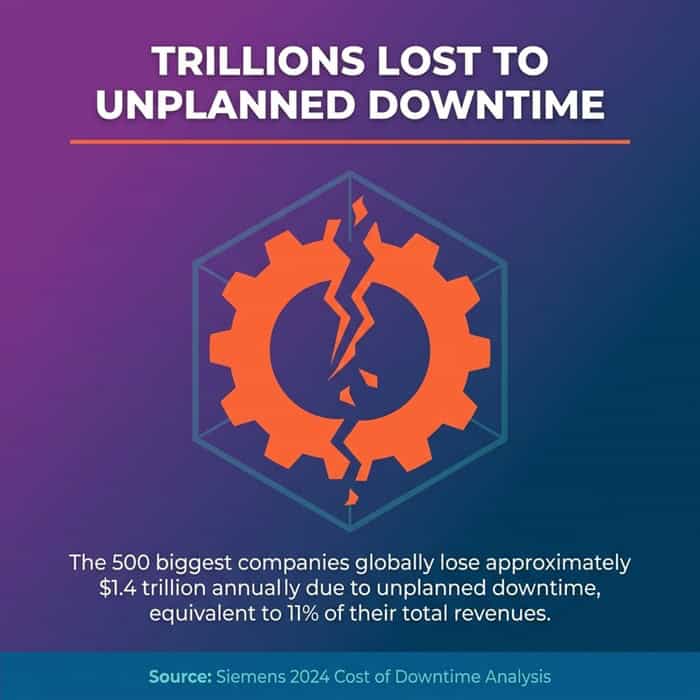
Unplanned downtime costs ~$T annually (≈11% of revenue) for the top 500 companies — a strategic imperative to fix.
Predictive vs. Preventive vs. Reactive Maintenance: The Real Differences
The three maintenance strategies represent fundamentally different philosophies about when to act on asset health, and the gap in operational outcomes between them is measurable.
Reactive maintenance is the default for organizations without a formal maintenance program. Equipment runs until something breaks. Response is fast but unplanned, which means spare parts are not staged, technicians are not scheduled, and production loss accumulates during repair windows. In high-value energy infrastructure, a single reactive event can cascade. A failed gearbox on an offshore wind turbine does not just cost the repair. It costs the lost generation during the weeks a crane vessel takes to mobilize.
Preventive maintenance applies discipline but not intelligence. Time-based service intervals reduce catastrophic failures but introduce their own inefficiency. A bearing replaced at 18 months because the schedule says so, when it had 24 months of useful life left, is wasted capital. Multiply that across a wind farm with 80 turbines and the waste compounds quickly.
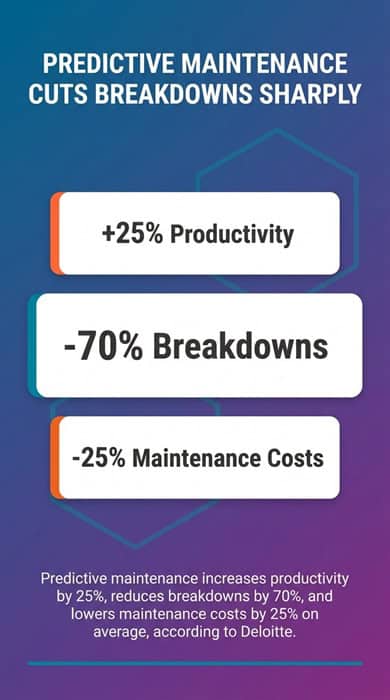
Predictive maintenance replaces schedule logic with condition logic. According to a recent study, this approach increases productivity by 25%, reduces breakdowns by 70%, and lowers maintenance costs by 25% on average. That 70% reduction in breakdowns is the number that matters most for energy infrastructure, where unplanned downtime directly reduces revenue and grid reliability.
| Maintenance Type | Trigger | Cost Profile | Downtime Risk |
|---|---|---|---|
| Reactive | Equipment failure | High (emergency labor, unplanned parts) | High, unplanned |
| Preventive | Fixed time intervals | Moderate (scheduled, sometimes unnecessary) | Low, planned |
| Predictive | Condition-based sensor data | Lower (targeted, data-driven) | Minimal, anticipated |
Core Technologies Powering Predictive Maintenance in Energy
Predictive maintenance in energy runs on four interconnected technology layers: IoT sensors for data collection, real-time monitoring infrastructure, artificial intelligence and machine learning for pattern detection, and digital twins for simulation and validation.
The sensor layer is where it starts. IoT sensors embedded in wind turbines, solar inverters, battery storage systems, and hydropower generators capture vibration, temperature, pressure, electrical output, and acoustic signatures at high frequency. Vibration analysis is particularly important for rotating equipment. Bearing misalignment and gearbox wear generate distinctive vibration signatures long before they produce audible noise or visible damage. IoT sensors catch those signatures in the data stream. Without that layer, the AI models have nothing to work with.
AI and Machine Learning in the Detection Layer
Artificial intelligence and machine learning convert raw sensor data into actionable maintenance intelligence. Machine learning models, including convolutional neural networks (CNNs) for time-series vibration data and recurrent neural networks (RNNs) for sequential anomaly patterns, learn what normal asset behavior looks like across thousands of operating hours, then flag deviations that statistically precede equipment failure.
The accuracy of these models depends on data quality and historical depth. Organizations that spent time cleaning sensor data, labeling failure events, and building consistent data pipelines before deploying machine learning are the ones whose models actually perform in production. The common thread is data. AI does not fix poor data foundations. It amplifies whatever foundation exists, good or bad.
Infrared thermography and thermal imaging add another detection dimension, particularly for solar panels and electrical switchgear. Thermal cameras identify hotspot anomalies in solar panel arrays that indicate cell degradation, bypass diode failure, or soiling patterns invisible to standard visual inspection. Real-time monitoring of thermal data through AI-driven dashboards allows operators to prioritize field visits by severity rather than by geography.
Digital Twins and Cloud Infrastructure
Digital twins, virtual replicas of physical energy assets, allow teams to simulate failure scenarios, test maintenance interventions, and validate predictive models without touching live equipment. The digital twin in the energy utility market was valued at USD 2,720 million in 2024 and is expected to grow to USD 10 billion by 2035, according to Wise Guy Reports’ digital twin energy utility market analysis. That growth reflects operational adoption, not just research interest.
Cloud infrastructure carries most of this workload. The cloud deployment model captured 72.6% market share in predictive maintenance for the energy sector in 2024, according to Mordor Intelligence’s broader predictive maintenance market report. Cloud platforms handle the data volumes that IoT sensor networks generate, provide the compute for machine learning model training, and enable real-time monitoring dashboards accessible to field crews and operations centers simultaneously. Tools like Azure Machine Learning and Microsoft Fabric are well-established in this stack for energy operators already running on Microsoft infrastructure.
For teams building this layer, our work on forecasting improvements using Azure Machine Learning shows how this infrastructure translates from architecture diagrams to working production systems in energy contexts.
Benefits of Predictive Maintenance Across Energy Infrastructure
Predictive maintenance in energy delivers measurable outcomes across four dimensions: reduced unplanned downtime, lower maintenance costs, extended asset lifespan, and improved workforce safety, with the strongest financial returns coming from avoided emergency repair events in high-value energy infrastructure.
The unplanned downtime reduction is the headline number. Offshore oil and gas provides a stark benchmark: an average offshore company experiences approximately 27 days of unplanned downtime per year, resulting in average annual losses of $38 million. That $38 million figure understates the full cost once lost production, emergency mobilization, and regulatory implications are included. Predictive maintenance’s ability to reduce breakdowns by 70% directly attacks that loss.
Asset lifespan extension is less dramatic but financially significant over decades. Equipment that never experiences a catastrophic failure event avoids the secondary damage that such events cause. A gearbox that fails under load damages adjacent components. A battery module that thermally degrades without intervention affects neighboring cells. Predictive maintenance keeps assets operating within design parameters, which compounds over the 20-to-30-year lifespan of wind turbines and hydropower generators into material capital cost savings.
Safety is the benefit that does not appear on a maintenance ROI calculation but drives real operational value. IoT sensors and real-time monitoring detect conditions, overheating electrical systems, structural anomalies in wind tower welds, gas buildup in battery enclosures, that create worker safety risks if undetected. Moving from reactive repairs in emergency conditions to planned interventions in controlled conditions reduces incident exposure for field technicians.
Our work helping an energy firm apply cloud computing and advanced multivariate analysis shows how these benefits materialize when the operational data infrastructure is actually in place, not just designed on paper.
How to Implement a Predictive Maintenance Program: Step-by-Step
Implementing predictive maintenance in energy requires a sequenced approach that builds data foundations before deploying machine learning models, starting with asset criticality assessment and ending with continuous monitoring loops that refine predictive accuracy over time.
Most organizations get this order wrong. They acquire IoT sensors and deploy a machine learning platform before their data is clean, labeled, or structured for model training. The result is a pilot that produces interesting dashboards but does not move to production because the predictions are not reliable enough to drive maintenance decisions. The sequence matters more than the speed.
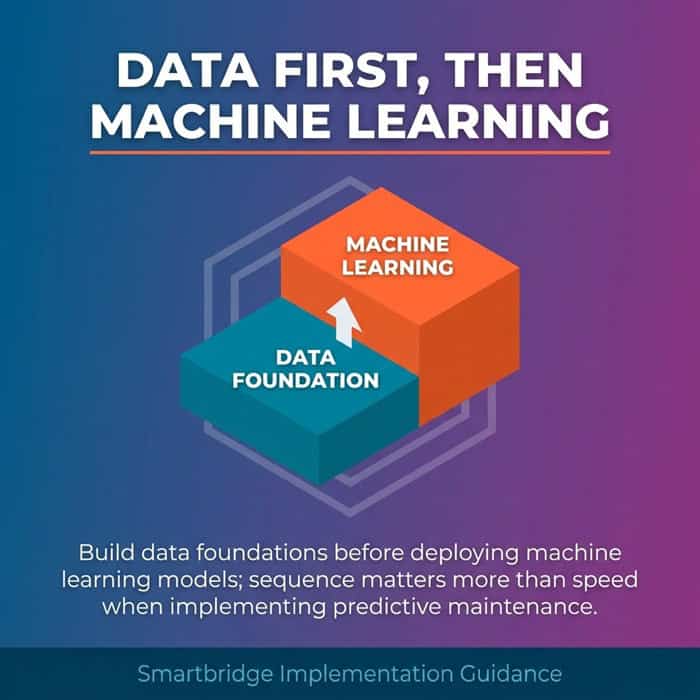
Data foundations first: clean, labeled, governed data and pipelines before ML — sequence beats speed.
Phase 1: Assess Assets and Define Failure Modes
Start with a criticality ranking of all assets in scope. Not every component warrants predictive maintenance investment. Wind turbine gearboxes, solar inverters, battery management systems, and hydropower turbine bearings typically rank highest because their failure consequences, cost, downtime duration, and safety risk, justify the sensor and analytics investment.
For each critical asset, document the specific failure modes you are targeting, the sensor types that detect their precursors, and the data frequency required. Vibration analysis for bearing wear needs high-frequency sampling. Temperature monitoring for battery thermal management needs continuous real-time data. Defining this before procurement prevents sensor gaps that undermine model training later.
Phase 2: Build the IoT and Data Infrastructure
Deploy IoT sensors to the prioritized assets. Connect them to a cloud data platform that can handle real-time data ingestion at the volumes your sensor network generates. Establish data governance protocols, labeling conventions for failure events, data retention policies, and access controls, before data starts flowing. This is the step that most teams want to skip. It is the step that determines whether your machine learning models work in production.
Historical data matters as much as live data. Pull maintenance logs, inspection records, and any existing sensor archives. Label failure events with the specific failure mode and the date it was first detectable. This labeled historical dataset is what machine learning models train on. More labeled failure examples produce more accurate models.
Phase 3: Deploy and Validate Machine Learning Models
With clean, labeled data in place, train machine learning models against historical failure patterns. Start with the failure modes that have the most labeled examples in your dataset. A model trained on 50 labeled gearbox failure events will outperform one trained on 5. Validate model performance against a held-out test set before deploying to production monitoring.
Set alert thresholds that reflect operational tolerance for false positives. A model that flags too many low-confidence anomalies will train maintenance teams to ignore alerts. A model with thresholds set too conservatively will miss early-stage failures. Calibrate based on the cost of a missed failure versus the cost of an unnecessary inspection for each asset type.
Phase 4: Integrate with Maintenance Workflows
Predictive maintenance alerts only create value when they connect to maintenance scheduling systems and field crew workflows. Integrate the predictive monitoring platform with your CMMS (computerized maintenance management system) so that a high-confidence anomaly alert automatically generates a work order with the relevant sensor data attached. Field technicians arrive knowing what to look for, not just that something triggered.
Teams that moved from experimenting with AI alerts to depending on them for daily maintenance planning are the ones who closed this integration loop early. The technology works. The workflow integration is what turns it from a pilot into a production program.
Phase 5: Continuously Monitor and Improve Model Accuracy
Predictive maintenance models improve with every new labeled failure event. Establish a feedback loop where technicians confirm or correct the failure diagnosis after each maintenance event, feeding that outcome back into the training dataset. Over time, the machine learning models become more accurate for your specific assets, operating conditions, and failure patterns, delivering measurable productivity and cost reduction benefits as the data foundation grows.
For energy operators building the device intelligence layer that makes this continuous loop possible, our analysis of device tracking improvements using Azure Machine Learning covers the architecture considerations that keep this infrastructure scalable as your asset base expands.
The global predictive maintenance market was estimated at USD 14.29 billion in 2025, according to Grand View Research’s global predictive maintenance market analysis, and the organizations building this capability now are positioning their energy infrastructure for the reliability and cost performance that the next decade of renewable energy growth demands. Digital innovation in energy is a journey, not a race. The right roadmap, built on clean data and purposeful AI deployment, outperforms the fastest implementation every time.
If you are mapping where your energy organization sits on the predictive maintenance maturity curve, or working through the data foundation work that makes AI-driven monitoring actually perform, we are here to work through that with you. Speak to an expert at Smartbridge for a consultation.