

AI in Oil & Gas: Use Cases for Safety, Efficiency and Emissions Tracking
AI now spots failing pumps and methane leaks at scale. The harder part is acting on the alerts. Here’s where AI delivers in oil and gas, with figures from Shell, Aramco, IOGP and UNEP.
AIin oil and gas means applying machine learning, computer vision and AI agents to sensor, satellite and operational data so operators can predict equipment failures, optimize production, protect workers and track emissions. The detection side already works at scale. UNEP’s Methane Alert and Response System has sent more than 3,500 alerts to 33 countries using satellite data and AI tools. Yet UNEP reports a response rate of just over 12%. Finding the problem is no longer the hard part – the value is now won or lost in what operators do next.
What AI in Oil & Gas Does From Wellhead to Refinery
Oil & gas was an early AI adopter, and the technology now runs from exploration to refining. The IEA describes the industry as an early adopter of AI that uses it to improve exploration, production, maintenance and safety.
| Segment | Typical AI use | Data it relies on |
|---|---|---|
| Upstream exploration | Subsurface interpretation | Seismic surveys and well logs |
| Drilling | Drilling parameter optimization | Rig and downhole sensors |
| Production | Real-time setpoint optimization | SCADA and well test data |
| Midstream | Leak detection and pipeline integrity | Pressure, flow and inspection records |
| Downstream refining | Process control and maintenance | Plant historians and equipment sensors |
| All segments | Emissions monitoring | Satellite, aerial and site sensors |
Every row depends on data most operators already collect. The constraint is whether historian, maintenance and inspection data sit where a model can read them and a person can act on the result. That makes AI a data & analytics question before it is a modeling question.
Shell Scaled Predictive Maintenance to More Than 13,000 Assets
Shell’s program shows predictive maintenance working at scale, which makes it the most proven AI use case in the industry. Models read sensor data to anticipate failures. Crews can then repair a pump on a planned schedule instead of after an unplanned shutdown.
Shell has run its program with C3 AI since 2018. By March 2022, C3 AI reported that Shell had extended it to more than 10,000 pieces of equipment. Those included control valves, pumps and compressors across upstream, manufacturing and integrated gas assets. C3 AI now puts coverage at more than 13,000 pieces of equipment.
Both counts come from the vendor and measure coverage, not downtime avoided. Ask for the downtime number when you evaluate any predictive maintenance claim, including your own.
Physics-informed digital twins sharpen the signal. A twin models how a compressor should behave under current load, pressure and temperature, so software can separate a developing fault from a normal response to a throughput change. Fewer false alarms matter because crews tune out systems that flag too much.
Scaling is repetitive work. Each new equipment class needs its sensor tags mapped, its maintenance history cleaned and its alerts routed to an owner. That integration work, more than the model, decides how fast a pilot becomes a program.
AI Agents Now Help Close the Loop After an Alert
The next stage of predictive maintenance is software that helps diagnose and fix a problem after flagging it. On June 4, 2026, C3 AI and Shell signed a new multi-year agreement that extends their program beyond anomaly detection. It adds AI agents for root cause analysis and remediation.
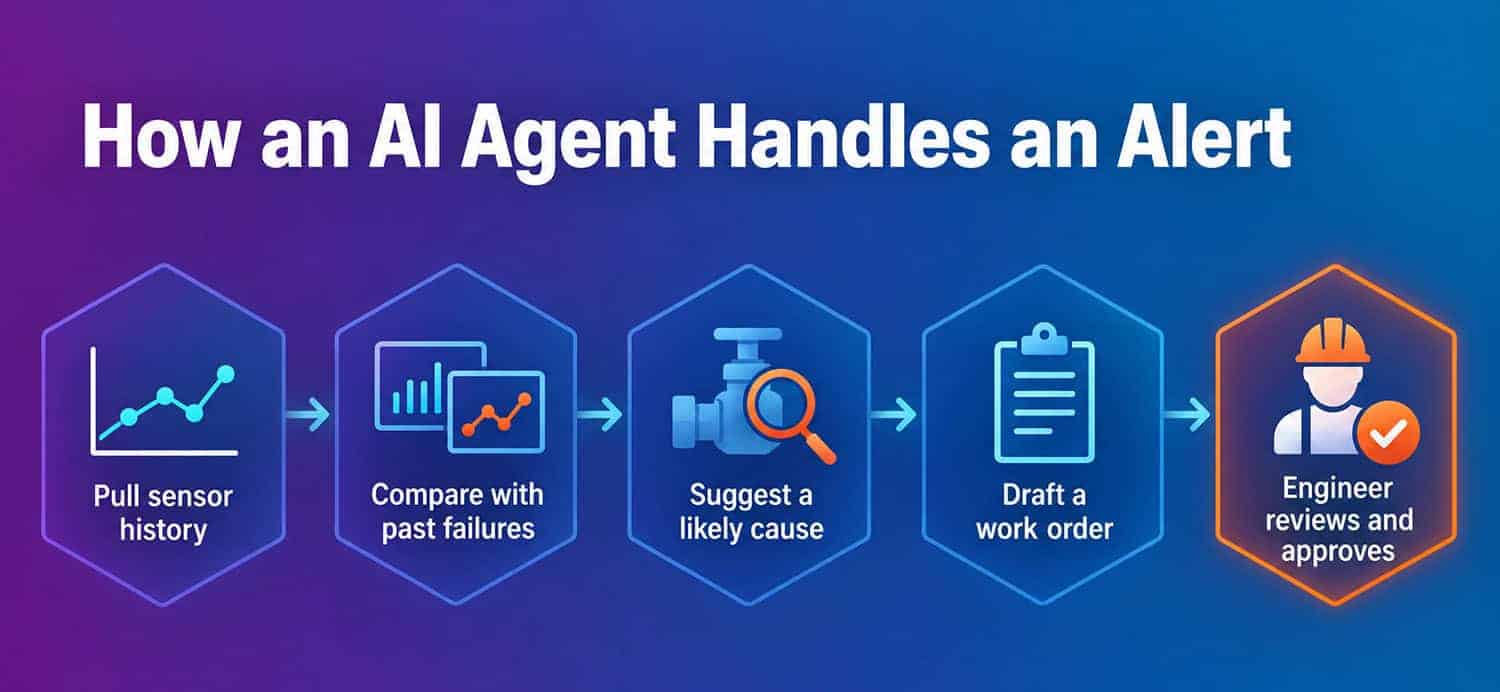
Keeping the engineer as the final approver gives every valve adjustment a named decision-maker, which auditors and crews both need.
Agentic AI carries out multistep tasks rather than answering a single prompt, which extends intelligent automation into investigative work. An agent can pull an asset’s sensor history, compare it with past failures, suggest a likely cause and draft a work order. An engineer then reviews and approves the plan.
Deciding which steps an agent may complete alone and which need sign-off is the central design choice in human-agent AI for oil and gas operations. Get it wrong in one direction and engineers ignore the agent. Get it wrong in the other and nobody can explain why a valve was adjusted.
Generative AI and large language models play a quieter role. Technicians use them to search manuals, procedures and maintenance histories in plain English. Answers are only as good as the documents behind them, so every response should cite its source and document cleanup belongs in the project plan.
Oil and Gas Injury Rates Fell in 2025 While Fatalities Rose
IOGP’s 2025 safety data shows why AI for safety should target high-consequence work first. IOGP member companies reported 52 fatalities in 2025. Their Fatal Accident Rate rose 75% compared with 2024, while the Total Recordable Injury Rate fell 6%.
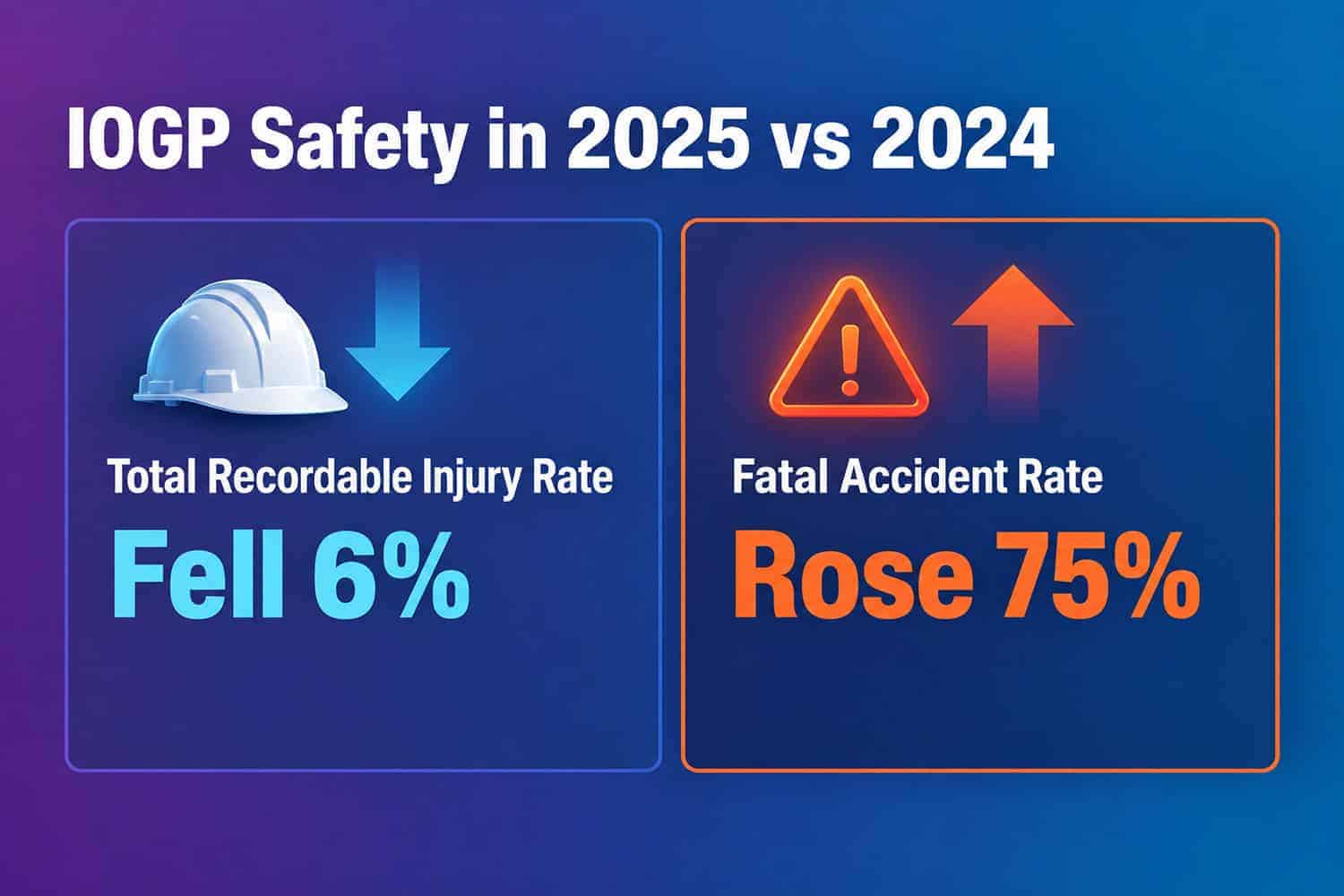
Falling injury counts can mask growing catastrophic risk, so safety dashboards should track high-consequence events separately.
IOGP’s breakdown shows 5 multi-fatality events that killed 17 people, alongside 35 single-fatality events. A program can drive down everyday injuries while catastrophic risk grows. Maintenance, drilling and transport carry that risk, so that is where AI attention belongs.
Computer Vision Watches PPE and No-Go Zones
Computer vision models read camera feeds to spot unsafe conditions as they happen. Common uses include PPE compliance and alerts when someone enters a no-go zone around rotating equipment, suspended loads or a live drill floor. The goal is to intervene before the incident. Tools that slow crews down get bypassed, which is why frontline workforce productivity and safety have to be designed together.
Robots and Edge AI Take People Out of the Line of Fire
Drones and crawlers inspect confined spaces, high structures and offshore assets that would otherwise need a person on a rope or in a tank. Edge AI runs the models on site, close to the camera or sensor. That matters at wellsites and offshore platforms where connectivity is limited and a warning cannot wait on a cloud round trip.
Aramco Credits AI With $2.6 Billion of 2025 Value
AI’s efficiency payoff adds up across a portfolio of measured use cases, and Aramco’s self-reported figures are the largest example. The company recorded $5.3 billion of “Technology Realized Value” in 2025 from AI, digital and other technology, bringing its total since 2023 to $11.3 billion. Aramco attributes $2.6 billion of the 2025 figure to AI and has identified 442 AI use cases.
At Davos in January 2026, CEO Amin Nasser said AI tools had raised output at some fields and reduced the number of wells needed per barrel. Fewer wells per barrel cuts capital spending, which is worth more than trimming operating cost at the margin.
Day to day, production optimization means models recommending real-time setpoints such as choke positions, injection rates and compressor loads, with less guesswork as conditions change. Narrow, metered processes make good first targets. AI-driven chemical injection optimization fits that profile, since injection rates, chemical spend and production response are already measured.
Aramco measures itself with its own metric, so treat the totals with care. The transferable lesson is outcome-focused: tie each use case to a baseline a CFO can follow.
Satellites Spot Methane Leaks, but Most Alerts Go Unanswered
Emissions tracking exposes the gap between detection and action more clearly than any other AI use case. The IEA estimates fossil fuel methane emissions at 124 Mt a year, including 45 Mt from oil and 36 Mt from natural gas. It found no sign that energy-related methane emissions fell in 2025.
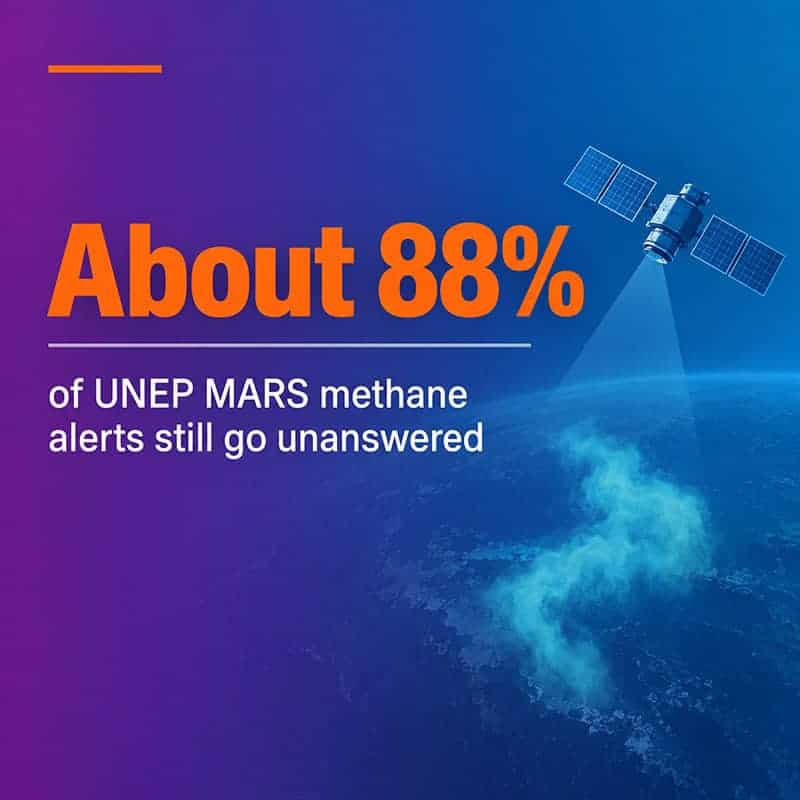
MARS can notify governments and operators but cannot compel repairs, so closing the gap rests on their own follow-through.
Detection coverage keeps expanding. IEA data shows satellites detected more than 5 Mt of methane from very large emission events in oil and gas operations in 2025. During its year of operation, MethaneSAT readings estimated emissions from about 23 basins in 16 countries. Those basins cover roughly a third of global oil and gas production.
Response is the weak link. The response rate to MARS alerts has climbed from 1% in 2024, but about 88% still go unanswered. MARS is a UN notification system. It flags leaks, but it sets no rules and enforces nothing. Any repair depends on governments and operators choosing to act.
For operators, the practical step is treating a methane alert like an equipment alarm, with an owner, a deadline and a closed work order. That record then becomes the evidence trail behind emissions and compliance in oil and gas operations. Carbon capture monitoring and energy-transition reporting need the same thing. They depend on measured data, traceable to a source and owned by someone accountable.
A Pilot-to-Production Checklist for AI in Oil and Gas
Scaling AI across an asset base depends more on data, ownership and crew trust than on model choice. In a 2025 survey of energy-sector leaders run by ADNOC and Microsoft, 88% agreed that scaling AI is essential to transforming energy. Agreement is the easy part. These are the items that decide whether scaling happens.
None of these items is glamorous. Together they turn scattered pilots into a digitally connected enterprise, which is what it means to build with purpose, not patchwork.
Quick Answers
How Is AI Being Used in Oil and Gas?
Operators use AI to predict equipment failures, optimize drilling and production, monitor worker safety with computer vision, and detect methane leaks from sensors and satellites.
Can AI Reduce Methane Emissions?
AI and satellites find leaks faster, but emissions fall only when someone repairs them.
What Is the Most Proven AI Use Case in Oil and Gas?
Predictive maintenance. Shell’s program monitors more than 13,000 pieces of equipment and is adding AI agents for root cause analysis.
Does AI Make Oil and Gas Work Safer?
It can, when it targets high-consequence tasks such as maintenance, drilling and transport.
Measure Your Alert-to-Action Ratio This Week
- 1Pull your last ten AI alerts from any system and count how many became completed work orders within a week. That ratio is your real AI maturity score.
- 2For each alert that went nowhere, record the reason, such as no owner, low trust in the model, missing data or no crew capacity.
- 3Pick the most common blocker and assign one person to fix it for a single equipment class or site.
- 4Report the ratio to your executive sponsor alongside the number of models deployed.
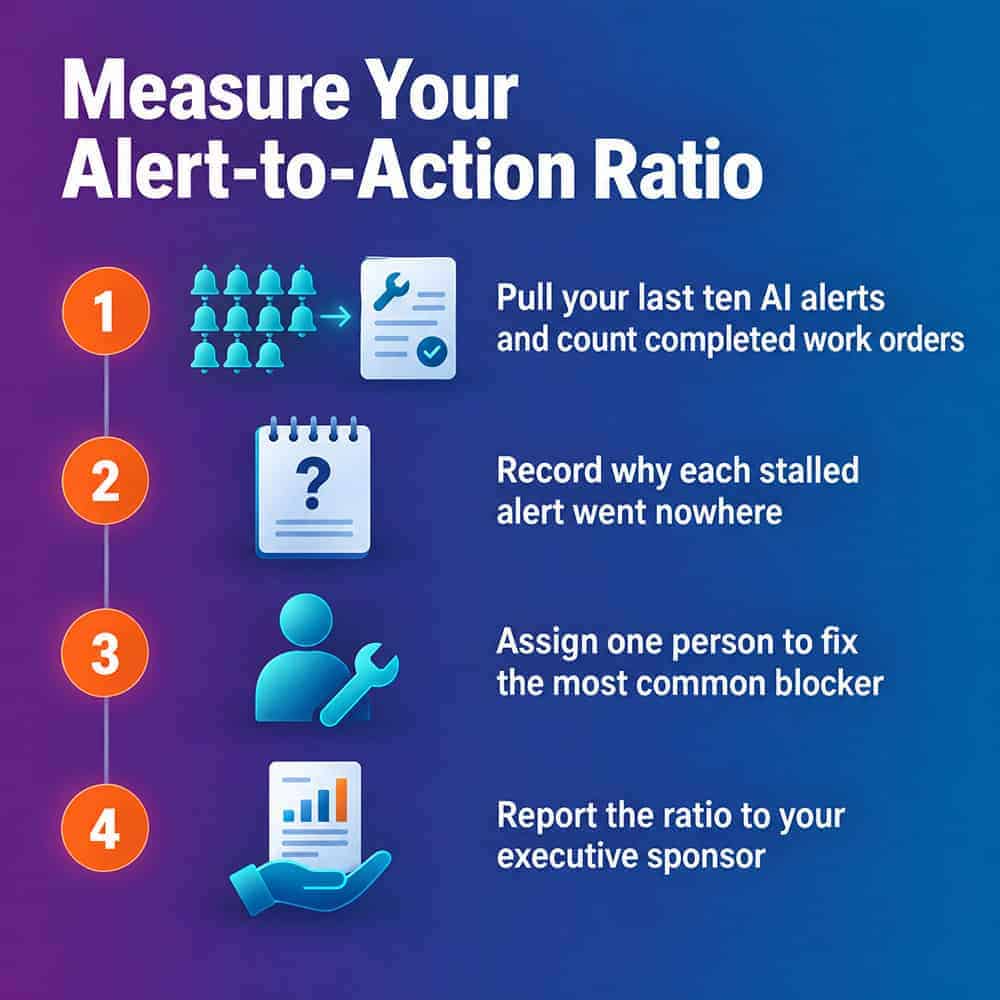
Repeating this check monthly turns a one-off audit into a trend leaders can compare against model count.
The same test works for a medtech quality alert or a restaurant refrigeration sensor. Talk to a Smartbridge expert about turning AI alerts into action in energy operations.