
Human-in-the-Loop: Where AI Should Act and Where It Shouldn’t in Oil & Gas Operations
Agents are part of the enterprise story now. The harder question is what “Human plus Agent” actually looks like in real operations, and where the line should be drawn.
I’ll be in Calgary for the 2026 Digitalization & AI in Energy Canada event, where I’ll be leading a panel on “Human plus Agent.” As I’ve been preparing, and thinking more about AI in oil & gas operations, I keep coming back to a simple question:
Not what AI can do, but rather, what it should be allowed to do.
In pipeline control rooms, in plants, and out in the field, the stakes are too high to get that wrong.
Most of the conversations I’ve had lately have been about control:
If those boundaries aren’t clearly defined, the technology doesn’t matter, and adoption won’t happen.
1. Defining “act, ask, or stop” in real operations
There are clear cases where agents can act independently. Repeatable, low-risk decisions within defined thresholds. Adjustments that operators already trust automation to handle today.
Then there are situations where the system should pause and ask. Not because the AI isn’t capable, but because the decision involves tradeoffs like cost, production targets, or downstream impact.
And then there are hard stop scenarios. Anything tied to safety, compliance, or asset integrity should never be fully delegated.
If an organization can’t clearly separate these three categories, it’s not ready to deploy AI agents in operations.
2. Trust is built with experience.
A lot of teams assume that if the AI is “right,” people will use it… that trust comes from accuracy. But that’s not how this works in the field.
Operators and engineers trust systems they can understand and challenge.
They want to know:
If the interface slows them down or forces them to interpret what’s happening, they’ll stop using it.
If notifications create noise instead of clarity, they’ll ignore them. And once that trust is lost, it’s very hard to get back.
3. If you can’t audit it or reverse it, you don’t control it
This is the area I think is still underdeveloped across most AI initiatives.
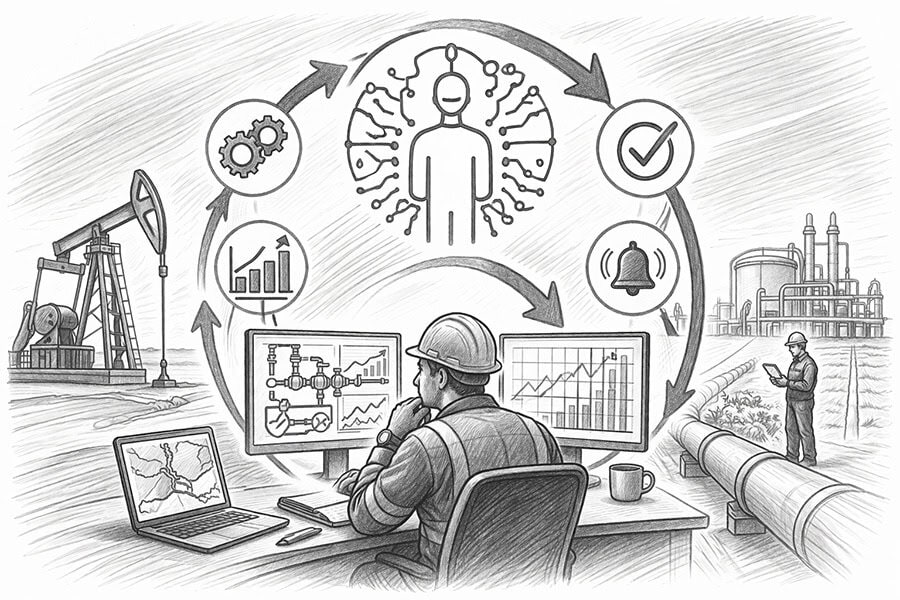
Every action an agent takes should be traceable.
Every decision should be explainable after the fact.
Every workflow should be reversible.
In oil & gas, control isn’t optional. Because at the end of the day, operations teams need to know they can step in, unwind a decision, and move forward without disruption.
These are some of the themes I’ve been thinking through as I get ready for this discussion.
The technology is moving quickly. But adoption in this industry will come down to control.
If you’re working through similar questions – where to draw the line between human and agent, how to build trust with your teams, or how to design these systems in a way that holds up in real operations – I’d enjoy comparing notes before the event.
I’ll be in Calgary during the event week. If you’re working through these same questions, I’d welcome the chance to connect and compare notes in person.
I’m also interested in what’s top of mind for you. What should we be discussing on this panel? Feel free to email me your questions, and I’ll do my best to bring them into the conversation.

Looking for more on AI for Energy?
Explore more insights and expertise at smartbridge.com/energy