

2026 Gartner AI Predictions for Oil and Gas
Gartner’s latest oil and gas AI predictions show the industry moving beyond pilots and into operational AI deployment. Explore what rising AI investment, AI agents, and workforce readiness mean for energy leaders.
For years, oil and gas companies explored AI through isolated pilots, analytics proofs of concept, and innovation initiatives, but that phase is ending.
According to Gartner’s 2026 oil and gas predictions, the industry is shifting from experimentation toward operational deployment. AI is becoming embedded in core workflows, frontline decision-making, and enterprise technology strategy.
It’s clear that AI is no longer a future-state initiative for energy companies, but instead is becoming part of how modern operators run.
Here are the key trends shaping that shift and what they mean for oil and gas organizations preparing for the next wave of digital enablement, according to Gartner.
AI Deployment in Oil and Gas Is Accelerating Quickly
Gartner found that 62% of oil and gas respondents have already deployed AI, with generative AI deployment matching that figure. AI agent adoption is also rising quickly, with nearly half of respondents planning deployment within the next 12–24 months.
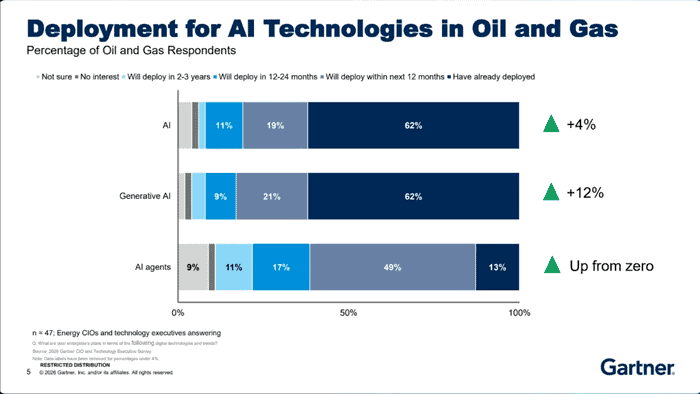
This signals a meaningful shift in maturity. Oil and gas companies are moving beyond experimentation and beginning to operationalize AI across business and field workflows. What matters now is not whether organizations are using AI. It is how effectively they are deploying it.
Many companies still have AI initiatives stuck in isolated pilots that deliver limited enterprise value. The organizations pulling ahead are those integrating AI directly into operational processes such as:
The next competitive advantage will come from embedding AI into day-to-day work, not simply proving the technology can function.
AI is Becoming a Top Funding Priority
Gartner’s funding data shows that generative AI, artificial intelligence, and business intelligence/data analytics rank among the highest investment priorities for oil and gas organizations entering 2026.
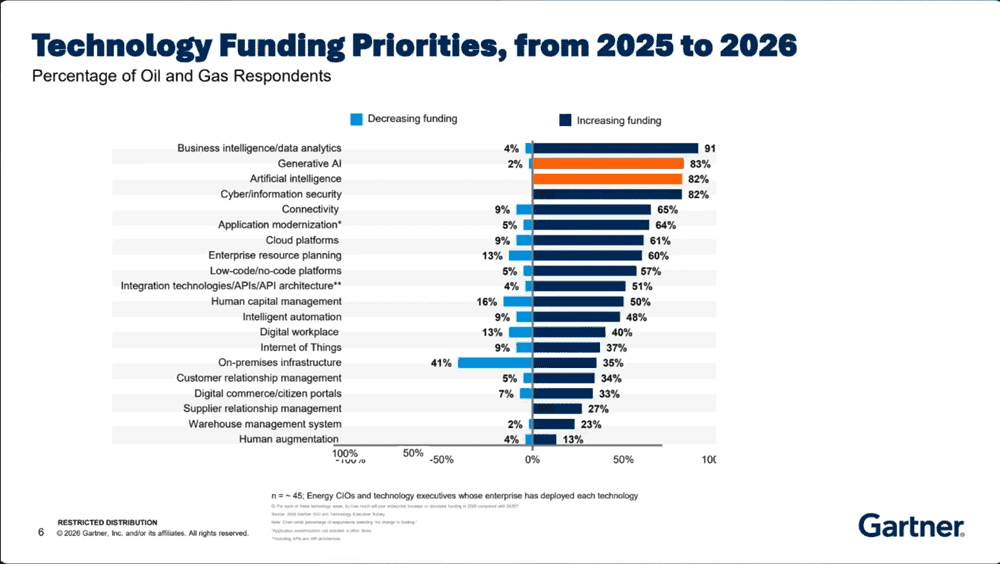
This reflects a broader strategic shift. Oil and gas companies increasingly view AI as an operational enabler rather than an experimental technology spend.
That said, increased funding alone does not guarantee outcomes. Organizations that generate meaningful ROI from AI investments are typically the ones that prioritize foundational capabilities first, including:
Companies that invest in AI without addressing these foundations often struggle to move beyond disconnected point solutions.
Multiagent AI Systems Are Entering Operations
Gartner predicts that by 2028, oil and gas companies using AI agents will improve operational efficiency by more than 10%.
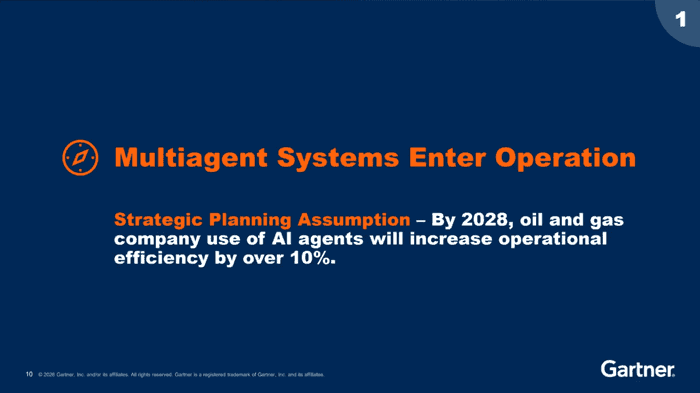
This is one of the most significant forward-looking predictions in the report. AI agents represent a shift from passive AI insights to active AI execution.
Rather than simply surfacing recommendations, AI agents can perform tasks, trigger workflows, coordinate actions across systems, and support autonomous decision-making.
In oil and gas, that may include use cases such as:
As organizations mature, multiagent systems will increasingly orchestrate work across departments and systems, not just assist individual users.
AI Readiness Is Becoming a Leadership Responsibility
Gartner predicts that by 2027, 70% of oil and gas CIOs and executive leaders will have formal responsibility for enhancing employee AI readiness.
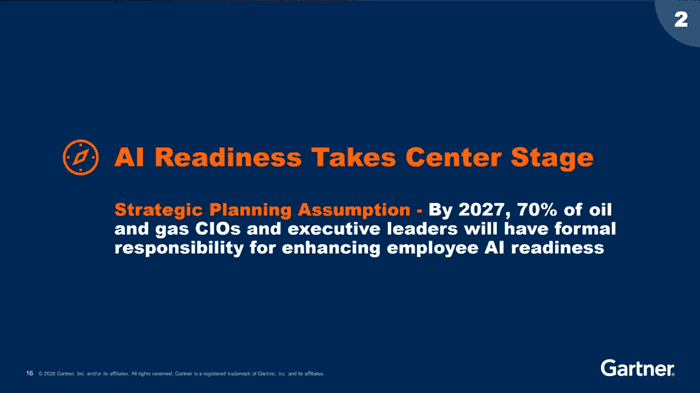
This reflects a critical reality many organizations are now facing: AI adoption is an organizational readiness challenge.
Even the best AI solutions fail when employees do not understand how to use them, trust them, or integrate them into daily workflows. Successful AI adoption requires leadership to drive:
The companies seeing the most traction with AI are treating readiness as a business transformation effort, not just a software rollout.
Frontline Expertise Will Become Critical AI Training Data
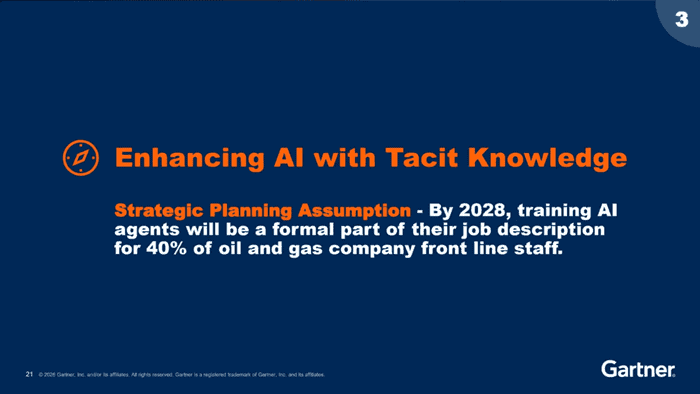
Gartner predicts that by 2028, training AI agents will become a formal part of the job description for 40% of oil and gas frontline staff.
This trend highlights the growing importance of tacit knowledge capture.
Much of the industry’s operational expertise still lives in the heads of experienced engineers, operators, field technicians, and production specialists. As workforce transitions continue across the industry, capturing that institutional knowledge becomes increasingly urgent.
AI systems can help preserve and scale frontline expertise, but only if organizations intentionally structure and capture that knowledge. Leading companies are beginning to formalize processes for:
In the future, frontline workers will use AI as well as actively train and improve it.
Process Mining Will Shape More Effective AI Deployments
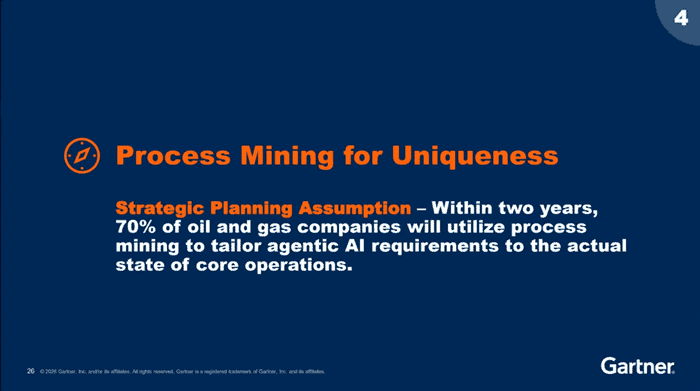
Gartner predicts that within two years, 70% of oil and gas companies will use process mining to tailor agentic AI requirements to actual operational workflows.
This matters because oil and gas operations are highly complex and highly unique. Generic AI implementations often fail because they do not reflect the reality of how work actually happens in the field or across operations.
Process mining helps organizations map real workflows based on system and operational data, revealing:
This creates a stronger foundation for AI deployment by ensuring automation and AI agents align with real-world operations rather than theoretical process maps. For oil and gas companies, this will become a critical step in scaling AI successfully.
The Future of AI in Oil and Gas Is Operational
Gartner’s predictions make one thing clear: Oil and gas is moving beyond AI trial and error.
The next phase of value creation will come from operationalizing AI across workflows, systems, and frontline decision-making. Organizations that succeed will move beyond isolated pilots and focus on building:
How quickly can your oil and gas organization adapt to take advantage of this rapidly shifting AI environment? For more information on how AI can help, contact us at Smartbridge for a deeper conversation.