

The Agentic Divide: How Salesforce Frames the Agentic Enterprise
How do you make the case for becoming an agentic enterprise when you’re stuck in the agentic divide? Start by getting clear on what that actually means.
Customers now expect AI-powered experiences that feel immediate, contextual, and accurate. They assume systems will understand intent, act on their behalf, and resolve issues without friction. Your enterprise systems likely don’t move that way yet.
That gap is the agentic divide.
On one side, customers experience AI as a finished product. On the other, enterprises deploy AI as pilots, proofs of concept, or tools bolted onto existing systems. The result shows up quickly: agents that lack context, data that can’t be trusted, and teams that hesitate to scale because control feels unclear.
If most enterprise AI pilots never reach production, the issue isn’t lack of ambition. It’s structure. Agents expose weaknesses in data, workflows, and ownership faster than dashboards ever did. When those foundations crack, trust erodes internally first, then with customers.
Naming the Agentic Divide
The agentic divide exists because expectations moved faster than enterprise readiness.
Customers already assume agents will understand history, remember preferences, and follow through across channels. Many organizations still treat AI as an overlay that sits outside core systems. That mismatch creates frustration on both sides. Customers feel ignored. Employees lose confidence in the tools meant to help them.
You can’t close that gap by adding more agents. You close it by changing how the enterprise operates.

What an Agentic Enterprise Actually Is
An agentic enterprise is an organization that elevates human work with agents that operate inside trusted systems—grounded in governed data, embedded in real workflows, and designed to act with context, accuracy, and clear boundaries.
Rather than replacing people, you’re reducing friction in how work moves. In agentic enterprises, employees resolve issues faster because context travels with the task. Customers stay loyal because interactions feel intentional rather than transactional. Operations run leaner because handoffs disappear. Decisions improve because data informs action in real time.
As AI begins to elevate a meaningful share of enterprise work, leaders face harder questions. Which work should agents support first? Who owns the outcomes? How do teams maintain trust as automation scales? These questions matter more than any individual feature.
Salesforce as Proof, Not a Promise
Salesforce didn’t arrive at this framing in theory. They operate as an agentic enterprise themselves.
Across support, sales, web, facilities, and internal operations, Salesforce uses agents embedded in everyday workflows. These agents work because they rely on shared data, consistent processes, and clear boundaries. The reported operational savings get attention, but the more telling signal is repeatability. This model works across teams because it was designed to.
That experience shapes how Salesforce talks about agents. Not as tools layered on top of the business, but as participants inside it.

Consulting Partner

Managed Services Provider
Why Customer 360 Wasn’t Enough
Salesforce introduces Agentforce 360 as a replacement for Customer 360 because the problem changed.
Connecting customer data alone doesn’t support agent-driven work. Agents need context that spans customers, employees, operations, and systems. They also need the ability to act, not just recommend.
Agentforce 360 reflects a re-architecture built for that reality. Instead of adding agents to existing tools, Salesforce designed a platform where data, workflows, agents, and experiences operate as a single system.
This distinction matters. Agents surface data quality issues immediately. They expose workflow gaps the moment something breaks. They make unclear ownership impossible to ignore. A platform built for agentic work must account for that from the start.
The Four Layers of an Agentic Platform
Salesforce frames Agentforce 360 around four connected layers that support agentic work without sacrificing trust or control.
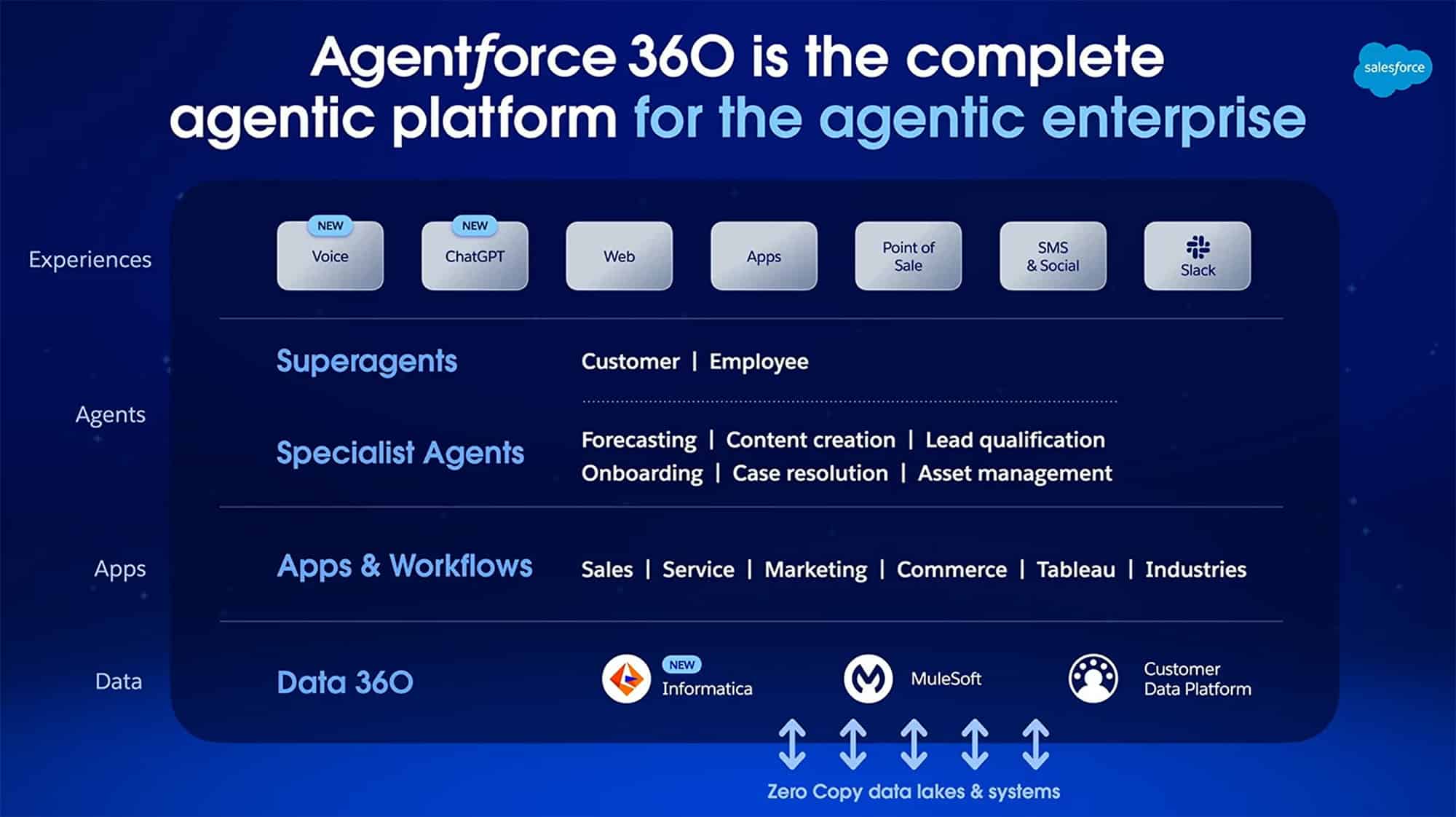
The 4 layers of a complete agentic platform – image courtesy of Salesforce
Together, these layers focus on accuracy, transparency, and time to value. Agents move faster, but not blindly. The system supports action while making accountability visible.
Salesforce has released multiple major Agentforce updates since late 2024, reinforcing that this is an evolving operating model, not a static product shift.
Why Most Enterprises Still Struggle
Many organizations recognize the opportunity and still stall.
Poor data quality becomes impossible to hide once agents rely on it. Governance questions slow progress because teams treat them as blockers instead of design inputs. Early use cases focus on novelty rather than value. DIY approaches create fragmentation that becomes hard to unwind.
Agents don’t cause these problems, they reveal them.
Where This Series Goes Next
There are already thousands of organizations operating as agentic enterprises. The real question isn’t whether agents belong in your organization, it’s whether you’re ready to operate them with intent, trust, and control.
In the articles that follow, we’ll break down how Salesforce approaches agentic work in practice. We’ll look at how agents get built, how context travels, how voice fits naturally into workflows, and how teams observe, govern, and scale agents without losing confidence.
If you want agents to work in the real world, structure comes first. Everything else builds from there.