
AI Readiness Assessment: Is Your Enterprise Actually Ready for AI?
An AI readiness assessment helps uncover the gaps in your data, infrastructure, governance, workforce, and strategy before they derail your plans. This guide breaks down what true AI readiness looks like and how to build a stronger foundation for AI that can move beyond pilots and scale.
An AI readiness assessment is a structured evaluation of an organization’s capacity to adopt, deploy, and scale artificial intelligence across six core dimensions: AI strategy, data quality, infrastructure, governance, workforce skills, and organizational culture.
Most enterprises are not ready. They believe their strategy is highly prepared for AI adoption, but they feel significantly less prepared in infrastructure, data, risk, and talent. Confidence in strategy rarely matches capability on the ground.
We see this constantly as consultants. An executive team is sold on AI and the roadmap looks crisp, but then when they start implementation, their data foundation falls apart, their infrastructure can’t scale, and nobody trained the workforce to work alongside machine learning tools. Now their AI pilot stalls and suddenly they aren’t seeing the realized value they hoped from this investment. Digital innovation is a path that needs to be traveled correctly. By skipping the readiness phase, you’ll easily end up exactly where you started, just with more debt and fewer options.
What an AI Readiness Assessment Actually Measures
An AI readiness assessment measures an organization’s actual capacity to deploy artificial intelligence, not its appetite for it. The distinction matters more than most leadership teams expect.
Appetite is easy and most forward-moving companies have plenty of it. According to McKinsey’s AI adoption survey, 88% of organizations now regularly use AI in at least one business function, up from 78% the prior year. That growth looks impressive on a chart. But usage is not the same as readiness, and it’s not the same as value.
A rigorous AI readiness assessment goes beyond asking “are we using AI?” It examines whether your data is clean enough to feed machine learning models, whether your infrastructure can handle the compute demands, whether your governance frameworks address regulatory risk, and whether your people have the skills to operate in an AI-integrated environment. Each of those dimensions is a potential failure point.
The assessment produces two outputs: a clear picture of where you stand today, and a prioritized action plan for closing the gaps. Without it, AI implementation is guesswork.
Why So Many AI Initiatives Fail Without a Readiness Check
Only 13% of organizations qualify as “Pacesetters,” meaning they are fully prepared to capture AI’s transformative value, according to the Cisco AI Readiness Index. That means the other 87% are adopting AI with meaningful gaps still open.
The failure patterns are consistent. Leadership commits to an AI strategy. Vendors are selected. Projects kick off. Then the data quality problems surface, the infrastructure hits a wall, or the workforce doesn’t have the skills to operationalize the output. The project either gets quietly shelved or limps along without delivering ROI.

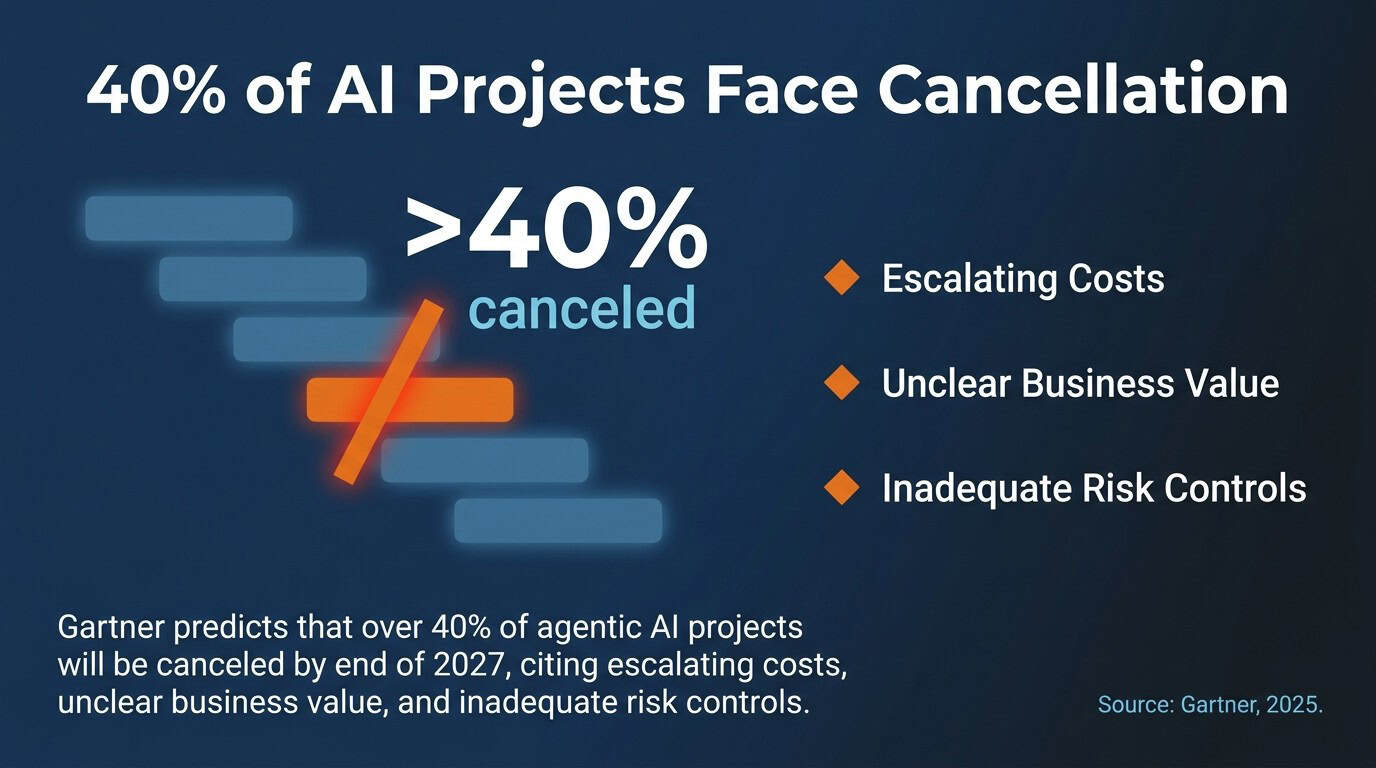
Gartner predicts that over 40% of agentic AI projects will be canceled by end of 2027, citing escalating costs, unclear business value, and inadequate risk controls. These are material investments in people, platforms, and time, so this is not a small loss. An AI readiness assessment conducted before launch is far cheaper than an abandoned program six months in.
The organizations getting real returns from AI adoption aren’t the ones who moved fastest. They’re the ones who built a solid foundation first, then accelerated on top of it. That’s the only sequence that works at scale.
The 6 Core Pillars of AI Readiness
A complete AI readiness assessment evaluates six pillars, and weakness in any single one can derail the entire AI integration effort.
Pillar 1: AI Strategy and Business Alignment
AI strategy readiness means your AI objectives connect directly to business outcomes, not technology experiments. An organization scores well here when executives can name specific problems AI will solve, identify measurable success metrics, and allocate budget with accountability attached.
Poor AI strategy alignment is the most common gap we find at the leadership level. Teams select tools before defining problems. That sequence produces impressive demos and disappointing results.
Pillar 2: Data Quality and Data Governance
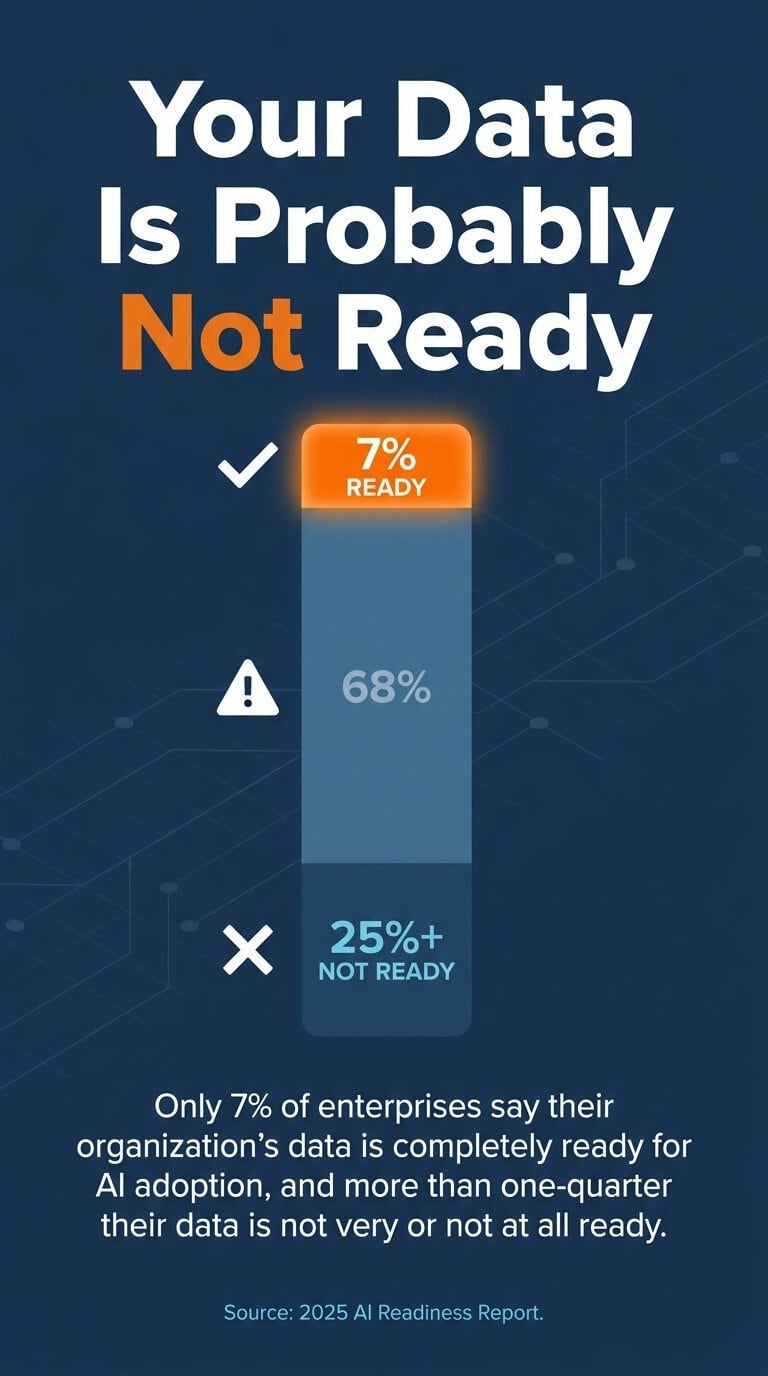
Data readiness is where most AI implementation plans quietly collapse. Only 7% of enterprises say their organization’s data is completely ready for AI adoption, and more than one-quarter report their data is “not very” or “not at all” ready, according to the 2025 AI Readiness Report. That 7% number is worth sitting with. It means the vast majority of organizations trying to deploy machine learning are doing it on a data foundation that isn’t ready.
Data quality issues include incomplete records, inconsistent formats, siloed storage, and lack of data governance policies governing access, ownership, and lineage. Machine learning models trained on poor data produce poor predictions. Garbage in, garbage out is not a cliché. It’s an operational guarantee.
Pillar 3: Infrastructure and Scalability
AI infrastructure readiness covers compute power, cloud architecture, storage capacity, and the ability to scale workloads as model complexity grows. Organizations still running on legacy systems or on-premise hardware often hit a hard ceiling before their first AI model reaches production.
Infrastructure gaps show up late in the process, which makes them expensive. A thorough AI readiness assessment surfaces these constraints early, before you’ve invested six months building on a foundation that can’t support the weight.
Pillar 4: AI Governance and Compliance
AI governance readiness means having documented policies that govern how AI models are trained, monitored, audited, and retired. It also means understanding your regulatory exposure, including frameworks like GDPR, CCPA, and sector-specific requirements in industries like life sciences and energy.
Governance is the operational discipline that keeps AI systems producing outputs that are accurate, fair, and defensible. Organizations without it are one model failure away from a compliance event.
Pillar 5: Workforce Skills and Talent
According to research on the AI skills gap, insufficient worker skills rank as the single biggest barrier to integrating AI into existing workflows. Not infrastructure. Not budget. People.
Workforce readiness covers both technical skills, such as data science, machine learning, and prompt engineering, and operational readiness, meaning the ability of non-technical staff to work effectively alongside AI tools. Both matter. An enterprise can have world-class models and still fail if the people using the outputs don’t trust them or know how to act on them.
Pillar 6: Organizational Culture and Change Management
Culture is the pillar most organizations skip in their AI readiness assessments, and it’s the one that kills more programs than any technical gap. AI adoption requires employees to change how they work. That means leadership must actively manage the transition and nurture it, not just announce it.
Organizations with strong AI readiness culture show visible executive sponsorship, clear communication about what AI will and won’t replace, and early wins shared at the team level. Without those elements, employee resistance compounds every technical challenge you’re already facing.
AI Readiness Checklist: Key Questions to Evaluate
This AI readiness checklist covers the questions that surface the gaps most likely to derail AI adoption. Work through each pillar with your team before committing to any implementation investment.
AI Strategy and Business Alignment:
Data Quality and Data Governance:
Infrastructure, Governance, and Workforce:
Score each question from 1 (not in place) to 4 (fully operationalized). Low scores cluster around your highest-priority remediation areas.
AI Readiness Maturity Levels: Where Does Your Organization Stand?
AI readiness maturity falls into four distinct tiers, each with different characteristics and different priorities for advancement. Knowing your tier tells you what to fix first.
Level 1: Laggards. No formal AI strategy. Data is fragmented, ungoverned, and largely inaccessible to analytical systems. Infrastructure is on-premise and constrained. Workforce has minimal AI awareness. The priority here is foundational: build a data governance policy, conduct a skills inventory, and identify one viable AI use case to anchor the conversation with leadership.
Level 2: Followers. AI experimentation is underway in isolated pockets, but there’s no coordinated AI strategy or organizational readiness infrastructure. Data quality varies widely by department. Infrastructure is partially cloud-enabled. These organizations often have one successful AI pilot that hasn’t scaled. The priority is connecting the dots: governance, data integration, and a shared AI roadmap.
Level 3: Chasers. A defined AI strategy exists and has executive support. Data governance is in place for some data sources. Machine learning models are in production for a small number of use cases. Infrastructure is cloud-capable. The gap here is usually workforce skills and culture. Chasers know where they’re going but struggle to bring the full organization along.
Level 4: Pacesetters. AI is embedded in core business processes. Data quality is managed systematically. AI governance covers model monitoring, ethics, and compliance. Workforce upskilling is continuous. Only 13% of organizations reach this level. But the path there is replicable when you follow the right sequence.
Common Gaps Found in AI Readiness Assessments
Across AI readiness assessments in energy, manufacturing, life sciences, and food service, the same gaps appear with regularity. Knowing them in advance saves time and sets realistic expectations.
Data quality problems run deeper than expected. Most organizations know their data has issues. Few understand how pervasive those issues are until a machine learning model tries to use the data and fails. Inconsistent formats, missing values, duplicate records, and undefined data ownership compound each other in ways that aren’t visible until you start building.
AI governance is treated as a legal function, not an operational one. Compliance teams review AI initiatives from a risk-avoidance lens. That’s necessary. But AI governance also covers model performance monitoring, output auditing, and drift detection. Organizations that hand governance entirely to legal end up with compliant but unmonitored models. Both functions need to own a piece of it.
Infrastructure assumptions don’t survive contact with production. Pilot environments rarely mirror production load. A model that runs cleanly in a sandbox frequently struggles when it hits real data volumes, concurrent users, or integration with legacy systems. Infrastructure readiness needs to be evaluated against production requirements, not pilot conditions.
Workforce skills gaps are underestimated at every level. Organizations typically assess technical skills, like data science and ML engineering, but underestimate the operational gap. Mid-level managers and frontline staff who interact with AI outputs need literacy training, too. An AI model is only as effective as the human decision-making it informs.
If you’re seeing these patterns, our post on signs your data foundation isn’t ready for AI walks through the specific indicators to look for before you start any AI implementation project.
How to Build Your AI Roadmap After the Assessment
An AI roadmap built from a completed AI readiness assessment translates gap analysis into a sequenced action plan with clear milestones and investment priorities.
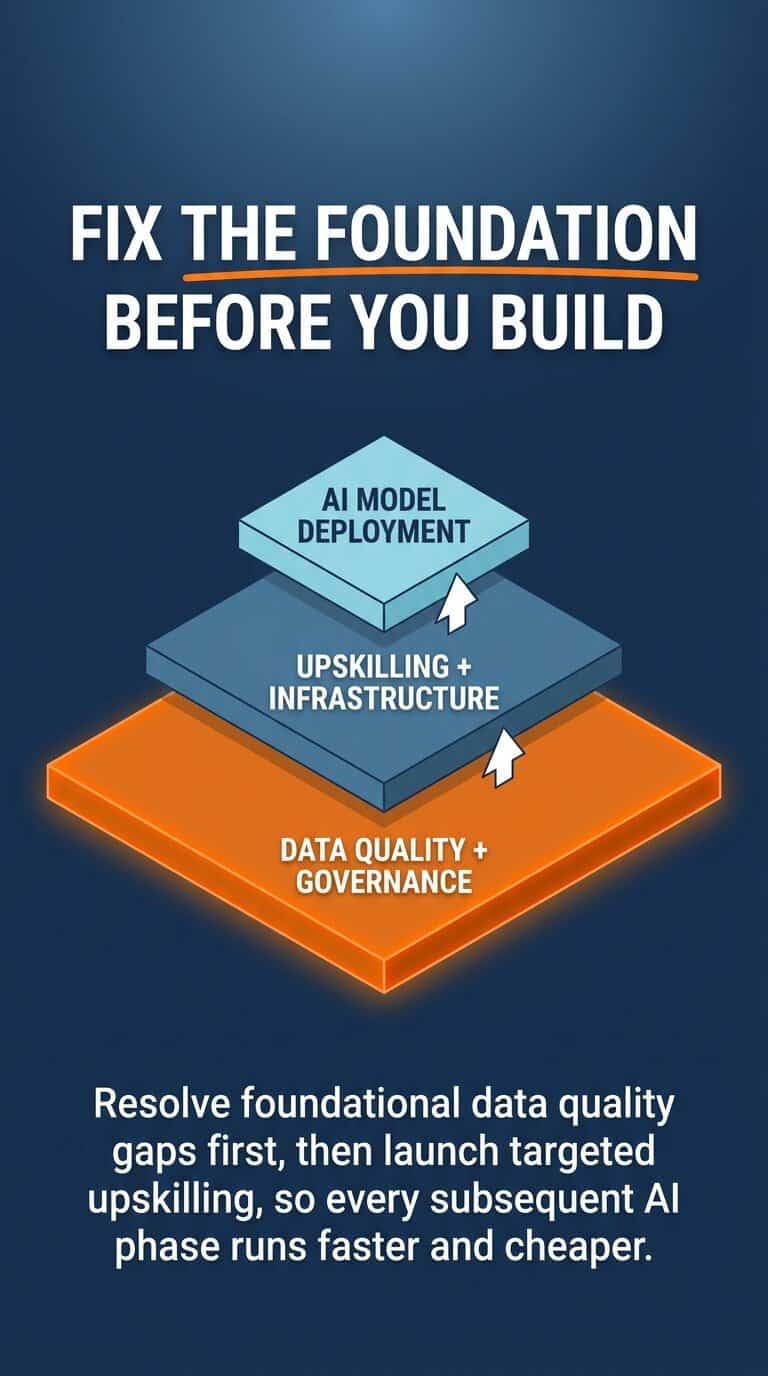
The sequence matters more than the speed. Organizations that try to run data remediation, infrastructure upgrades, and AI model development simultaneously typically make slow progress on all three. The more effective approach: resolve foundational gaps in waves, with each wave unlocking the next phase of AI integration.
Phase 1: Fix the foundation
Address the highest-impact data quality gaps first. Implement or formalize your data governance framework. Conduct a workforce skills assessment and launch targeted upskilling for the roles most directly involved in your priority AI use cases. This phase typically runs 60 to 90 days and produces no AI models, but it makes every subsequent phase faster and cheaper.
Phase 2: Build and validate
Select your highest-priority AI use case and build it properly, with governance controls, monitored outputs, and a defined success metric. Run it in a production environment, not a sandbox. Treat the outcome as your proof of concept for broader organizational readiness.
Phase 3: Scale with structure
Use the governance and operational frameworks built in phases one and two to expand AI integration to additional use cases. At this stage, you’re not starting over each time. You’re extending a working model. That’s where AI adoption starts generating compounding returns.
For a deeper look at how this sequencing applies to your specific industry context, explore our resources on enterprise AI strategy and how to align AI investments with business outcomes. If your data foundation is still the primary constraint, the data and analytics services we provide are designed specifically to get mid-market and enterprise organizations ready for what’s next.
Your Next Step Starts With an Honest Inventory
Most organizations overestimate their AI readiness at the strategy level and underestimate their gaps at the operational level. That’s a pattern and patterns are fixable when you can see them clearly.
An AI readiness assessment gives you that clarity. It tells you exactly where your data quality, infrastructure, AI governance, and workforce skills stand today, and it gives you a prioritized sequence for closing the gaps that matter most.
The organizations pulling ahead in AI adoption aren’t moving faster than everyone else. They’re moving with more structure, better data foundations, and a roadmap built on what they actually know about themselves.
If you’re ready to find out where your organization stands, start with our AI and machine learning consulting services. We’ll listen first, assess honestly, and build a roadmap that’s true to where you are and where you’re going. That’s the Smartbridge way.