
Responsible AI Governance for Enterprise Implementation
AI adoption moves faster when responsible AI governance is built in from the start. See how the right framework can help enterprise teams balance innovation, compliance, security, and responsible implementation.
In our first AI governance blog post, we covered at a high level what an AI governance framework looks like. Here, we’ll dive a little deeper and go into more detail on responsible AI governance for enterprise implementation.
To start, an AI governance framework is a structured system of policies, roles, processes, and controls that organizations use to develop, deploy, and monitor AI responsibly, ensuring systems remain transparent, accountable, fair, and subject to human oversight across their full lifecycle. Three leading frameworks that a majority of enterprises align with are the NIST AI Risk Management Framework, the EU AI Act, and ISO/IEC 42001, each approaching AI governance from a different angle but converging on the same core accountability principles.
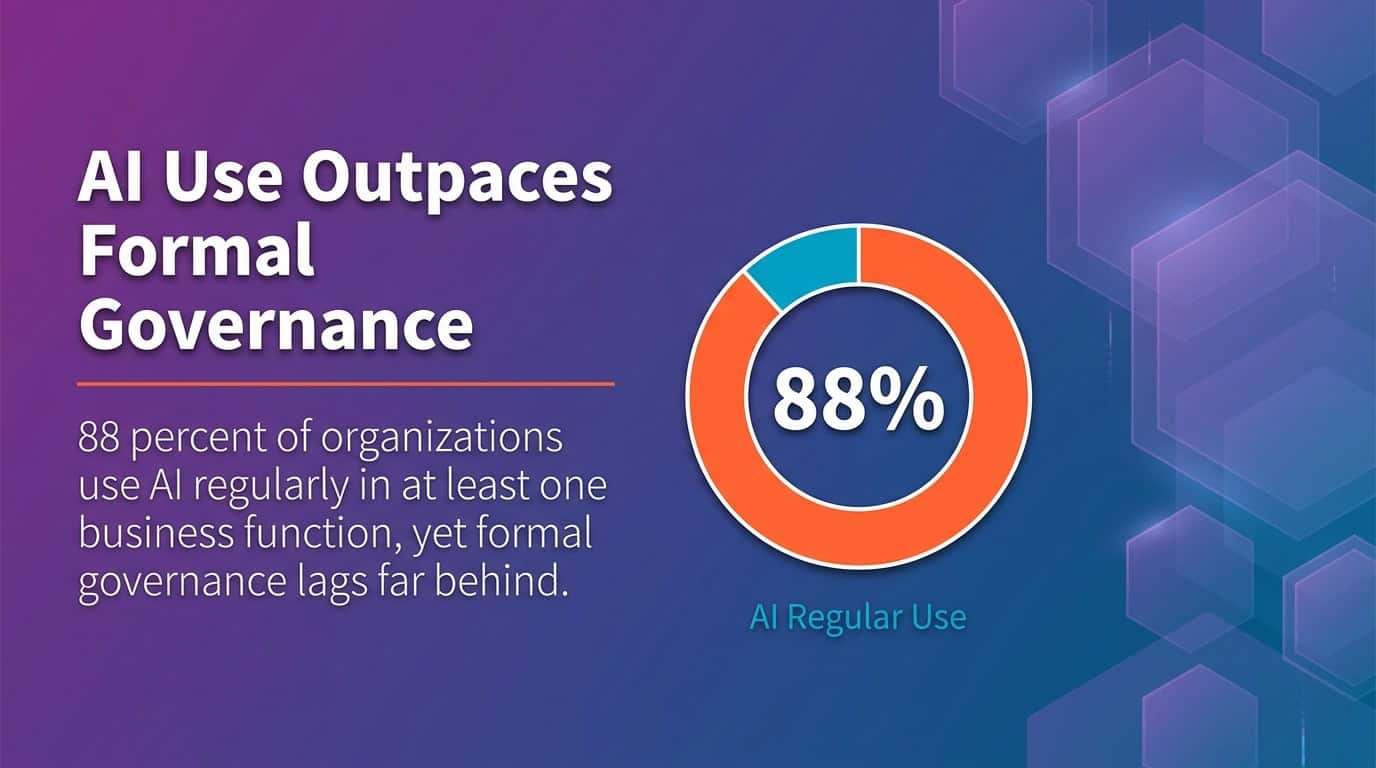
According to the Alice Labs Global AI Adoption Index, roughly one in five firms in the EU and OECD report using AI, yet 88 percent of organizations use AI regularly in at least one business function. That gap between broad usage and formal governance is where organizations accumulate risk.
As Smartbridge watched enterprises move from AI pilots to production deployments, we noticed a consistent pattern. The organizations that scaled AI successfully weren’t the ones with the most sophisticated models. They were the ones that built governance foundations first.
What Is an AI Governance Framework?
An AI governance framework is the complete set of organizational structures, standards, and controls that guide how AI systems are built, deployed, monitored, and retired within an enterprise, covering everything from data quality to regulatory compliance to incident response.
Most people conflate responsible AI governance with AI ethics. They’re related but not the same thing. AI ethics describes the values and principles an organization commits to, things like fairness, non-discrimination, and respect for human dignity. An AI governance framework is the operational mechanism that turns those commitments into enforced processes. Ethics tells you what you believe while governance determines whether you actually do it.
The distinction matters because good intentions without governance produce exactly the kind of patchwork outcomes we see repeatedly across industries: a responsible AI policy nobody reads, bias in a credit-scoring model that nobody caught, a generative AI tool deployed without a data privacy review. An AI governance framework closes that gap between stated values and operational reality.
A well-designed AI governance framework covers six core domains:
Each domain connects to the others. Weak data governance, for example, undermines model fairness regardless of how strong your risk classification process is.
Why Responsible AI Governance Matters for Enterprise Operations
AI governance matters for enterprise operations because ungoverned AI creates compounding risks across legal liability, reputational damage, operational failure, and regulatory penalties, any one of which can outweigh the efficiency gains that motivated AI adoption in the first place.
We’ve seen this played out before. A financial services firm deploys an automated underwriting model without adequate bias testing. A healthcare organization deploys a clinical decision support tool without clear human oversight protocols. A manufacturer uses generative AI to draft supplier contracts without a data provenance review. Each of these represents a governance failure, not a technology failure.
The regulatory environment makes governance non-negotiable. The EU AI Act, adopted in 2024, classifies AI systems into four risk tiers, with high-risk applications in healthcare, credit, employment, and critical infrastructure subject to mandatory conformity assessments, continuous monitoring, and comprehensive logging requirements. Organizations operating globally face a patchwork of overlapping requirements. In Canada, privacy laws remain the primary regulatory framework governing AI use. The 2025 US presidential executive order reflected concern about fragmented state-level AI regulation impeding consistent national policy.
For enterprise decision-makers, the business case for an AI governance framework goes beyond compliance. Governance creates the operational discipline that lets organizations move from experimenting with AI to depending on it at scale. Without it, every AI deployment carries hidden risk that eventually surfaces at the worst possible time.
Core Principles of an Effective AI Governance Framework
An effective AI governance framework rests on five cross-cutting principles that appear across every major international standard and regulatory regime:
Transparency and Explainability
Transparency in AI governance means that stakeholders can understand how an AI system reaches its outputs. Explainable AI governance includes frameworks and oversight processes specifically designed to make AI decision pathways visible and auditable.
Practically, transparency requires model documentation. Model cards should include purpose, usage, performance metrics, data provenance, and known risks, giving any reviewer a clear picture of what the system does and where it might fail. This is the mechanism that makes accountability possible.
Accountability and Human Oversight
Accountability in an AI governance framework means every AI system has a named owner responsible for its performance, its risks, and its outcomes. Ontario’s responsible AI principles, for example, explicitly call for assigning clear responsibility for AI oversight as a baseline requirement.
Human oversight is the practical expression of accountability. It means humans remain in the loop at critical decision points, especially in high-risk applications. This doesn’t necessarily mean that a human is required to approve every AI output, but it does mean that there are clear protocols defining when human review is mandatory, who conducts it, and what escalation paths exist when the system behaves unexpectedly.
Fairness and Bias Management
Fairness in AI governance means the system performs consistently across demographic groups and doesn’t encode or amplify bias present in training data. Bias detection requires ongoing monitoring because model performance on fairness metrics can degrade as population distributions, data inputs, and usage patterns shift over time.
Effective bias management includes pre-deployment fairness testing across protected attributes, clear thresholds for acceptable disparity, and defined remediation processes when those thresholds are breached. Without those operational structures, fairness remains a principle rather than a practice.
Key Components of an AI Governance Framework
A complete AI governance framework contains eight operational components that work together to manage risk across the AI lifecycle, from initial use-case evaluation through deployment, monitoring, and eventual decommissioning.
Most organizations we’ve watched struggle with AI governance have one or two components in place and nothing connecting them. That’s the patchwork problem where individual policies without a system produce gaps, and gaps are where risk accumulates.
Risk Classification and Assessment
Risk classification assigns every AI use case a risk tier before development begins, determining the level of scrutiny, documentation, and oversight required. A four-tier model of unacceptable risk, high risk, limited risk, minimal risk provides a useful starting template for enterprises building their own classification schema.
Practically, your risk classification process should evaluate four dimensions for each use case:
A model that flags fraud for human review carries different risk than one that automatically denies a loan application.
Data Governance Integration
Data governance is the foundation that AI governance sits on. Models inherit the quality, completeness, and bias of their training data, which means weak data governance directly undermines every other component of your AI governance framework. We’ve all heard the phrase before: garbage in garbage out.
For AI systems specifically, data governance must address:
Building a unified data governance framework is the prerequisite, not the parallel track, to scaling AI safely.
Model Governance and Documentation
Model governance covers the full lifecycle of an AI model from development through retirement. It includes version control, performance benchmarking, bias testing, documentation standards, and change management processes for model updates.
The model card is the central artifact of model governance. A complete model card documents purpose, intended users, performance metrics by demographic subgroup, known limitations, data provenance, and acceptable use boundaries. Without it, there’s no consistent basis for audit or accountability.
Monitoring, Auditing, and Continuous Improvement
Production AI systems will degrade over time because input distributions shift, user behavior changes, and model performance on key metrics drifts in ways that aren’t visible without active monitoring.
An effective monitoring program defines specific performance thresholds, automated alerts when those thresholds are breached, regular scheduled audits at defined intervals, and a clear incident response process when a model fails in production. Monitoring without defined response protocols is basically theater.
Policy, Incident Response, and Continuous Improvement
Governance policies set the rules while incident response makes them operational. Every AI governance framework needs a defined process for identifying, classifying, containing, and learning from AI-related incidents, whether that’s a model producing discriminatory outputs, a data breach affecting training data, or a generative AI tool producing misleading content at scale.
Continuous improvement closes the loop. Incidents and audit findings feed back into risk classification criteria, documentation standards, and training programs, making the governance framework stronger over time rather than static.
How to Implement an AI Governance Framework
Implementing an AI governance framework requires a structured sequence, starting with inventory and risk assessment, building accountability structures, establishing data and model governance processes, aligning with applicable regulatory frameworks, and then operationalizing monitoring before scaling.
Organizations that skip the inventory step and jump straight to policy writing end up with governance that doesn’t map to their actual AI portfolio. Again, that’s a patchwork where itt looks like governance but doesn’t function as one.
Phase 1: Inventory and Risk Assessment
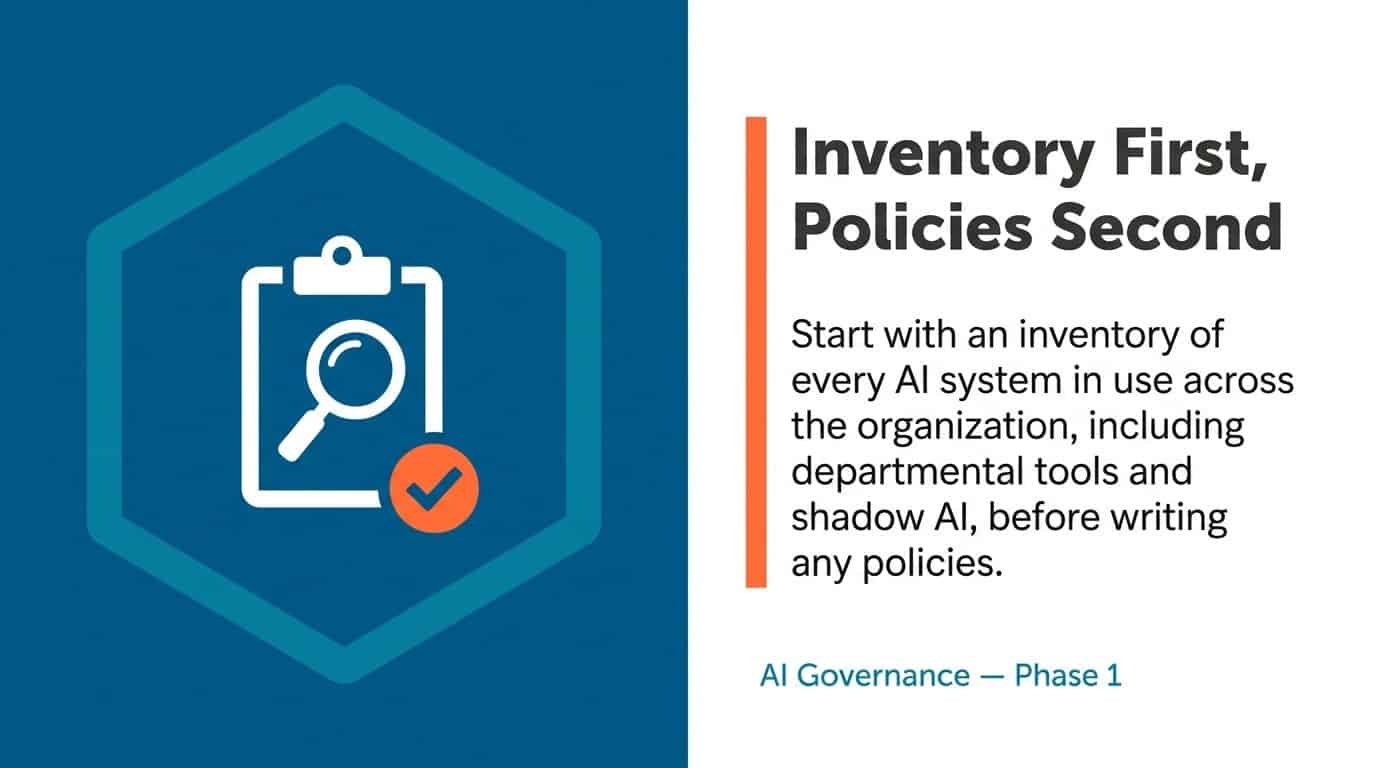
Start by building a complete inventory of AI systems currently in use or under development across the enterprise, including shadow AI and departmental tools adopted without IT involvement. For each system, apply a risk classification using your chosen framework’s criteria, whether that’s the four tiers we listed earlier or your own internal schema.
The inventory is the foundation of everything that follows. Without it, accountability structures, monitoring programs, and compliance mappings have nothing concrete to attach to. Most large organizations discover AI deployments they didn’t know existed during this phase which is a governance gap and finding it early is the point.
Phase 2: Establish Accountability Structures
Assign a named AI owner for every system in the inventory, responsible for its performance, risks, and regulatory compliance. Stand up an AI governance committee or ethics board with cross-functional membership drawn from legal, compliance, IT, data science, operations, and other relevant business units.
A RACI matrix for AI governance decisions provides the operational clarity that committees alone don’t. It defines who is Responsible for each governance activity, who is Accountable for outcomes, who needs to be Consulted before decisions, and who should be Informed of results. Without a RACI, governance committees tend to discuss risks without anyone actually owning the response.
For agentic AI deployments, accountability structures require particular attention. When an AI agent takes autonomous actions across multiple systems, the chain of human oversight must be explicit and enforced at the design stage, not added after deployment.
Phase 3: Build Data and Model Governance Processes
Establish data governance standards that specifically address AI training data requirements: lineage documentation, bias assessment, privacy compliance, and access controls. Then build model governance processes covering development standards, documentation requirements (model cards for every production system), testing protocols including bias and fairness testing, version control, and a change management process for model updates.
These two governance streams must connect. A data governance decision, say, to exclude a data source from training, must trigger a model governance review. Siloed data and model governance produce inconsistent outcomes and audit failures.
Phase 4: Regulatory Compliance Alignment
Map your AI inventory against applicable regulatory requirements based on your geography, industry, and use case. High-risk AI systems may simultaneously face EU AI Act obligations, GDPR data processing requirements, sector-specific rules (FDA, financial regulators), and emerging state-level AI laws. Regulatory compliance is a continuous process as requirements change and your AI portfolio grows.
Phase 5: Operationalize Monitoring and Continuous Improvement
Define performance metrics and fairness thresholds for each production AI system, implement automated monitoring with alerts for threshold breaches, schedule periodic audits at defined intervals, and establish an incident response process. Feed audit findings and incident postmortems back into your risk classification criteria and governance policies. The AI governance framework that improves over time is the one that actually moved the needle.
AI Governance by Industry: Energy, MedTech, and Restaurant Operations
AI governance looks different across industries because AI risk looks different across industries. The same core principles still apply, but the controls need to match the operational environment.
For energy and oil and gas companies, AI governance is closely tied to asset reliability, worker safety, environmental compliance, and financial performance. Many AI use cases in this space influence decisions in the field, where inaccurate recommendations can affect production, maintenance planning, regulatory reporting, or safety exposure. Governance helps define who owns each model, how operational data is validated, when human review is required, and how performance is monitored after deployment.
For life sciences and medtech organizations, AI governance must account for higher expectations around quality, traceability, and regulatory oversight. AI may support internal operations, regulated workflows, or decisions that eventually affect patients. Strong governance creates the documentation and auditability needed to use AI responsibly in environments where trust and accountability are non-negotiable. It also helps define when validation is required, who can access sensitive data, and how AI-supported outputs should be reviewed before they influence compliance or product decisions.
For restaurant, QSR, and food service organizations, AI governance often focuses on consistency, scalability, and decision support across locations. Forecasting tools, labor planning models, customer insights, and operational reporting can all shape how teams manage stores and serve guests. Governance helps prevent overreliance on inaccurate outputs, keeps data use within approved boundaries, and ensures human operators stay involved when AI recommendations could affect staffing, inventory, or the guest experience.
The goal is the same across all three industries which is to match governance intensity to business risk. Low-risk productivity tools may only need basic usage policies and data handling rules. AI systems that influence safety, compliance, financial outcomes, workforce decisions, or customer-facing operations need stronger oversight. A practical AI governance framework should be flexible enough to support innovation, but disciplined enough to keep AI accountable where mistakes matter most.
Roles and Responsibilities in AI Governance
Effective AI governance requires defined roles across four organizational layers: executive leadership, a dedicated AI governance committee, technical AI owners and data scientists, and operational business units who deploy and use AI systems in practice.
The most common governance failure we see is missing ownership. A responsible AI policy that nobody is accountable for enforcing is just decoration.
Executive Leadership and the AI Governance Committee
At the executive level, a Chief AI Officer or equivalent role is responsible for enterprise AI strategy, governance framework design, and regulatory compliance at the organizational level. In organizations without a dedicated CAIO role, this accountability typically falls to the CTO or CIO, though the workload and expertise requirements increasingly justify a dedicated function.
The AI governance committee or AI ethics board provides cross-functional oversight of the governance framework itself, reviews high-risk AI deployments, adjudicates escalated governance decisions, and reports to the board on AI risk. Membership should include legal, compliance, IT, data science, HR, and representatives from major business units using AI.
Technical Roles: AI Owners and Data Scientists
Each AI system needs a named technical owner responsible for model documentation, performance monitoring, bias testing, and incident response for that specific system. Data scientists responsible for model development operate within governance standards set by the committee but carry day-to-day accountability for technical quality.
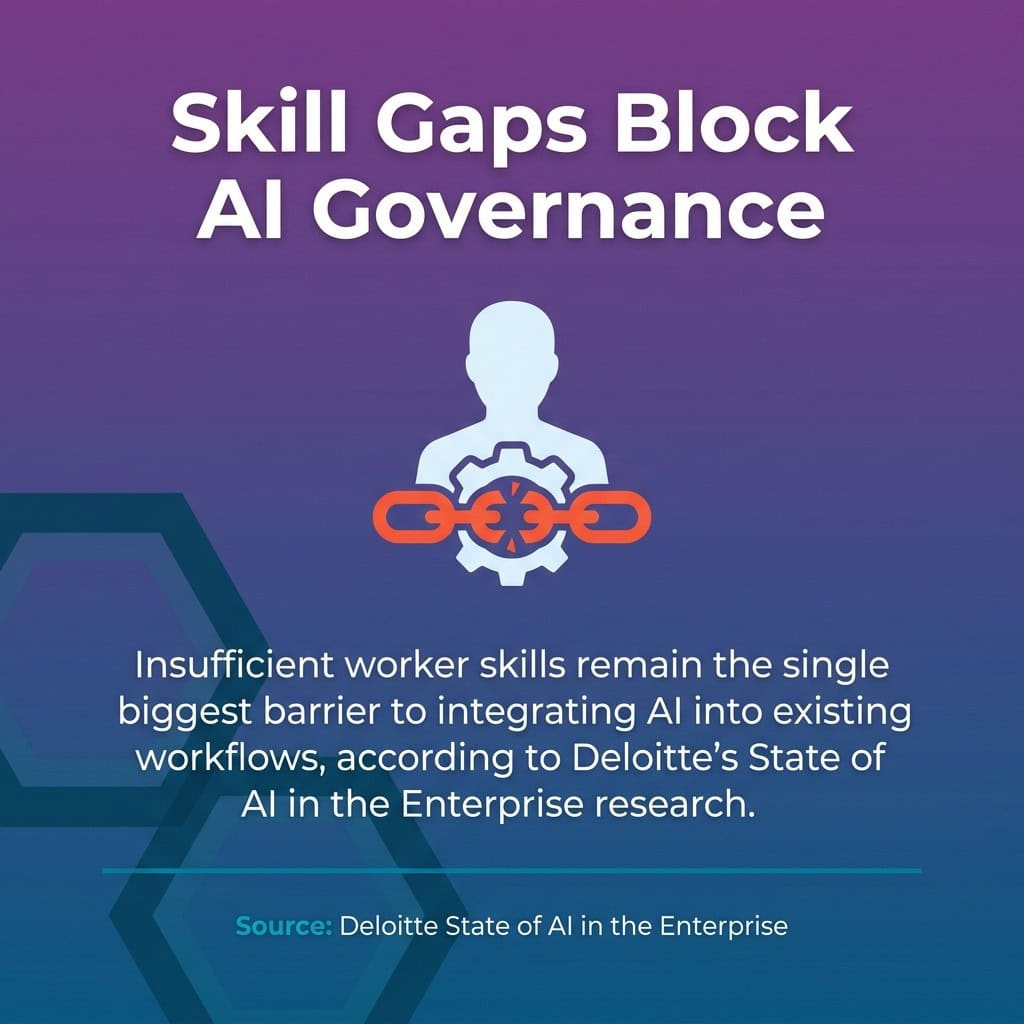
Insufficient worker skills remain the single biggest barrier to integrating AI into existing workflows. Organizations frequently lack the technical skills to implement bias testing, model monitoring, and documentation standards at the level their governance frameworks require.
Business Units and Operational Users
Business units that deploy or use AI systems carry compliance responsibilities under the governance framework: following approved use policies, reporting anomalous system behavior, completing required training, and participating in governance reviews for new AI use cases. Human oversight at the operational level, meaning users who understand when to trust AI outputs and when to escalate, is the last line of defense in a responsible AI program.
AI Governance Challenges and How to Address Them
The four most common AI governance challenges that enterprise organizations encounter are skill gaps in governance implementation, the pace of AI adoption outrunning governance maturity, fragmented regulatory requirements across jurisdictions, and the specific risks posed by generative AI and agentic systems.
None of these are unsolvable, but they require honest assessment rather than governance theater.
Skill Gaps and Organizational Readiness
Governance frameworks require people who can execute them. Bias testing, model auditing, data lineage documentation, and regulatory compliance mapping are specialized skills. Many organizations have governance policies but lack the internal capability to operationalize them consistently.
You can address this directly by auditing your current team’s capabilities against your governance framework’s operational requirements, identify the gaps, and then build a training roadmap that closes them. For capabilities that can’t be built internally at the required pace, specialist partnerships fill the gap without compromising governance integrity.
Generative AI and Agentic AI Governance
Generative AI models and agentic AI systems present governance challenges that traditional model governance frameworks weren’t designed to handle. Generative models can hallucinate, produce biased outputs at scale, expose training data through adversarial prompts, and generate content that violates regulatory requirements. Agentic AI systems can take sequences of autonomous actions across enterprise systems with minimal human review at each step.
For enterprise AI-first deployments, governance frameworks need specific extensions for generative and agentic use cases: output monitoring and filtering, defined human review triggers for high-stakes agent actions, clear data handling policies for prompts and outputs, and adversarial testing protocols. The standard model card format doesn’t fully capture these risks, so supplementary governance documentation is needed for each generative or agentic deployment.
Regulatory Fragmentation
Global enterprises face AI regulatory requirements across multiple jurisdictions simultaneously. The EU AI Act, US federal and state requirements, Canada’s privacy-law-based AI framework, and sector-specific rules in healthcare and financial services create a complex compliance matrix that a single AI governance framework must address.
The practical solution is a tiered governance approach. Build your internal AI governance framework to the most stringent applicable standard and use that as the baseline. Regulatory compliance requirements in less stringent jurisdictions then become a subset of what your framework already requires, reducing duplication and governance overhead.
Building Responsible AI Governance For the Enterprise That Actually Works
The organizations that get AI governance right treat it the same way they treat data governance or information security: as a business-critical operational function, not a compliance checkbox. That shift in framing changes everything about how the work gets done.
What we’ve noticed across enterprise AI deployments is that governance maturity and AI ROI move together. Organizations with mature AI governance frameworks deploy more use cases at production scale because they’ve built the trust, the accountability structures, and the operational discipline that responsible AI requires.
The AI governance framework you build today is the foundation that lets your organization move confidently from pilots to production at scale. If you’re ready to chart your path to AI governance maturity, speak to a Smartbridge expert about building a governance roadmap designed for your specific AI portfolio and regulatory context.