

Regulatory Harmonization in MedTech: How Much Can You Really Reuse Across Markets?
Regulatory harmonization helps medtech companies reuse more of their regulatory foundation across markets, while still accounting for local requirements, product changes, and lifecycle obligations.
In this article:
Harmonized Does Not Mean Identical
Build a Global Regulatory Core
Know What Has to Stay Local
Every Product Change Needs a Global Impact Check
AI and Software Make This Even More Important
What This Looks Like Across Our Three MedTech Segments
A Regulatory Harmonization Readiness Check
Harmonization Is About Reuse, Not Uniformity
Iam a big supporter of regulatory harmonization.
If a medical device manufacturer has already done the work to prove that a product is safe, effective, secure, and well controlled, it makes sense to reuse as much of that work as possible when entering another market.
But I would be careful with the word “harmonized” – it does not mean identical.
Different markets can still have different requirements for submissions, evidence, labeling, post-market reporting, privacy, cybersecurity, and how product changes are handled.
So the goal should not be to create one regulatory package and assume it will work everywhere.
The better goal is to build a strong global foundation that can be reused, then understand exactly where each market requires something different.
For life sciences companies operating across multiple countries, that can save a lot of duplicated work. It can also make regulatory teams much more consistent when the product changes later.
And medtech products are changing more frequently. Software gets updated. AI models evolve. Connected devices add functionality. Cybersecurity requirements change. Products move into new markets and sometimes into entirely new use cases.
Every one of those changes can create another regulatory question somewhere.
That is why I think regulatory harmonization is really a data, process, and content-management challenge as much as it is a regulatory one.
The more reusable your foundation is, the less you have to start over every time the product or market changes.

Harmonized Does Not Mean Identical
I think the work organizations like the International Medical Device Regulators Forum (IMDRF) are doing is a big step forward. Common principles, shared terminology, and more consistent regulatory expectations can save medical device manufacturers a lot of duplicated effort.
But individual regulators still make their own decisions about how to adopt those principles. Some adopt IMDRF documents directly, while others adapt them to fit their own regulatory requirements.
For a life sciences company preparing to enter multiple markets, there are several areas where local requirements still need attention:
- 1
Device classification and approval pathways: The same product may follow different regulatory pathways depending on the market.
- 2
Clinical evidence: Understand what evidence each authority expects and how much of your existing documentation you can reuse.
- 3
Labeling and documentation: Language, labeling, and market-specific information requirements can create additional work.
- 4
Post-market surveillance: Reporting requirements and procedures may differ across jurisdictions.
- 5
Software and cybersecurity: Determine how each market handles software changes, cybersecurity documentation, and ongoing product updates.
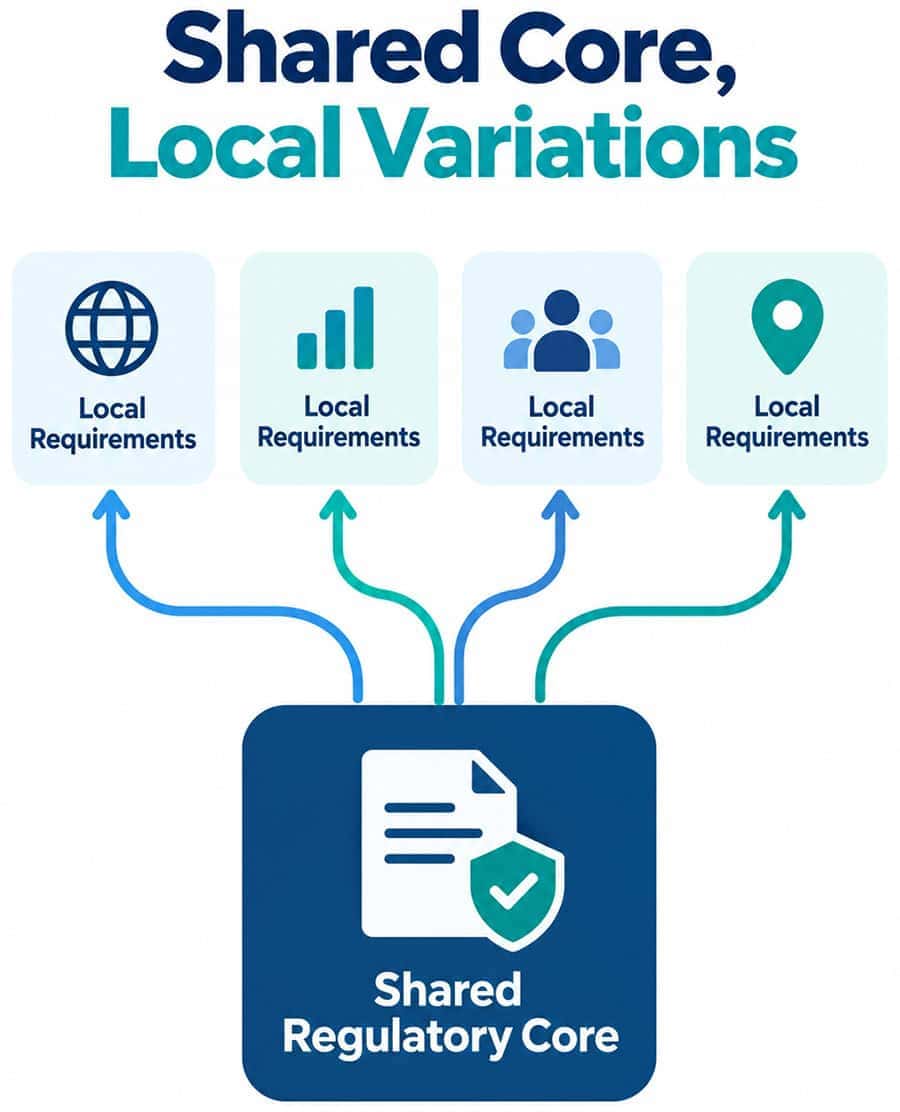
Harmonization doesn’t guarantee identical requirements
IMDRF develops common regulatory documents, but participating authorities may adopt or adapt them to satisfy their own jurisdiction’s requirements.
The FDA acknowledges that medical device regulations and safety standards continue to vary by country, despite ongoing international harmonization efforts.
I’d rather see regulatory teams identify those differences early than discover them when the company is already preparing for launch.
That means understanding which requirements are genuinely shared, where local variations exist, and what additional evidence or documentation each market needs.
It also gives technology teams a clearer idea of what they need to build. If regulatory information is scattered across spreadsheets, disconnected document repositories, and individual market teams, reusing it becomes unnecessarily difficult.
Build a Global Regulatory Core
If you know some requirements will vary by market, the next question is obvious: what can you standardize?
I would start with the pieces that should be consistent no matter where the product is sold.
That usually includes:
- 1
Core product information
Intended use, product description, architecture, specifications, and key technical documentation. - 2
Safety and performance evidence
Risk management, verification and validation, clinical evidence, and documentation showing the device performs as intended. - 3
Quality and lifecycle records
Change history, software versions, CAPA, complaints, post-market information, and cybersecurity documentation. - 4
Reusable submission content
Sections that can serve as the foundation for multiple markets, with local requirements layered on top. - 5
Traceability
A clear way to connect requirements, evidence, product changes, and the markets affected by those changes.
IMDRF’s Essential Principles are a good example of the kind of common foundation regulators are trying to create. Its 2024 guidance lays out shared safety and performance principles for medical devices and IVDs that can support more consistent regulatory frameworks.
For life sciences companies, the real value is not just having reusable documents. It is knowing which information is current, where it came from, which version was submitted, and where else a change needs to be reflected.
IMDRF’s Essential Principles were updated in 2024 to provide a common set of safety and performance expectations for medical devices and IVDs.
That is where regulatory teams can lose a lot of time. If product evidence is scattered across document repositories, spreadsheets, email, and separate regional processes, every submission starts to feel more custom than it should.
A stronger global regulatory core gives medtech companies something stable to build from.
You still handle the local differences, but you stop rebuilding the common pieces from scratch.
Know What Has to Stay Local
A strong global regulatory core can save a lot of time, but some parts of the process are always going to stay local.
That is not a failure of harmonization. It is just the reality of selling medical devices across different regulatory systems.
I would separate the reusable work from the market-specific work as early as possible.
The local pieces may include:
- 1
Submission format and pathway
The same product can move through different approval or clearance routes depending on the country. - 2
Labeling and language
Local language, symbols, instructions for use, and labeling rules may vary. - 3
Clinical or performance expectations
A regulator may ask for additional evidence based on the product, patient population, or intended use. - 4
Post-market reporting
Timelines, terminology, and reporting processes can differ by jurisdiction. - 5
Privacy and data requirements
Connected devices and software products may face different expectations around where data is stored, how it moves, and who can access it.
For life sciences companies, the mistake is assuming that a harmonized principle means the local implementation will look the same everywhere.
It usually does not. The better approach is to make the differences visible and manageable.
If your team knows exactly what changes by market, you can reuse the common foundation without accidentally carrying one country’s assumptions into another.
That becomes even more important when the product itself changes. A software update, cybersecurity fix, new indication, or AI feature may be minor in one market and trigger additional review in another.
The global core gives you consistency. The local layer keeps you compliant.

Every Product Change Needs a Global Impact Check
This is where regulatory harmonization gets very practical.
A product change that looks small to engineering can create a much bigger regulatory question once the device is sold in multiple markets.
That could be:
- 1
A software update
- 2
A new cybersecurity control
- 3
A change in intended use
- 4
A new AI feature or model update
- 5
A component or supplier change
- 6
A labeling or workflow change
The same change may not be treated the same way everywhere.
One market may allow the change under an existing process. Another may require additional documentation, notification, or review.
For medical device manufacturers, that makes change control a global regulatory issue, not just an internal quality process.
I would want teams to answer a few questions every time a meaningful product change is proposed:
The last question can create a lot of operational complexity, because if one market can accept the change quickly and another cannot, you may end up supporting multiple product versions at once.
This is especially common with software-driven medtech products, where updates happen much more frequently than they did with traditional hardware.
A good global regulatory process should make those impacts visible early, before the company is already committed to a release date.
That is the real benefit of harmonization at the operating level: not eliminating every difference, but making the differences easier to manage.

AI and Software Make This Even More Important
Software already made global regulatory management harder. Then here comes AI, raising the stakes again.
A traditional hardware change might happen occasionally. Software can change much more often, and AI-enabled medical devices may need ongoing monitoring, model updates, new data, performance checks, or planned modifications after launch.
That creates a bigger question for medical device manufacturers: how do you make changes globally without turning every update into a different regulatory project in every market?
This is one area where harmonization could make a real difference.
IMDRF published 10 Good Machine Learning Practice principles in January 2025 to support a more consistent international approach to AI/ML-enabled medical devices. It is also developing a technical framework for AI lifecycle management, with a 2026 consultation focused on creating a harmonized approach to the development, deployment, maintenance, and use of AI-enabled medical device software.
FDA is moving in the same lifecycle direction. Its guidance for AI-enabled device software emphasizes planning for modifications, monitoring performance, and managing risk across the total product lifecycle rather than treating approval as the finish line.
For life sciences companies building SaMD or agentic medical-device capabilities, I would focus on a few things:
- 1
Know what can change
Model behavior, data inputs, thresholds, workflows, or supporting software. - 2
Plan changes before they happen
FDA’s Predetermined Change Control Plan approach is specifically designed to help manufacturers define certain planned AI-enabled device modifications in advance. - 3
Track performance after release
AI-enabled devices may need ongoing monitoring to make sure performance remains safe and effective in real-world use. - 4
Understand the market impact
A planned change that fits one regulator’s framework may still need a different treatment somewhere else.
IMDRF’s 2025 Good Machine Learning Practice document sets out 10 guiding principles for AI/ML medical device development across the total product lifecycle.
This is why I would not separate AI governance from regulatory strategy.
If the product is expected to evolve after launch, the regulatory model has to be able to evolve with it.
What This Looks Like Across Our Three MedTech Segments
Regulatory harmonization is not going to affect every medtech category the same way.
For Agentic and Software as a Medical Device,, the pressure is highest around change. Software can evolve quickly, and AI-enabled products may need ongoing updates, monitoring, and model governance. Medical device manufacturers need to know which changes can be handled within an existing framework and which ones trigger new regulatory work in each market.
For smart implants and wearables, the regulatory picture gets broader. You are not only dealing with the device itself, but also connectivity, patient data, mobile applications, remote monitoring, cybersecurity, and post-market surveillance. Different markets may align on the core safety principles while still treating data, reporting, or software updates differently.
For surgical equipment, the challenge is often the combination of hardware, software, accessories, service, and hospital integration. A product update may affect more than one component, and a change that looks small in engineering can create different documentation or approval requirements across regions.
I would keep the same questions in front of all three groups:
- 1What parts of the regulatory package can we reuse?
- 2What has to be localized?
- 3Which product changes have different impacts by market?
- 4Can we trace those differences back to one controlled source of truth?
- 5Can we support more than one product version if approvals do not move at the same speed?
In regards to the last question, if one market accepts a software update and another does not, the company may have to support multiple versions, different documentation, and different customer expectations at the same time.
The more complex the product becomes, the more valuable a reusable global regulatory foundation becomes. It makes the local work easier to see, plan, and manage.
A Regulatory Harmonization Readiness Check
Before a medtech company tries to scale one regulatory approach across multiple markets, I would check five things.

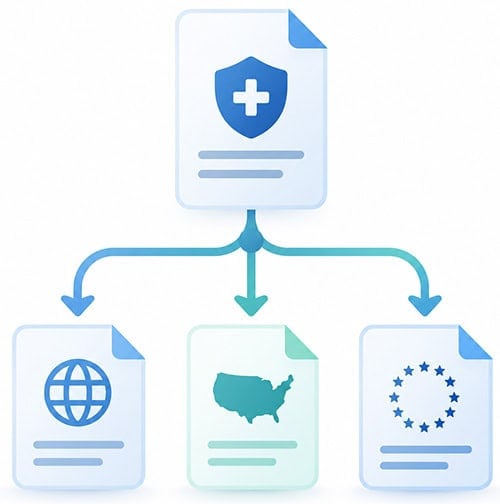

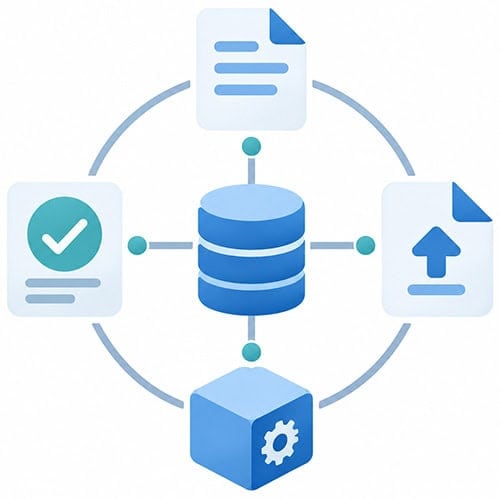
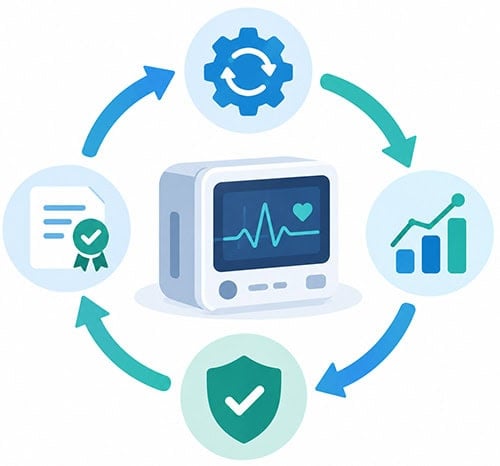
If those five areas are in good shape, harmonization becomes much more useful in practice.
You still have local regulatory work to do. The difference is that you are starting from a controlled foundation instead of rebuilding the process for every market.
For life sciences companies managing increasingly software-driven medical devices, that can save a lot of time and make global change management much easier.
Harmonization Is About Reuse, Not Uniformity
I don’t think regulatory harmonization is about getting every country to follow the exact same process – the real opportunity is reuse.
Build a strong regulatory core once. Know which evidence, documentation, and controls can travel with the product. Then make the local differences clear enough that teams can manage them without starting over every time.
For medtech and life sciences companies, that becomes even more valuable as products get more connected, more software-driven, and easier to update after launch.
The companies that handle global growth well will know three things:
- What stays consistent
- What changes by market
- What happens everywhere else when the product changes
That gives regulatory teams more control without slowing down the business every time the company enters a new market or releases a new version.
Six Trends, One Bigger Shift
This article closes out my six-part look at some of the forces reshaping medtech:
- Strategic Portfolio Management
- Commercial Velocity
- Hospital at Home
- Outcome-Based Pricing
- Cybersecurity by Design
- Regulatory Harmonization
They may look like separate trends, but they keep leading back to the same issue.
Medical devices are becoming more connected to data, software, patients, providers, commercial systems, and regulatory processes. That makes it harder to treat any one part of the business in isolation.
The product may start in engineering, but what happens next depends on how well the rest of the organization is ready to support it.
That is where I think a lot of the next phase of medtech growth will be won or lost.