

Hospital at Home Is Redefining What a Medical Device Must Do
What It Means for MedTech Product Design and Delivery
As care moves into the home, medtech companies have to design for a less controlled environment, more patient responsibility, greater connectivity, and a much tighter link between the device, data, support, and clinical workflow.
In this article:
The Home Is Becoming a Clinical Environment
Designing for Patients, Not Just Clinicians
Connectivity Becomes Part of the Product
Remote Monitoring Only Works if Someone Can Act on the Data
Support and Service Have to Follow the Device Home
What This Means Across Our Three MedTech Segments
A Practical Home-Readiness Framework
Hospital at Home Changes More Than the Location of Care
A medical device in a hospital has a lot going for it. Trained clinicians use it. The network is managed. Support is nearby. If something goes wrong, there are people and processes around the device to respond.
Put that same technology in someone’s home and the situation gets very different.
The patient or caregiver may be responsible for setup. Connectivity may depend on home Wi-Fi or a mobile network. Data has to reach the right clinical team. Someone needs to know when an alert matters. And when something stops working, the patient cannot walk down the hall and find biomedical engineering.
I think this is one of the biggest implications of Hospital at Home for medtech companies: the device is only part of the product.
For companies building Agentic and Software as a Medical Device, smart implants and wearables, or equipment that supports care outside the hospital, product planning now has to account for connectivity, patient usability, remote support, data integration, cybersecurity, and clinical response.
Hospital at Home is not simply moving care to a different location. It is putting more responsibility on the technology to work reliably with fewer safety nets around it.
The Home Is Becoming a Clinical Environment
When a medical device leaves the hospital, it does not leave the care process. In a hospital, the environment is built around the technology. At home, the technology has to work around the environment.
The device may need to function with inconsistent connectivity, limited technical support, different levels of patient comfort with technology, and caregivers who may be helping without formal training. It may also need to fit into routines that look nothing like a clinical workflow.
For a home-based device, reliability is not only about whether the hardware works. It also includes whether the patient can set it up correctly, whether data transmits when it should, whether alerts reach the right person, and whether someone can resolve an issue without requiring the patient to return to the hospital.
This is where I think medtech companies need to be careful about treating home use as a simple extension of hospital use. It is a different operating environment with different risks.
The best home-based products reduce the amount of effort required from the patient and make the clinical workflow behind the device easier to manage.
That means thinking beyond the device itself and asking:
These are product questions, but they are also service, data, support, and workflow questions.
The home is becoming part of the care environment. Medtech companies need to design for it that way.
Designing for Patients, Not Just Clinicians
A device can be clinically strong and still be hard to use at home.
Patients and caregivers do not approach medical technology the way trained clinicians do. They may be dealing with pain, fatigue, stress, limited mobility, poor vision, or simply a lack of confidence with the device. And the product has to account for that.
For smart implants and wearables, this can mean simpler pairing, clearer notifications, fewer unnecessary alerts, and a more intuitive mobile experience. For SaMD and agentic tools, it means making outputs understandable and giving users clear next steps instead of presenting more data than they know what to do with.
I also think medtech teams need to be careful about assuming that more functionality creates more value.
At home, complexity can become friction very quickly.
A feature that looks useful in a product roadmap may create another setup step, another login, another alert, or another opportunity for the patient to get stuck. The best experience may be the one that asks less of the user.

A few practical questions can help expose those issues early:
For medtech companies, this means usability cannot sit at the end of product development.
It has to be designed into the product, the software, the onboarding, the support model, and the patient experience from the beginning.
The closer care moves to the home, the more the patient becomes part of the operating model.
Connectivity Becomes Part of the Product
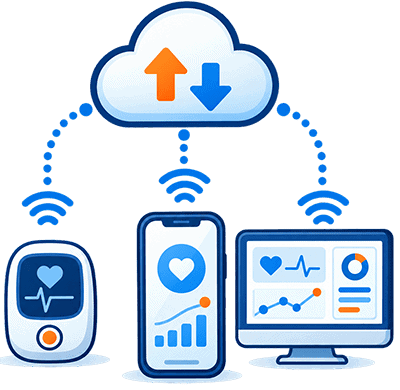
Once a device depends on data moving between the patient, the cloud, and the care team, connectivity stops being an IT detail and becomes part of the product experience.
For home-based care, that connection may depend on Wi-Fi, cellular service, Bluetooth, a mobile app, or some combination of all four. Any break in that chain can affect what the patient sees, what the clinician receives, and whether the device can do what it was designed to do.
This is especially relevant for smart implants and wearables.
If the device is collecting patient data continuously, the company needs to think through what happens when transmission is delayed, interrupted, or incomplete. Does the device store the data locally? Does the patient receive a warning? Can the care team tell the difference between “no issue” and “no data”?
Agentic and SaMD products have similar dependencies. Their value may rely on access to current patient data, integration with provider systems, or the ability to surface recommendations at the right point in the workflow. If the data arrives late or out of context, the software may still function technically while becoming less useful clinically.
This is why connectivity planning should include more than uptime.
Medtech teams should ask:
For home-based care, a disconnected device is rarely just a technical inconvenience. It can create uncertainty for the patient and blind spots for the care team.
The product architecture has to assume that connectivity will fail sometimes and still provide a safe, understandable experience when it does.
Remote Monitoring Only Works if Someone Can Act on the Data
Remote monitoring sounds simple until the data starts flowing.
A device collects information.
The data reaches a platform.
An alert is generated.
Then what?
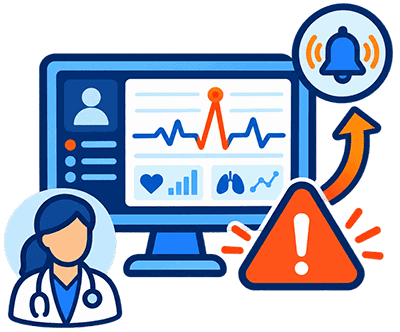
This is where a lot of home-based care models get complicated. The value does not come from collecting more data. It comes from knowing which data needs attention, who should respond, and what happens next.
For smart implants and wearables, that may mean identifying a meaningful change in patient status without overwhelming clinicians with false alarms or low-value notifications.
For Agentic and SaMD products, the challenge can be even more nuanced. The system may summarize trends, prioritize cases, or recommend an action, but the care team still needs clear context and a defined way to review, accept, or override that recommendation.
I think the biggest risk is building a great monitoring capability without designing the response workflow around it.
Medtech teams should be asking:
This is also where AI can be useful without trying to replace clinical judgment.
An agent may help prioritize alerts, summarize patient history, identify patterns, or route cases to the right team. But the workflow still needs clear human ownership.
A home-monitoring product should not stop at “we can see the data.”
The stronger question is: can the care team act on it quickly, consistently, and with confidence?
Support and Service Have to Follow the Device Home
When a device moves into the home, support becomes part of the product experience.
Patients cannot be expected to troubleshoot connectivity, software, accessories, charging, or setup issues on their own. And providers do not want every technical problem turning into a clinical escalation.
The support model has to be designed with the product.
For smart implants and wearables, that can include remote diagnostics, replacement workflows, app support, connectivity troubleshooting, and clear escalation paths. For SaMD and agentic tools, support may also involve user access, data synchronization, integration issues, and software updates.
The strongest models make common problems easier to resolve remotely.
That may mean:
This is also where service teams need better data. If support can see the device, software version, connectivity history, previous issues, and customer context in one place, they can resolve problems faster and avoid asking the patient to repeat the same information.
A home-based device may be clinically effective, but if the patient cannot get help when something goes wrong, the experience breaks down quickly.
For medtech companies, support is no longer just what happens after the sale. It is part of how the product delivers value.
What This Means Across Our Three MedTech Segments
Hospital at Home does not affect every medtech company in the same way.
For Agentic and Software as a Medical Device, the focus is on context, usability, and clinical workflow. The software may need to interpret patient-generated data, prioritize cases, support decisions, or guide patients between visits. That puts more pressure on data quality, integration, explainability, and human oversight.
For smart implants and wearables, the connection to home care is more direct. These products may need to monitor patients continuously, transmit data reliably, support remote follow-up, and identify when something changes. The device, mobile experience, cloud platform, and clinical workflow all have to work together.
For surgical equipment, the impact may be less obvious, but it is still there. More procedures are shifting to ambulatory settings, and more recovery is happening outside the hospital. That creates opportunities around post-operative monitoring, connected recovery tools, remote support, and better continuity between the procedure and what happens afterward.
The common thread is simple: the product has to work beyond the walls of the hospital.
That means medtech companies need to think more broadly about the experience they are designing. Hardware, software, connectivity, support, and clinical workflow can no longer be planned as separate pieces.
For many companies, the next competitive advantage may not come from adding another feature to the device.
It may come from making the entire experience around the device easier to use, easier to support, and easier to act on.
A Practical Home-Readiness Check
Before moving a product further into home-based care, medtech teams should pressure-test more than the device itself.
A simple readiness check can focus on five areas:



A product does not need to score perfectly across every area on day one.
But if one of these pieces is weak, the home experience usually exposes it quickly.
That is why I would evaluate home readiness as a complete operating model, not just a product feature checklist.
Hospital at Home Changes More Than the Location of Care
Hospital at Home puts more responsibility on the device, the software around it, and the teams supporting it.
The product has to be easier to use, more resilient when connectivity fails, better integrated with clinical workflows, and easier to support remotely. It also has to generate data that someone can actually act on.
I think medtech companies that treat home-based care as a simple extension of the hospital will miss the bigger opportunity.
The stronger approach is to design for the full experience: patient, caregiver, clinician, support team, data flow, and service model.
That is where the real value starts to show up.
Next in the Series: Outcome-Based Pricing
As medtech products become more connected and generate more real-world data, another question comes into focus:
What if companies are paid based on the value the product creates, not simply the product itself?
In the next article, I’ll look at outcome-based pricing in medtech and what companies need in place to measure results, prove value, and support a more performance-driven commercial model.