

Commercial Velocity in MedTech: Removing Friction from Lead to Revenue
Why MedTech Commercial Growth Depends on More Than Sales
In this article:
Commercial Velocity Is Bigger Than Sales Velocity
Complex Products Create Complex Commercial Processes
Configuration and Quoting Can Become the First Bottleneck
Can Sales See What Operations Can Actually Deliver?
The Revenue Model Is Getting More Complicated
Commercial Velocity Requires Connected Data and Workflows
Medtech companies spend years developing products that can improve clinical care, create new treatment options, or make procedures more efficient.
Then the product reaches the commercial organization.
A quote needs engineering review. Pricing lives in multiple systems. Inventory availability is unclear. A customer requires a configuration that sales cannot validate on its own. Contract terms trigger another approval. Installation depends on a different team. Billing cannot begin until documentation catches up.
None of these issues belongs solely to sales, but all of them affect how quickly an opportunity becomes revenue.
That is the real challenge behind commercial velocity in medtech.
Commercial velocity is not simply about shortening the sales cycle. It is about reducing friction across the entire path from customer interest through configuration, contracting, fulfillment, activation, service, and revenue recognition.
For companies competing in Agentic and Software as a Medical Device, smart implants and wearables, and surgical equipment, that path is becoming more complex as products combine hardware, software, data, services, subscriptions, and ongoing customer engagement.
Commercial Velocity Is Bigger Than Sales Velocity
When commercial performance slows, the sales organization often gets the first look.
Are reps moving opportunities fast enough? Are they following up? Are they positioning the right products? Are they getting access to the right accounts?
Those questions matter, but they only explain part of the problem.
In medtech, commercial velocity often depends on how quickly the rest of the organization can support the sale.
A representative may identify a qualified opportunity in days, then wait weeks for product configuration, technical validation, pricing approval, contract review, inventory confirmation, reimbursement input, implementation planning, or service commitments. The customer experiences all of that as one buying process, even when the work spans several internal teams and systems.
That is why I think commercial velocity is a better measure than sales velocity.
Sales velocity focuses on how quickly an opportunity moves through the pipeline. Commercial velocity looks at the broader system required to turn demand into delivered value and revenue.
For medtech companies, that system may include:

If any one of those areas depends heavily on manual handoffs, disconnected systems, or tribal knowledge, the organization can lose momentum even when customer demand is strong.
The challenge becomes more pronounced as medtech offerings become more complex.
An Agentic or Software as a Medical Device offering may require software licensing, implementation, data access, security review, validation, user onboarding, and recurring support. A smart implant or wearable may depend on device availability, patient enrollment, connectivity, remote monitoring setup, and provider workflows. Surgical equipment may require product configuration, capital approval, installation planning, training, service agreements, consumables, and hospital-system integration.
In each case, the commercial process extends well beyond the sales team.
This is also where companies can misdiagnose the problem. Adding more sellers or increasing pipeline activity will not necessarily improve growth if the organization cannot move opportunities through the rest of the commercial process efficiently.
The better question is: where does momentum get lost?
Is it in quoting? Engineering review? Pricing approval? Contracting? Inventory? Implementation? Billing?
Once leadership can see those points of friction clearly, commercial improvement becomes much more actionable. Instead of simply asking sales to move faster, the organization can redesign the workflows, data, approvals, and systems that determine how quickly a customer can move from interest to value.
Complex Products Create Complex Commercial Processes
Commercial complexity usually grows with product complexity.
That is especially true in medtech, where the sale may involve far more than a single product, price, and purchase order. The offering can include hardware, software, services, accessories, training, installation, recurring support, data access, subscriptions, and sometimes reimbursement considerations.
Each additional element creates another opportunity for delay.
For Agentic and Software as a Medical Device, the commercial process may include licensing, implementation, security review, validation, data access, user provisioning, onboarding, and ongoing software support.
Customers may also need answers about how the product integrates with existing systems, how data is governed, and how updates are managed.
That means the opportunity cannot live only in CRM. Sales, legal, security, product, implementation, and support teams may all need access to the same customer and product context.
This is where platforms such as Salesforce can play an important role when they connect the commercial process rather than simply track it. CRM can provide the customer and opportunity foundation, while capabilities such as CPQ, workflow automation, Experience Cloud, and integrations with ERP, product, and service systems can help move the opportunity forward without relying on disconnected handoffs.
Smart implants and wearables introduce a different kind of complexity.
The commercial transaction may depend on device availability, provider onboarding, patient enrollment, connectivity, remote monitoring setup, support, and ongoing engagement. A sale may look complete from a contracting perspective while the product is still weeks away from producing value for the provider or patient.
If sales cannot see inventory, activation status, onboarding progress, or service issues, the commercial organization loses visibility at the point where customer experience matters most.
For these companies, commercial velocity may depend on connecting CRM with device inventory, provider data, patient-facing processes, service operations, and billing. That connected view allows teams to see where an account stands beyond the opportunity stage.
Surgical equipment often creates the most visible commercial complexity.
A single opportunity may include a base system, optional modules, accessories, software, installation, training, service agreements, and consumables. Product rules may prevent certain configurations. Engineering may need to validate exceptions. Hospitals may require site planning, IT review, procurement approval, and capital budgeting before installation can begin.
When these processes depend on spreadsheets, email, and manual approvals, the sales cycle slows quickly.
CPQ and visual product configuration can make a major difference here. Business rules can help sales teams build valid configurations, apply approved pricing, and identify required components without sending every quote through engineering. Connected approval workflows can route exceptions to the right team, while ERP integration can provide better visibility into product availability and fulfillment.
The goal is not to automate every decision.
The goal is to automate the routine decisions, surface the right information earlier, and reserve expert involvement for the situations that genuinely require it.
Across all three segments, the same pattern appears: the more complex the product becomes, the more important it is to connect the commercial process around it.
The companies that move faster will not necessarily be the ones with the simplest products. They will be the ones that make complex products easier to sell, configure, approve, deliver, and support.
Configuration and Quoting Can Become the First Bottleneck
For many medtech companies, commercial friction shows up early in the process: the customer is interested, but the organization cannot produce a complete, accurate quote quickly.
That problem is especially common when the product has multiple configurations, accessories, service options, software components, or customer-specific requirements.
A sales representative may know what the customer wants, but still need engineering to confirm whether the configuration is valid. Pricing may require a separate approval. Product availability may live in ERP. Service requirements may sit somewhere else. Contract terms may depend on which products, warranties, or support packages are included.
The result is a quote that takes too long to build and even longer to approve.
For surgical equipment companies, this can be one of the biggest sources of commercial drag. A system may include a base platform, multiple modules, accessories, consumables, installation, training, and service. Some combinations may not be technically compatible. Others may require site-specific considerations or engineering review.
When configuration rules live in spreadsheets, tribal knowledge, or the heads of a few product experts, sales has to stop and ask for help repeatedly.
That is where CPQ and visual product configuration can have a real impact.
A connected configuration process can guide sales teams through valid options, enforce product rules, calculate pricing, identify required components, and route true exceptions for review. A visual configurator can also help the customer understand what they are buying before the quote is finalized.

This is an area where Salesforce can become more than a CRM system.
Salesforce Revenue Cloud and CPQ-style capabilities can support product configuration, pricing, approvals, and quote generation, while integrations with ERP and product systems can bring in availability, fulfillment, and customer-specific data. When those workflows sit closer to the opportunity, sales teams spend less time coordinating across systems and more time moving the deal forward.
The same principle applies to software-based offerings.
Agentic and SaMD products may need to be packaged by user count, site, module, data volume, implementation scope, or support level. Pricing can become difficult to manage if those variables are handled manually or if each deal becomes a custom exercise.

Consulting Partner

Managed Services Provider
Smart implants and wearables can introduce different dependencies. The quote may need to account for hardware, monitoring services, software access, support, replacement policies, or provider onboarding. If those elements are not modeled clearly in the commercial process, quoting becomes harder to scale.
The objective is not simply to create quotes faster – it’s to make the quoting process more accurate, more repeatable, and less dependent on manual intervention.
A stronger configuration and quoting process can help medtech companies:
A quote should not only help win the deal but also create a reliable record of what the customer expects to receive.
When the commercial process captures configuration, pricing, service, and delivery requirements correctly from the start, every downstream team benefits.
When it does not, the organization simply moves the friction further down the process.
Can Sales See What Operations Can Actually Deliver?
A deal can move quickly through sales and still stall once it reaches operations.
That often happens when commercial teams do not have a clear view of inventory, installation capacity, service availability, onboarding status, or fulfillment constraints.
For surgical equipment companies, sales may need to know whether a configured system can be built, delivered, installed, and supported within the customer’s timeline. For smart implants and wearables, the issue may be device availability, field inventory, patient onboarding, or activation. For agentic and SaMD products offerings, the constraint may be implementation capacity, integration readiness, security review, or user provisioning.
When that information sits outside the commercial process, sales can commit to timelines or configurations that operations cannot support.
A connected commercial model gives teams better visibility before those commitments are made. CRM and Salesforce can play an important role when they connect opportunity data with ERP, inventory, service, and implementation systems rather than operating as a separate front-end system.
The goal is not to expose every operational detail to sales. It is to surface the information that affects the customer promise.
That may include:
Better visibility helps sales set realistic expectations and gives operations cleaner information about what has been sold.
Commercial velocity improves when the handoff is not really a handoff at all. The opportunity, order, delivery, activation, and service process should function as connected stages of the same customer journey.
The Revenue Model Is Getting More Complicated
Medtech companies are increasingly selling more than a one-time product.
A commercial offering may now combine hardware, software, services, subscriptions, consumables, implementation, support, or usage-based components. That creates more ways to generate revenue, but it also creates more complexity across pricing, contracting, billing, renewals, and revenue recognition.
The challenge is especially clear across the three segments we have been discussing.
For Agentic and SaMD offerings, companies may need to manage subscriptions, user or site licensing, implementation fees, support tiers, and recurring renewals.
Smart implants and wearables may combine device revenue with monitoring services, software access, replacement policies, or ongoing support.
Surgical equipment can bring together capital equipment, service contracts, software, accessories, consumables, training, and maintenance.
If those models are managed through disconnected spreadsheets, manual contract interpretation, or one-off billing processes, commercial velocity slows quickly.
This is another area where Salesforce can help when CRM, quoting, contracts, and revenue processes connect to ERP and billing systems.
The goal is not to force every medtech offering into the same pricing model. It is to build commercial processes that can support increasing variation without creating a custom workflow for every deal.
That becomes even more important as some medtech companies explore pricing tied to usage, performance, or outcomes. I’ll address that shift more directly later in this series, but the underlying requirement is already clear: more flexible revenue models require cleaner data, stronger integration, and better commercial governance.
Commercial Velocity Requires Connected Data and Workflows
Commercial velocity depends on more than having the right systems. It depends on whether those systems work together.
CRM may hold the opportunity. CPQ may manage configuration and pricing. ERP may hold inventory and order data. Service platforms may track installation and support. Finance may manage billing and revenue.
If those systems do not share the right information at the right time, teams fall back on manual work.
That is where delays, duplicate entry, missed updates, and conflicting data start to appear.
Salesforce can serve as an important commercial layer here, especially when it connects CRM, quoting, service, customer portals, and workflow automation with ERP and other operational systems.
The objective is to create a connected flow of data and decisions so that sales, operations, service, and finance are working from the same commercial picture.
That is what turns a collection of systems into a commercial operating model.
What Does Good Commercial Velocity Look Like?
Commercial velocity is not one metric. It shows up in how consistently the organization can move from customer interest to delivery and revenue without unnecessary friction.
A practical way to assess it is to look across five areas:



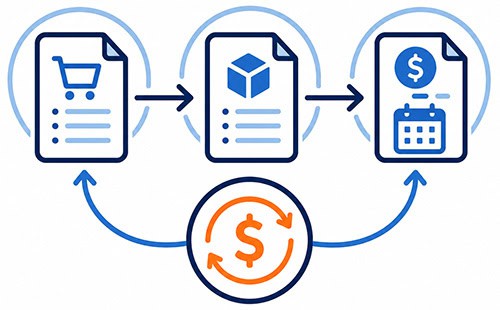

The goal is to make routine work move quickly, make exceptions visible, and give each team the information it needs to keep the customer moving forward. Not to remove every approval, exception, or human decision.
That is what commercial velocity should ultimately create: a faster path from demand to delivered value.
Commercial Velocity Comes From Removing Friction
Commercial velocity removes the friction that slows the path from demand to delivered value.
For medtech companies, that friction can appear almost anywhere: product configuration, pricing, approvals, contracting, inventory, onboarding, implementation, service, billing, or renewals. The more complex the offering becomes, the more important it is to connect those steps around a common commercial process.
That does not mean every medtech company needs to rebuild its commercial technology stack.
In many cases, the bigger opportunity is to identify where momentum consistently gets lost, then improve the data, workflows, decision rules, and system connections around those points.
The payoff is broader than a shorter sales cycle.
It can mean fewer configuration errors, cleaner handoffs, more realistic customer commitments, faster onboarding, better operational visibility, and a more consistent path to revenue.
For medtech leaders, that is the real measure of commercial velocity: how effectively the organization can turn customer demand into delivered clinical and business value.
Next in the Series: Hospital at Home
The next trend pushes the commercial and operating model in a different direction.
As more care moves beyond traditional hospital settings, medical devices must work in environments with less technical support, more patient involvement, and greater dependence on connectivity, remote monitoring, and digital engagement.
In the next article, I’ll look at how the rise of Hospital at Home is changing what medtech companies need to consider across product design, patient experience, data, service, and support.