

AI in Restaurants: Practical Use Cases for Multi-Unit Operators
AI can help restaurants reduce food and labor costs, save managers time, and make better operating decisions. This guide looks at the restaurant AI use cases producing measurable results and how multi-unit operators can approach adoption strategically.
AI in restaurants is an operational layer that separates profitable multi-unit operators from those still patching together spreadsheets and gut-feel scheduling. According to Restaurant365’s 2026 mid-year industry report, 62% of operators using artificial intelligence have implemented it in at least one back-office function, more than double the level reported at the start of the year. Operators using restaurant AI report concrete results: 61% reduced food costs, 62% reduced labor costs, and 88% save time every week.
Most content on this topic lists capabilities, but that’s not enough. Multi-unit operators need to know which applications actually move the needle, what the realistic barriers look like, and how to build a foundation that scales. Because we know that a network of disconnected tools creates more chaos than it solves.
Toast’s restaurant AI survey found that 86% of operators are comfortable using AI, 81% plan to use more in the future, and 81% believe artificial intelligence will help them run more efficient operations. The skepticism has largely shifted to implementation questions like where to start, how to prioritize, and how to avoid building another silo.
The context of the industry matters too when looking at implementing AI. Total U.S. restaurant and foodservice industry sales are projected to reach $1.55 trillion in 2026, but real inflation-adjusted growth is closer to 1.3%. Margins are thin, labor is expensive and hard to keep, food costs keep climbing.
Why Restaurants Are Adopting AI: The Real Benefits
The benefits of AI for restaurants concentrate in three areas: cost reduction, time savings, and better decision-making. The data from actual operators is specific enough to be useful.
Let’s start with the labor side. A survey of restaurant operators found 62% report reduced labor costs after implementing AI tools, while 61% report reduced food costs. Meanwhile, 88% say they save time every week. For a multi-unit operator managing 10 or 30 or 100 locations, those weekly time savings compound into something meaningful at the regional level.
The executives running larger operations are paying attention. Deloitte’s restaurant AI survey found 82% of restaurant executives plan to increase AI investments in FY2025-26. Their top expected benefits: customer experience (60%), restaurant operations (36%), and loyalty programs (31%). Notice that customer experience ranks first. The most forward-moving companies in this space understand that artificial intelligence can be a successful customer relationship tool.
The gap between AI users and non-users is starting to show in financial performance which is the profitability divide worth paying attention to. Operators who treat AI adoption as a future-state project are already behind the operators who started building their data foundation two years ago.
AI for Customer Experience: Ordering, Reservations, and Personalization
AI in restaurants produces its most visible customer experience gains through three connected systems: AI-powered ordering kiosks, voice AI at the drive-thru, and AI chatbots handling reservations and inquiries.
AI-Powered Ordering Kiosks
Ordering kiosks equipped with artificial intelligence use machine learning to analyze order history, time of day, weather, and current inventory to present personalized recommendations at the exact moment a customer is deciding. A guest who always orders a specific sandwich gets a different prompt than a first-time visitor, and that personalization is what creates a unique customer experience.
The practical impact for multi-unit operators is that ordering kiosks reduce order errors and generate structured data on every transaction. That data feeds directly into demand forecasting and menu optimization.
Voice AI and Drive-Thru Automation
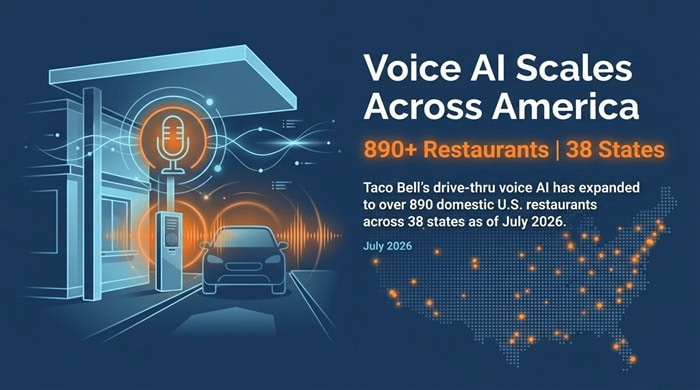
Voice AI at the drive-thru is past the pilot stage. Taco Bell’s drive-thru voice AI has expanded to over 890 domestic U.S. restaurants across 38 states as of July 2026. Natural language processing is accurate enough and reliable enough for a major quick-service chain to roll it across nearly a thousand locations.
For multi-unit operators considering voice AI, the business case centers on throughput and consistency. Drive-thru voice AI handles peak volume without fatigue errors and also captures every order in structured data automatically.
AI Chatbots and Reservation Management
AI chatbots handle reservation inquiries, waitlist management, and common customer service questions around the clock. For full-service and fast-casual operators, this matters for one simple reason: your phone lines and reservation platforms don’t stop getting traffic at 10pm, but your staff does.
Well-deployed AI chatbots resolve the majority of inbound contact without escalation. They collect guest preferences, confirm reservations, send reminders, and flag VIP guests automatically. The customer experience improves because response time drops to seconds. The operational benefit is that your team handles exceptions rather than routine requests.
AI in Kitchen Operations and Food Preparation
Back-of-house AI in restaurants applies computer vision and machine learning to food preparation, quality control, and kitchen workflow in ways that directly affect food safety and consistency.
Industry data shows 53% of operators prioritize POS investment as part of a broader back-of-house technology push. The POS is the data collection point: every transaction, every menu item, every modifier. AI in restaurants builds on that foundation.
Computer vision systems monitor food preparation in real time. They flag portion inconsistencies, identify food safety temperature violations, and catch plating errors before they reach the guest. For a multi-unit operator whose brand promise depends on consistency across 50 locations, this kind of automated quality control is harder to achieve through manager observation alone.
Kitchen display systems integrated with AI also optimize ticket routing. When a rush hits, artificial intelligence sequences orders to balance cook times across stations, reducing ticket times and improving table turn rates. The technology doesn’t replace an experienced expo but instead gives that person better information faster.

Inventory Management and Food Waste Reduction with AI
AI-driven inventory management connects purchasing data, sales history, and demand forecasting to give operators real-time visibility into what they have, what they need, and what they’re about to waste.
Food cost is the most immediate pain point in the industry right now. Restaurant365’s mid-year 2026 report found 83% of operators reported food cost increases in the first half of the year, and 52% responded by raising menu prices. Raising prices is the short-term lever. Reducing waste through better inventory management is the sustainable one.
More than half of restaurant executives are already acting on this. The Deloitte restaurant AI survey found 55% of executives are using AI to forecast product needs or track inventory today.
How Predictive Analytics Reduces Food Waste
Predictive analytics pulls from weather data, local event calendars, historical sales patterns, and day-of traffic signals to forecast demand at the item level. An AI inventory management system doesn’t just tell you how much chicken you ordered last Tuesday. It also tells you how much you’ll sell this Friday given that there’s a high school football game two miles away and rain is forecasted.
That specificity reduces over-ordering and less over-ordering means less food waste. Less food waste directly improves food cost percentage. For a restaurant running 28% food cost, shaving two points through better inventory management is worth more than most marketing campaigns.
Automated Purchasing and Supplier Integration
The next layer: AI in restaurants automates purchase order generation based on par levels, predicted demand, and current inventory counts. The system flags variance between actual and theoretical food cost, surfacing theft, spoilage, or portioning issues that a manual weekly count would catch too late.
Multi-unit operators who build this data foundation create a connected view of inventory across every location. Regional purchasing decisions get smarter. Vendor negotiation gets stronger. This is what we would call Customer 360 visibility that is applied to your supply chain, and it compounds over time.
Staff Scheduling and Workforce Management
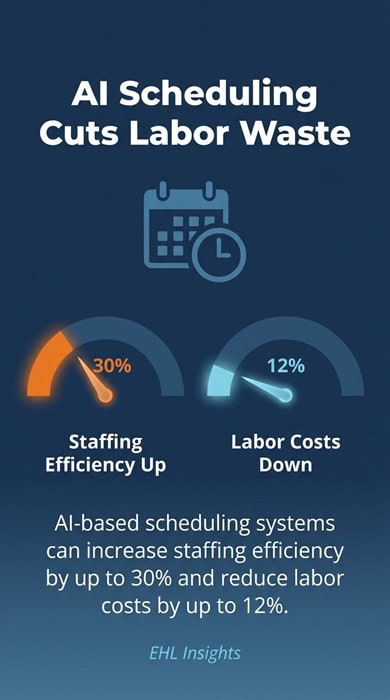
AI-based scheduling systems can increase staffing efficiency by up to 30% and reduce labor costs by up to 12%, according to EHL Insights’ analysis of AI applications in foodservice, and the labor context makes this one of the most urgent restaurant AI applications right now.
Restaurant turnover was approximately 74% as of March 2026, per Bureau of Labor Statistics data. Full-service restaurant employment remained 174,000 jobs below pre-pandemic levels as of May 2026, per Toast’s industry statistics. The labor pool is smaller, more expensive, and harder to retain. Scheduling errors cost money twice: once in overtime, and again when understaffed teams deliver a worse customer experience.
AI scheduling tools analyze historical sales data, upcoming reservations, local event calendars, and employee availability to generate optimized schedules. They account for labor law compliance automatically: breaks, overtime thresholds, and predictive scheduling requirements in certain jurisdictions. Managers stop spending four hours on Sunday building next week’s schedule and start reviewing a draft that’s already 80% right.
The employee experience angle matters too. Consistent, fair scheduling built on data reduces the frustration that drives turnover. When staff know their hours in advance and see that shifts are distributed logically, retention improves. That’s a workforce management outcome most operators don’t connect to their restaurant AI investment, but it’s real.
Menu Optimization and Dynamic Pricing
AI-powered menu optimization uses machine learning to analyze product mix, contribution margin, sales velocity, and customer preference data to identify which items to promote, which to retire, and how to price for profitability.
Classic menu engineering required a quarterly sit-down with your POS reports. But, AI menu optimization runs continuously. It detects that a new appetizer is trending among lunch guests but underperforms at dinner. It flags that a high-margin item has a name that guests skip over on the digital menu. It identifies that your Tuesday burger special is cannibalizing a higher-margin entrée. These insights surface in a dashboard built on your own transaction data.
Dynamic Pricing in Practice
Dynamic pricing in restaurants adjusts item prices based on demand, time of day, and inventory levels. This is standard in hospitality and travel. In restaurants, it’s newer and more nuanced.
The customer experience concern is very real: guests notice price changes on digital menus, and the reaction depends entirely on how the change is framed. Operators who use dynamic pricing most effectively focus it on digital and delivery channels where menu presentation is flexible, and they use demand forecasting to move prices gradually rather than dramatically. A $0.50 difference on a delivery platform during peak hours rarely drives complaint, but a $2.00 jump on a dine-in menu board does.
The bigger opportunity for most multi-unit operators is static menu optimization rather than dynamic pricing. Using AI to build a menu that performs better every quarter, without price volatility, delivers consistent margin improvement with no customer experience risk.
AI-Powered Marketing, Loyalty Programs, and Customer Retention
AI in restaurants transforms loyalty programs from point-accumulation schemes into genuine personalization engines, and it makes marketing automation specific enough to actually change guest behavior.
The Deloitte survey found loyalty programs ranked third among the top expected benefits of restaurant AI investment, cited by 31% of executives. But that ranking understates the actual opportunity. A basic loyalty program without AI might only tell you how many points a guest has. A loyalty program with AI can tell you that this specific guest visits every Thursday, always orders a salad, and hasn’t come in for three weeks. It then can automatically send them a targeted offer before that gap becomes a lost customer.
To add to this, Marketing automation built on artificial intelligence goes well beyond scheduled email campaigns. AI chatbots on your website and social channels handle inbound inquiries, collect preference data, and qualify guests for promotions in real time. Conversational marketing through these channels builds a richer customer profile than any static survey.
Personalization at Scale
Personalization at scale is the specific challenge that restaurant AI can solve. A regional operator with 40 locations might have 200,000 loyalty members. Manually segmenting that list into meaningful groups and crafting relevant offers for each group is not feasible without machine learning.
AI-powered loyalty programs segment automatically based on visit frequency, spend level, order preferences, and response to past promotions. They generate personalized offers at the individual level, send them at the optimal time, and measure response. The feedback loop improves with every campaign and with human input. That’s the compounding advantage that forward-moving restaurant groups are building right now.
The practical starting point for most restaurant operators is to connect your POS data to your loyalty platform and stop treating them as separate systems. The data foundation is already there in most restaurant tech stacks.
Challenges and Barriers to AI Adoption in Restaurants
Despite the clear benefits, only 26% of restaurant operators report using AI-related tools today, per the NRA’s 2026 State of the Industry report. The barriers are specific and worth addressing directly.
The top four obstacles for non-adopters, per the Restaurant365 mid-year report, are data privacy and security concerns (37%), confidence in output accuracy (34%), implementation costs (29%), and uncertainty about where to start (18%). These are reasonable responses to a market that has produced both genuine tools and a lot of hype.
Data Privacy and Security
Data privacy is the right concern to take seriously first. AI in restaurants runs on customer data, transaction data, and employee data. Each category carries compliance requirements. PCI DSS governs payment data while state privacy laws govern customer personal data and employment regulations govern workforce data.
The best way to go about this is to work with AI vendors who can demonstrate where your data lives, who can access it, and how it is encrypted. Contracts should specify data ownership clearly. Your restaurant AI tools should not be training their models on your proprietary customer data without explicit consent and clear contractual protections.
Implementation Costs and Where to Start
Implementation costs worry 29% of non-adopters. The honest answer is that some restaurant AI applications require significant investment, and some don’t. AI-powered scheduling tools and basic inventory management systems are within reach for independent operators and small chains. Voice AI at the drive-thru and full computer vision kitchen systems require more capital and integration work.
The right starting point for most multi-unit operators is the back office. Back-office AI (scheduling, inventory management, demand forecasting) delivers measurable ROI faster and requires less customer-facing change management, so start there. Build the data foundation then expand to customer-facing applications once the operational layer is working.
How to Build an AI Strategy for Multi-Unit Restaurant Operations
A restaurant AI strategy that scales across multiple locations starts with data integration, not necessarily tool selection, which is what most operators get backwards.
The AI in food and beverage sector was valued at $13.39 billion in 2025 and is projected to reach $67.73 billion by 2030, a 38.30% compound annual growth rate. As the industry grows, vendors will multiply and features will expand. The operators who build a clean, unified data foundation now will be able to evaluate and adopt new capabilities quickly. Those who stay fragmented will keep buying point solutions that don’t talk to each other.
What should a multi-unit operator do first?
Start by auditing your current data infrastructure. Clean, unified POS data is the prerequisite for every AI application. Then implement one back-office AI tool (inventory management or scheduling) and measure its impact over 90 days. Build the business case from real results before expanding to customer-facing applications.
AI in restaurants is already separating the operators who are building toward sustainable profitability from those still managing by instinct and spreadsheet. If your data foundation isn’t ready for what’s next, that’s the place to start. Smartbridge works with restaurant and food service organizations to build the data and AI infrastructure that makes meaningful transformation possible, with speed, clarity, and focus. That’s the Smartbridge way.