

Agentic AI Use Cases: From Concept to Enterprise Impact
Agentic AI is moving beyond chatbots and one-off prompts to take on complete, multi-step workflows across the enterprise. See how organizations are applying AI agents across areas like customer service, healthcare, sales, supply chain and cybersecurity, plus what it takes to scale them with the right governance and human oversight.
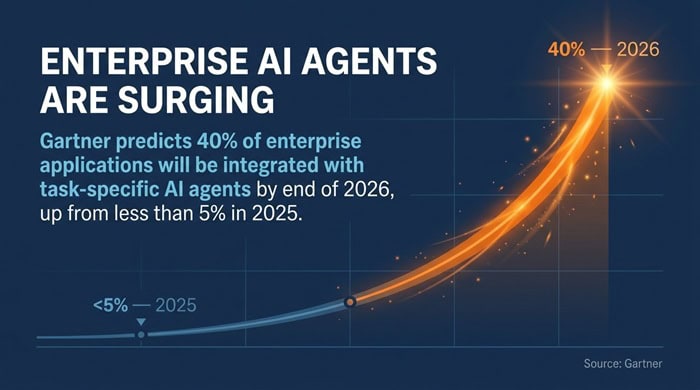
Agentic AI refers to autonomous AI systems that plan, reason, use tools, and execute multi-step tasks without requiring a human to direct each action, setting it apart from generative AI or chatbots that only respond to individual prompts. According to Mordor Intelligence’s agentic AI market report, the global market was valued at USD 6.96 to 7.29 billion in 2025. Meanwhile, Gartner predicts 40% of enterprise applications will be integrated with task-specific AI agents by end of 2026, up from less than 5% in 2025. That is not a slow shift. That is a structural change in how enterprises operate.
Most conversations about agentic AI get stuck on the definition and skip the part that actually matters: where does it create real impact, and how fast? We have spent over 22 years helping mid-market and enterprise organizations cut through exactly this kind of digital chaos, so let’s get specific.
What Is Agentic AI, and How It Differs from Generative AI
Agentic AI is a category of AI systems that combine large language models with memory, planning capabilities, and tool-calling functions to execute multi-step tasks autonomously across complex workflows.
Generative AI, like a standard ChatGPT session, answers a question and stops. It waits for the next prompt. Agentic AI does not wait. It receives a goal, breaks that goal into steps, decides which tools to use, calls those tools, evaluates the results, and adapts its approach until the task is complete.
A good way to think about it is: Chatbots are scripted. Generative AI is responsive. Agentic AI is autonomous. The distinction is important because organizations that treat AI agents like smarter chatbots will build solutions that underdeliver. The ones who treat them as autonomous systems with defined scope, guardrails, and human oversight will build something durable.
The Core Components That Make AI Agents Work
Agentic AI systems operate through four interconnected capabilities: reasoning and planning (breaking goals into steps), memory (retaining context across actions), tool calling (connecting to APIs, databases, and external systems), and agent orchestration (coordinating multiple specialist agents toward a shared objective).
Multi-agent systems add another layer. Rather than one AI agent handling everything, agent orchestration assigns specialized agents to different functions, with an orchestrator managing sequencing and handoffs. A procurement workflow might use one agent to analyze vendor contracts, another to check compliance rules, and a third to draft the purchase order. Each agent handles what it does best.
Large language models provide the reasoning core. But LLMs alone are not agentic. It is the combination of LLMs with persistent memory, planning logic, and tool access that produces agentic AI capable of running enterprise workflows end to end.
Agentic AI Use Cases in Healthcare
Healthcare agentic AI use cases address both a clinical quality challenge and a workforce capacity problem, with the World Health Organization projecting a global shortage of 11 million health workers by 2030, creating direct pressure to automate administrative and diagnostic support functions.

Eleven million is a gap that can’t really close by hiring faster. It closes partly by changing what health workers spend their time on.
Clinical Documentation and Prior Authorization
Clinical documentation is one of the most time-consuming, low-clinical-value tasks physicians perform. Agentic AI listens to patient encounters, generates structured clinical notes, and updates the electronic health record automatically. The physician then reviews and signs. This can drop the documentation burden substantially.
Prior authorization is a related problem. Insurers require specific documentation before approving procedures. Agentic workflows pull the relevant clinical evidence from patient records, match it against payer requirements, and submit the authorization request. Denials trigger an autonomous appeals process that drafts supporting documentation for clinician review. What previously took administrative staff hours runs in minutes.
Patient Monitoring and Diagnostic Support
Agentic AI in patient monitoring tracks vitals from connected devices, identifies deterioration patterns, and alerts care teams before a patient reaches a critical threshold. The agent does not just send an alert. It compiles the relevant data, identifies the likely concern, and presents it in a format the nurse or physician can act on immediately.
Diagnostic support agents analyze imaging data, lab results, and patient history together, presenting ranked differential diagnoses with the evidence behind each one. The physician still makes the clinical decision, but the agent makes sure the physician has the full picture before doing so.
Agentic AI Use Cases in Customer Service and Support
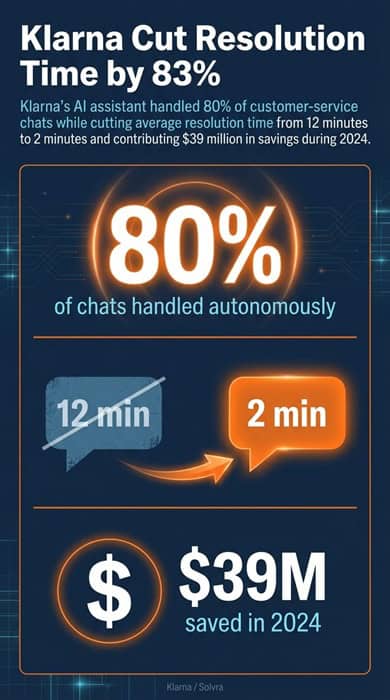
Customer service is where agentic AI has its most visible and measurable enterprise track record, with Klarna’s AI assistant handling 80% of customer-service chats while cutting average resolution time from 12 minutes to 2 minutes and contributing $39 million in savings during 2024, according to Solvra’s analysis of AI agent ROI in customer service.
Agentic AI in customer service goes well beyond traditional chatbots. Like we mentioned before, a chatbot follows a script. An AI agent reasons through the customer’s issue, accesses account data, checks order status, initiates returns, escalates to a human when the situation requires judgment, and follows up afterward. The entire resolution workflow becomes autonomous for the majority of common issues.
Proactive support is the next step. Agentic workflows monitor customer accounts for signals, like a subscription approaching renewal or a shipment delayed, and reaches out before the customer contacts support. Repeat inquiry volumes fall because the problem gets solved before the customer knows it exists. Klarna’s AI assistant reduced repeat inquiries by 25%, which is the kind of result that compounds across large customer bases.
Human oversight stays in the loop for escalations. The agent handles resolution, but the human handles relationship. This works because the agent is reasoning from customer data with defined boundaries around what it can and cannot do autonomously.
Agentic AI Use Cases in Human Resources
Human resources departments use agentic AI to compress the time and effort involved in recruiting, onboarding, payroll processing, and employee development without removing the human judgment that good HR requires.
Resume screening is the most common starting point, but it is also the least interesting. Agentic AI in recruiting goes further: sourcing candidates from multiple channels, scheduling interviews, sending follow-up communications, collecting feedback, and tracking pipeline status across hiring managers. The recruiter focuses on the conversations that require human judgment while the agent handles every step in between.
Onboarding is a process with a defined sequence of tasks, documents, system access requests, training assignments, and check-in touchpoints. Agentic workflows execute that sequence automatically, monitor completion, and escalate delays. New employees get a consistent experience and HR teams stop chasing paperwork.
Employee development applications use AI agents to analyze skills gaps against role requirements, recommend learning resources, and track progress over time.
When internal mobility opportunities arise, the agent matches open roles against employee profiles and surfaces candidates the manager may not have considered. That kind of proactive talent visibility is hard to create manually at scale.
Agentic AI Use Cases in Sales and Marketing
Sales and marketing agentic AI use cases produce the most direct revenue attribution, making them a priority for organizations that want measurable ROI quickly.
In sales, AI agents handle lead qualification by analyzing inbound activity, scoring prospects against ideal customer profiles, and routing qualified leads to the right sales rep with a briefing already prepared. The rep engages at the moment of highest intent, with context already in hand. Pipeline management agents monitor deal health, flag stalled opportunities, and suggest next best actions based on what has worked in comparable deals.
Personalized outreach at scale is where agentic AI changes the math for sales development. An AI agent can research a prospect, identify relevant pain points, draft a personalized message, and schedule follow-ups across channels. Done right, this becomes individual outreach that happens to be automated.
Marketing applications run the same pattern. Audience segmentation agents analyze behavioral data and build segments that update dynamically as customer behavior changes. Campaign optimization agents monitor performance in real time, reallocate budget toward high-performing creative, and generate performance summaries for the marketing team. Content generation agents produce first drafts at the volume marketing teams need, with a human editor in the loop for final quality control.
CRM integration is what ties the sales and marketing agentic workflows together. When AI agents write directly to and read from the CRM, the data stays current without manual entry, and every agent in the system works from the same customer record.
Agentic AI Use Cases in Supply Chain and Logistics
Supply chain and logistics agentic AI use cases address the coordination complexity that makes traditional automation difficult, specifically the need to respond to disruptions in real time across multiple systems and stakeholders.
Shipment rerouting is a clear example. When a carrier delay occurs, an agentic workflow identifies affected shipments, evaluates alternative routing options, calculates cost and time tradeoffs, selects the best option within defined parameters, and notifies the customer, all without human intervention for routine disruptions. Humans review the exceptions that fall outside those parameters.
Demand planning agents process sales history, market signals, seasonal patterns, and external data feeds to generate forecasts that update continuously rather than on a monthly planning cycle. When demand signals shift mid-quarter, the agent flags the change and adjusts procurement recommendations before the organization is caught short.
Predictive maintenance is a supply chain use case that often gets categorized under manufacturing, but the logistics impact is direct. An AI agent monitoring equipment sensor data identifies failure probability before the equipment breaks down, schedules maintenance during low-demand windows, and coordinates parts procurement automatically. Unplanned downtime in a distribution center costs more than the maintenance itself.
Key Benefits of Agentic AI
The business case for agentic AI rests on four operational benefits that compound across the enterprise:
Around-the-clock operation is not a trivial benefit. AI agents do not have shifts, holidays, or sick days, so they could handle customer service agents inquiries at 2 AM.
Monitoring agents catch threats on weekends. Compliance agents process regulatory updates the day they are published. The organization runs continuously without staffing a night shift.
Cost reduction through agentic workflow automation is most visible in high-volume, rules-based processes. The Klarna example is instructive: $39 million in savings from customer service automation in a single year. That is production-scale impact from a mature agentic AI deployment.
Scalability without proportional headcount growth changes the unit economics of growth. A company that doubles its customer base no longer needs to double its support team. A bank that adds new loan products does not need proportionally more underwriters. The agentic workflows scale with demand, not with hiring cycles.
Decision quality improves when AI agents process current data rather than periodic reports. A supply chain agent working from real-time inventory and demand data makes better procurement recommendations than a planner working from last month’s numbers. The decision is the same type, but the data quality is fundamentally different.
Adoption, Governance, and What Comes Next
Agentic AI adoption in the enterprise is accelerating faster than governance frameworks are being built, which is the central risk forward-moving companies need to manage now rather than later.
McKinsey’s State of AI 2025 report found 23% of organizations are actively scaling an agentic AI system, with an additional 39% experimenting. That means nearly two-thirds of enterprises are somewhere on the agentic AI path already.
The governance gap is significant. With only one in five companies having a mature model for overseeing autonomous AI agents, most organizations are scaling agentic workflows faster than their risk frameworks can track. Human-in-the-loop design is not optional. It is what separates responsible autonomous operation from unchecked agent behavior.
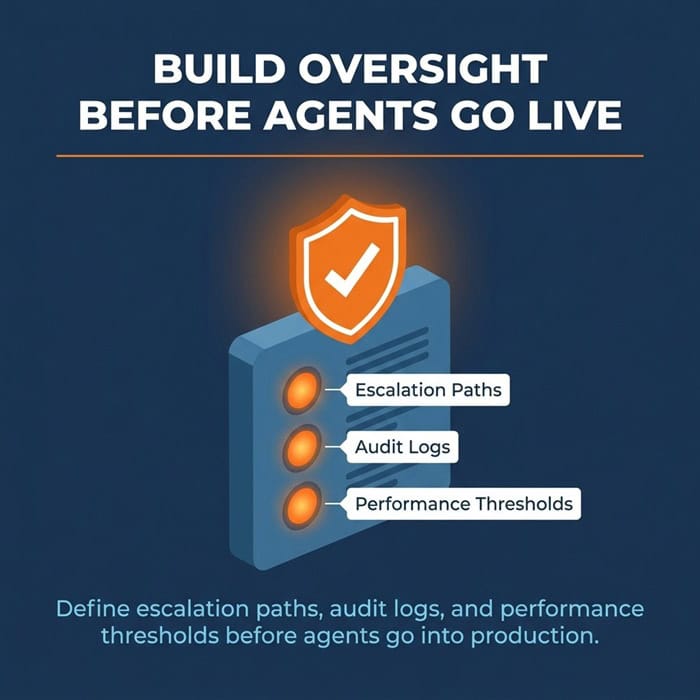
Start with the workflows that have clear boundaries, defined inputs and outputs, and existing human review processes. Those are the ones agentic AI can take over fastest with the least governance complexity. Build the oversight model in parallel, not after the fact. Define escalation paths, audit logs, and performance thresholds before agents go into production.
The organizations that will lead in agentic AI adoption are not the ones that deploy the most agents the fastest. They are the ones that build an agentic enterprise with the structure to scale, the governance to trust, and the outcomes to justify the investment. If you are working through where agentic AI fits in your transformation roadmap, our team at Smartbridge helps organizations make exactly those decisions with speed, clarity, and focus.
Ready to move from concept to impact? Talk to a Smartbridge expert and let’s build your agentic AI roadmap the right way.