

QSR Digital Transformation: Restaurant Technology Roadmap
Over the past year, restaurant operators have had to adjust to higher labor costs, changing guest expectations and growing pressure to make operations more efficient. For many brands, technology is no longer a future initiative. It is becoming part of how restaurants manage daily work, control costs and create a better guest experience.
The numbers tell the story. The restaurant technology market reached USD 7.49 billion in 2026 and is projected to hit USD 14.73 billion by 2031. The growth points to a clear change in how restaurants are planning, investing and operating.
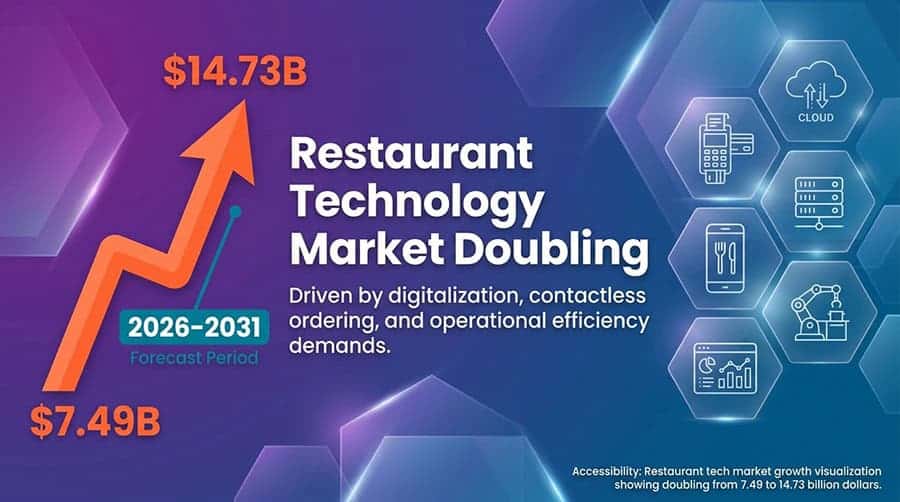
Restaurant technology market set to nearly double from $7.49B (2026) to $14.73B (2031)
Guests have become more comfortable with direct ordering, contactless payment and more personalized restaurant experiences. Many brands have already responded by modernizing the way they manage ordering, payments, loyalty, kitchen operations and guest engagement.
At this point, the question is less about whether restaurant technology matters and more about how to make the right investments. A strong roadmap helps operators avoid disconnected tools, reduce manual work and build systems that support the business instead of adding more complexity.
This guide walks through the core areas of a restaurant technology roadmap, including the systems that can improve operations, the role of AI-powered tools in reducing cost and errors, and the value of integrating platforms so teams, data and workflows can work together more effectively.
What Restaurant Technology Actually Means in 2026
Restaurant technology includes the digital systems that support day-to-day operations, from point of sale systems and kitchen display screens to online ordering platforms, inventory tracking, guest data management and AI-powered analytics.
The category has expanded quickly. Five years ago, many operators focused on the POS system and perhaps a reservation platform. Today, a restaurant technology stack often includes eight to twelve connected systems that support ordering, payment, kitchen operations, reporting, staffing, loyalty and guest engagement.
Even with that growth, many operators are still frustrated by their current systems. Only 13% of restaurant operators report full satisfaction with their current tech stack, and much of that dissatisfaction comes from poor integration. When the POS does not communicate with inventory management, or the kitchen display system operates separately from online ordering, technology can create more operational friction instead of reducing it.
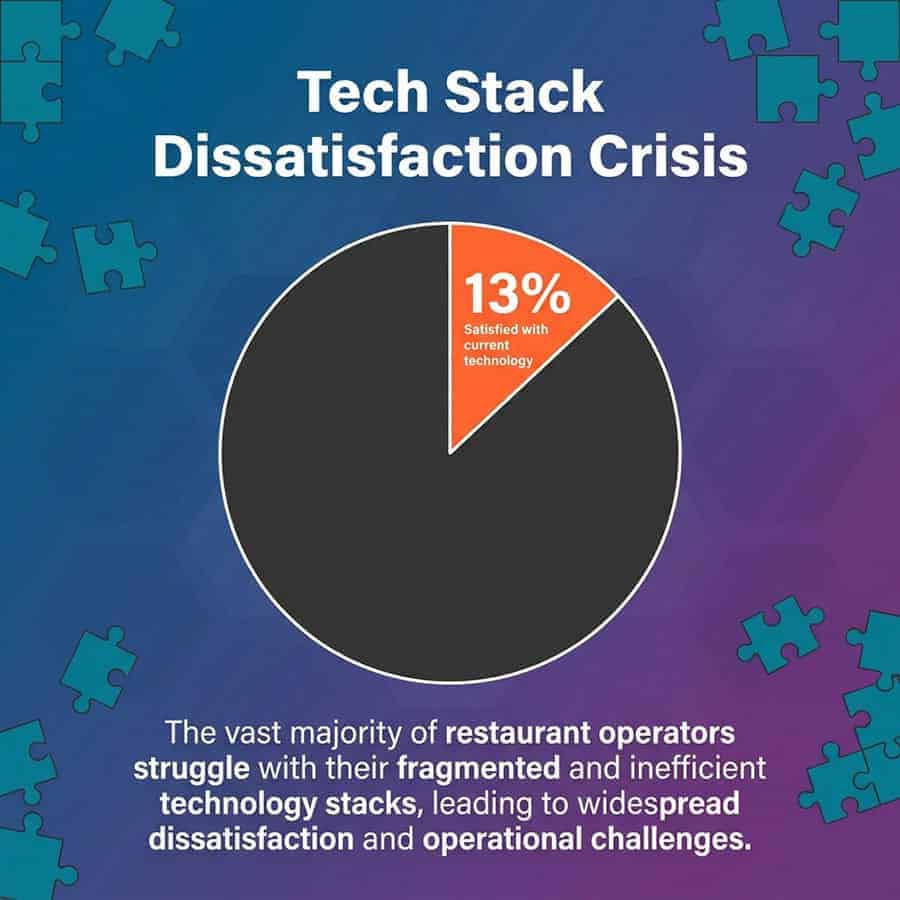
Only 13% of operators are satisfied with their tech stack—underscoring the need for integration
Modern restaurant technology should help solve three core challenges. It should reduce manual work where labor is constrained. It should improve the guest experience through faster service, better accuracy and more relevant interactions. It should also give operators clearer visibility into performance so they can make better decisions across locations, shifts, menus and teams.
That is one reason AI investment is increasing. 82% of restaurant executives plan to increase AI investment in the next fiscal year, which points to a broader shift from basic digitization to more intelligent operations. The restaurant brands that benefit most over the next several years will likely be the ones that move beyond disconnected tools and build platforms that can share data, automate workflows and support better decisions.
The Technology Categories That Matter
Restaurant technology falls into several major categories, each supporting a specific part of the operation:
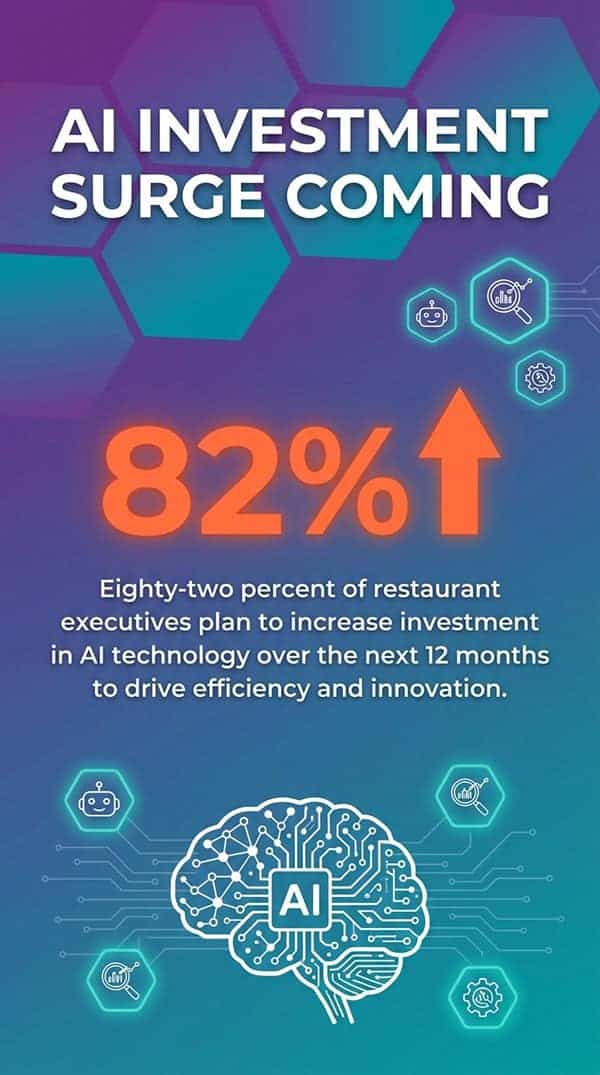
82% of restaurant executives plan to increase AI investment in the next fiscal year
The distinction between these categories matters less than how well they work together. A standalone POS system can process transactions. A POS system connected to inventory, guest data, kitchen operations and reporting can give operators a more complete view of performance and a stronger foundation for decision-making.
Cloud-Based vs. On-Premises Systems
Cloud-based systems captured 60.87% of the restaurant management software market in 2025. That market share reflects practical advantages for restaurant operators. Cloud platforms can update automatically, support multi-location visibility and integrate more easily with third-party systems.
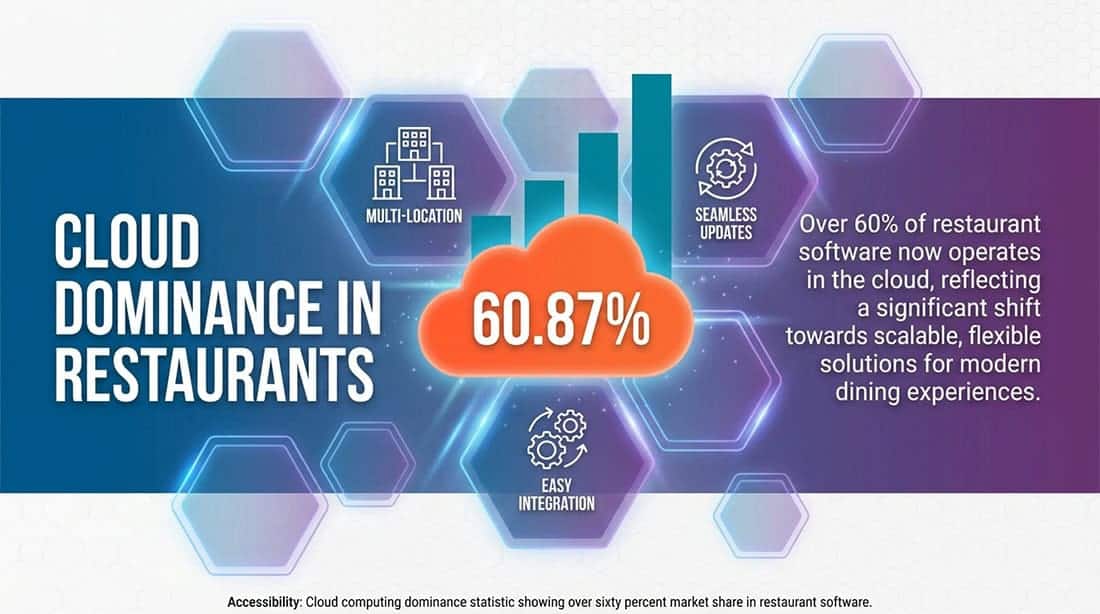
Cloud-based platforms lead with 60.87% market share (2025), driven by flexibility and integration
On-premises systems still have a place in certain operating environments. Some restaurants need tighter control over data or infrastructure because of regulatory, security or connectivity requirements. Others operate in locations where internet reliability remains a concern. For those operators, the decision often comes down to how they balance control, flexibility, scalability and support.
For most restaurant brands, cloud-based solutions now make the most sense for core operations. The accessibility, update model and integration capabilities often outweigh the perceived advantages of maintaining systems on local infrastructure.
Why Your Restaurant Technology Strategy Can’t Wait
Guest expectations have changed faster than many operators expected. With 68% of consumers reporting that they cut back on restaurant dining in early 2026, restaurants have to make each visit count. When guests do choose to dine out or order in, they expect accuracy, speed and a consistent experience across channels.
The margin pressure has also intensified. Menu prices rose 3.6% year-over-year as of April 2026, while labor and food costs remained difficult to manage. Operators are trying to protect profitability while still meeting higher expectations from guests, employees and franchise stakeholders.
Technology can help address those pressures when it supports specific operational goals. The right systems can reduce manual work without lowering service quality. They can improve forecasting to limit food waste. They can help increase check size through more relevant recommendations and better customer data.
Labor Efficiency Gains
Labor shortages have pushed restaurant operators to rethink which tasks require staff attention and which tasks can be automated or streamlined.
AI voice ordering systems provide one example. Restaurants that implemented AI-powered phone ordering saw average order value increase to $52, generated $100,800 annually and realized $18,000 in labor savings. Those results show how automation can support revenue and efficiency when it fits a clear operational need.
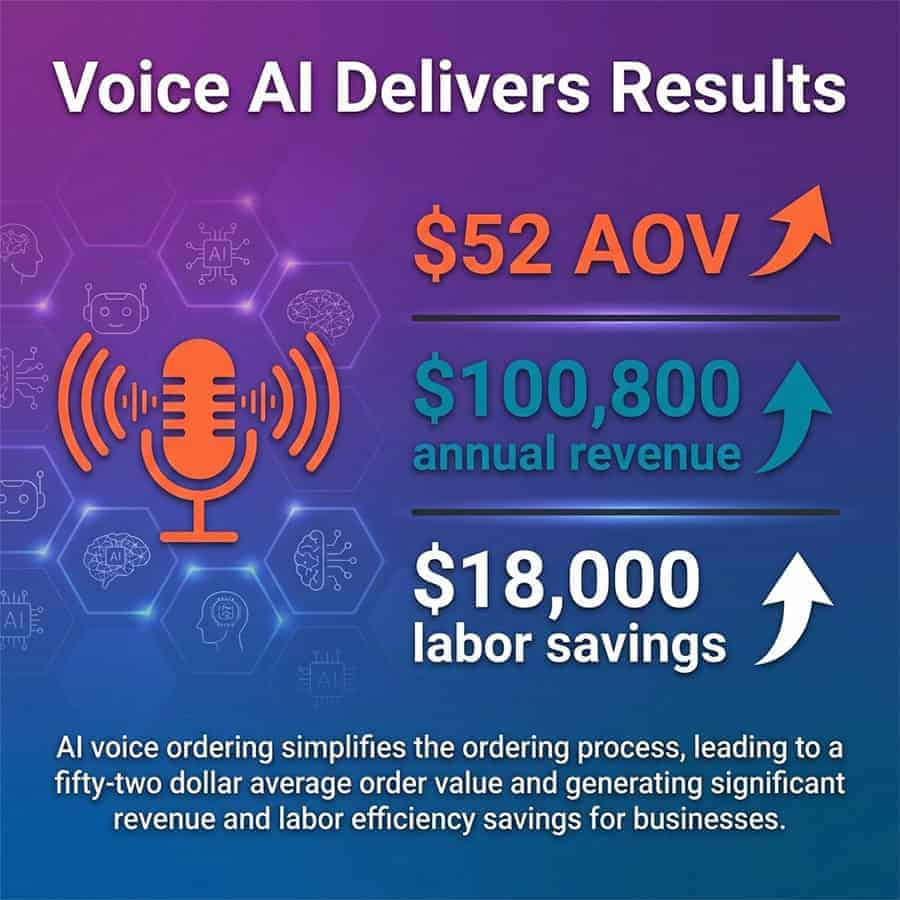
AI voice ordering boosts AOV to $52 and yields ~$100.8K annually with $18K in labor savings

Self-service kiosks offer similar benefits. Global kiosk installations approached 450,000 as of June 2025, and each unit can handle a high volume of orders without requiring a team member to manage every transaction. For many quick-service concepts, kiosks also create a more consistent ordering experience and a more reliable upsell process.
Kitchen Display Systems reduce another source of manual work. They eliminate the need to run paper tickets to the kitchen, improve visibility across prep stations and reduce order errors by 40% compared to paper ticket systems. They also help coordinate timing across multiple stations, which becomes especially valuable during peak periods.
Customer Experience Improvements
Speed now matters across every ordering channel. Guests expect the experience to feel smooth whether they order at the counter, through a mobile app, at a kiosk or from a third-party delivery platform.
Integrated restaurant technology helps create that consistency. When a guest places an order through a mobile app, the order should flow directly to the Kitchen Display System. The kitchen should receive preparation details right away. The POS should update inventory based on the order. The guest should receive accurate timing information without staff having to manually intervene.
Personalization also plays a larger role in repeat visits. 52% of consumers participate in restaurant loyalty programs, but those programs produce stronger results when they connect to real guest data. Purchase history from the POS, preference data from online ordering and campaign engagement from loyalty tools can work together to support more relevant offers and interactions.
Data-Driven Decision Making
Restaurant operators have relied on experience and instinct for decades. That judgment still matters, but it works best when supported by timely and accurate data.
Modern restaurant systems generate operational data throughout the day. Every transaction, order modification, inventory adjustment, table turn and labor hour can tell operators something useful. The challenge is making that data accessible, connected and actionable.
69% of operators who added new technology reported efficiency and productivity improvements. Those gains often come from practical uses of data, such as optimizing labor schedules, adjusting menu pricing, reducing food waste and improving table turns.
Restaurants that build stronger data practices will have a clearer view of what is working and where they need to adjust. That requires systems that capture clean data and analytics tools that surface insights in a way managers can use during the normal course of operations.
Point of Sale Systems: Your Digital Foundation
The POS system sits at the center of restaurant operations. Transactions flow through it. Menu changes begin there. Many reports depend on the data it captures.
The gap between legacy POS systems and modern cloud-based platforms has grown considerably. Legacy systems can still process transactions, but modern POS platforms support a broader operating model. They help connect ordering channels, payment options, inventory data, staff management and reporting.
Restaurants that still run older POS technology often face integration challenges. Those systems were not built to connect easily with online ordering, loyalty programs, delivery platforms or kitchen display systems. The result is often a set of workarounds that create data gaps and extra manual effort.
Core POS Capabilities
Modern POS systems do much more than process payments. They support several operational functions that influence speed, accuracy and decision-making.
| Capability | Function | Operational Impact |
|---|---|---|
| Transaction Processing | Accept payments across multiple methods | Faster checkout and reduced friction |
| Menu Management | Update pricing and availability across channels | More accurate menus and fewer manual updates |
| Inventory Integration | Track ingredient usage based on items sold | Better purchasing, reorder triggers and waste reduction |
| Staff Management | Manage clock-ins, permissions and activity | Labor cost visibility and stronger controls |
| Reporting and Analytics | Track sales, trends and performance metrics | Better menu, pricing and staffing decisions |
The strongest POS systems integrate with the rest of the restaurant technology stack. The online ordering platform should reflect the same menu the counter staff sees. The kitchen display system should receive orders from every channel through a consistent process. Inventory counts should adjust automatically when items sell.
Cloud-Based POS Advantages
Cloud-based POS systems offer several operational benefits. Updates happen without manual intervention. Multi-location operators gain centralized visibility. Managers can access data remotely instead of waiting until they are on site.
Data accessibility matters most. Cloud systems centralize transaction data, which gives operators more useful reporting and analytics. They can compare performance across locations, analyze labor efficiency by shift and identify menu items that contribute the most to profitability.
Security has also improved. Cloud POS providers typically invest in data protection, PCI compliance, backups and monitoring at a level most individual restaurants would struggle to maintain internally. That does not remove the need for good security practices, but it does change the risk and support model.
POS Selection Criteria
Choose a POS system based on operational requirements rather than feature lists. Start by mapping the current process, identifying pain points and documenting the integrations the business needs.
Key selection factors include:
The lowest-cost POS system rarely delivers the best value. Operators should calculate the full cost over several years and factor in training, integration, support and efficiency gains. A system that costs more upfront can still create a better financial outcome if it reduces labor requirements, eliminates manual work or improves order accuracy.
Online Ordering and Delivery Platform Integration
Consumers spent more than $72 billion on DoorDash alone in the first three quarters of 2025, which reflects how deeply off-premises dining has become part of restaurant demand.
Restaurant operators have to make careful decisions about online ordering and delivery. Direct ordering gives brands more control and better access to guest data. Third-party delivery platforms provide reach, demand generation and convenience, but the commission structure can make profitability harder to manage.
Many restaurants need both. A hybrid model lets operators maintain visibility on third-party platforms while encouraging guests to order directly through loyalty rewards, exclusive offers or a better branded experience. The strategy works best when the technology connects cleanly across channels.
Direct Ordering Platforms
Direct ordering platforms give restaurants more control over the customer relationship. The brand owns the guest data, manages the experience and avoids some third-party commission costs.
The trade-off is customer acquisition. Third-party marketplaces already have active users. A direct ordering channel needs traffic, which usually requires investment in marketing, loyalty programs, email, SMS and in-store promotion.
A common strategy is to use third-party platforms for discovery while building long-term direct relationships. Guests may first find the restaurant through a delivery app, then shift to direct ordering after they receive loyalty incentives, personalized offers or a better order-ahead experience.
Third-Party Delivery Integration
The global online food delivery market is projected to reach $223.7 billion by 2027. That growth creates opportunity, but it also raises operational and financial questions.
The opportunity comes from access to a large base of customers who are already looking for meal options. The challenge comes from commission rates that can consume 15-30% of order value.
Integration helps protect margins and reduce operational strain. Third-party orders should enter the POS automatically. The kitchen display system should show orders from every channel in one workflow. Inventory management should track ingredient usage whether the order came from the counter, website, mobile app or marketplace.
Menu management matters here as well. When an ingredient runs out, the item should become unavailable across all ordering channels at the same time. Manual updates across multiple platforms increase the risk of errors, canceled orders and guest frustration.
Virtual Brands and Cloud Kitchens
45% of QSR sales are linked to cloud kitchens and virtual brands, and that model continues to attract operators looking to use existing kitchen capacity more efficiently.
Virtual brands allow restaurants to test new concepts without committing to new real estate. Operators can use existing kitchens during slower periods, reach different customer segments and test menu ideas with less investment than a traditional brick-and-mortar launch.
The technology requirements remain similar. Virtual brands still need POS integration, online ordering, kitchen routing, inventory controls and reporting. The difference is that the same kitchen infrastructure supports multiple concepts, making coordination and data visibility even more important.
Kitchen Display Systems: Operations Without Paper
Paper ticket systems create several points of friction. Servers have to communicate orders manually. Kitchen staff have to interpret handwriting. Tickets can fall, get misplaced or move out of sequence. During rush periods, small communication gaps can quickly turn into delays.
Kitchen Display Systems remove much of that friction. Orders appear on screens automatically, route to the appropriate stations and update as staff begin or complete items. The system can coordinate timing across courses or prep areas and help managers spot delays.
The benefits go beyond replacing paper. A KDS connected to the POS and online ordering platforms can receive orders from every channel, update order status in real time and give front-of-house staff better information when guests ask for timing.
How Kitchen Display Systems Work
Orders flow from the POS or online ordering platform to kitchen display screens. The system routes each item to the right station, such as grill, salad, bar, expo or dessert.
Kitchen staff see preparation details, modifiers and timing requirements on screen. They can mark items as started or completed, which creates a timestamped view of kitchen activity. Over time, that data helps operators understand prep speed, station load and bottlenecks.
When the full order is ready, the system alerts expo staff to verify accuracy and move the order forward. The process gives restaurants a cleaner operating workflow and a more complete record of kitchen performance.
Operational Improvements from KDS
Kitchen Display Systems improve order accuracy because instructions appear clearly and consistently. Handwriting issues disappear, modifiers remain attached to the order and staff can flag questions before the order reaches the guest.
Speed improves through better coordination. The system can account for preparation times and help staff sequence items so the full order comes together properly. That matters for complex orders, multi-course meals and high-volume dayparts.
The data also gives managers a better way to improve performance. They can see average ticket time by daypart, identify items that slow down the kitchen and recognize where staff may need additional training. Kitchen efficiency becomes something managers can measure, discuss and improve.
KDS Integration Requirements
Kitchen Display Systems create the most value when they connect to the rest of the restaurant technology stack. The POS should send orders automatically. Online ordering platforms should follow the same routing rules. Table management systems should support course timing where needed.
The integration should work in both directions. When kitchen staff update order status in the KDS, that information should flow back to the POS or guest-facing system. Servers can see where orders stand, and guests can receive more accurate updates.
Menu changes should also move through the stack quickly. When an item is marked unavailable, it should stop appearing in the KDS and become unavailable across relevant ordering channels. That reduces confusion for staff and avoids disappointing guests after they have already placed an order.
AI-Powered Restaurant Technology Transforms Operations
AI has moved from experimentation into practical restaurant operations. Operators are using it to solve specific problems, such as demand forecasting, labor scheduling, order-taking, inventory planning, marketing personalization and waste reduction.
The strongest use cases focus on measurable operational needs. AI can forecast demand more accurately than historical averages alone. It can recommend labor schedules based on predicted traffic. It can analyze guest data to support more relevant offers. It can identify waste patterns and help managers make menu or purchasing adjustments.
AI does not replace operator judgment. It gives managers better inputs, faster analysis and more consistent recommendations so they can make stronger decisions.
AI Voice Ordering Systems
Drive-through and phone ordering have remained difficult to staff consistently, especially during peak periods. AI voice ordering systems help reduce that constraint by handling routine order-taking through natural conversation.
These systems can manage modifications, answer common questions, suggest relevant add-ons, process payment and send orders to the kitchen. When designed and implemented well, they create a more consistent ordering experience while allowing staff to focus on food preparation, guest service and exception handling.
The operational benefits can be significant. Average order value can increase when the system consistently recommends relevant add-ons. Labor costs can decrease when restaurants redeploy order-takers to higher-value tasks. Order accuracy can improve when the system captures and routes details consistently.
Guest acceptance has also been stronger than some operators expected. Many customers respond well to a consistent ordering process, especially during busy periods when human order-taking can feel rushed or distracted.
Predictive Analytics and Demand Forecasting
Traditional forecasting often relies on historical averages. Sales from last Tuesday become the starting point for this Tuesday, with manual adjustments for weather, holidays or events.
AI-powered forecasting can evaluate many variables at once, including historical sales patterns, weather forecasts, local events, holidays, seasonal demand, social trends and competitive promotions. The system weighs those factors and produces a more informed demand forecast.
Those forecasts support several operating decisions. Labor schedules can align more closely with expected traffic. Inventory orders can reflect predicted item-level demand. Prep plans can reduce overproduction and avoid stockouts.
AI forecasting typically achieves 15-20% better accuracy than manual methods. In restaurant operations, that kind of improvement can affect labor efficiency, waste reduction and guest experience at the same time.
Inventory Management and Waste Reduction
Food waste in hospitality costs more than $100 billion annually. In many restaurants, that waste comes from over-ordering, poor forecasting, inconsistent prep planning and limited inventory visibility.
AI-powered inventory management tracks ingredient usage in real time. The system understands how much of each ingredient goes into each menu item, adjusts counts as items sell and flags discrepancies that may point to waste, spoilage, theft or process issues.
The system can also recommend purchases based on forecasted demand, current inventory, lead times and shelf life. That helps operators order closer to what they need and reduce the amount of inventory that expires before use.
Restaurants using AI-powered inventory management typically reduce food waste by 20-30%. For a restaurant with $1 million in annual food costs, that range could represent $200,000 to $300,000 in avoided waste if the reduction translates fully into cost savings.
Customer Data Analysis and Personalization
Customer data often sits across several disconnected systems. The POS tracks purchase history. The loyalty platform stores contact information. The online ordering platform captures preferences. Email and SMS tools record engagement. When those systems do not connect, the restaurant has data but lacks a complete view of the guest.
AI-powered customer data platforms can bring that information together. They create more complete guest profiles, identify ordering patterns, predict churn risk and recommend offers that fit each customer’s behavior.
That personalization can improve marketing performance. Email campaigns using AI-generated recommendations can achieve 40-50% higher conversion rates than generic promotions, while loyalty offers tailored to individual preferences can generate 60% higher redemption rates.
The value depends on integration. AI needs access to data from the POS, online ordering, loyalty, marketing and customer engagement channels. The more complete and accurate the data, the more useful the recommendations become.
Contactless Payment and Self-Service Solutions
Contactless payment and self-service technology accelerated during the pandemic, but the operating case has lasted well beyond that period. Guests appreciate the convenience, and operators benefit from faster transactions, better accuracy and more flexible labor deployment.
Self-service kiosks have become common in quick-service restaurants. QR code ordering has become more familiar in casual dining and fast-casual formats. Table-side and mobile payment options have helped speed checkout and improve table turns.
These tools can reduce labor requirements, increase average check size, improve order accuracy and free staff to focus on the parts of service where human attention matters most.
Self-Service Kiosks
Self-service kiosks help quick-service restaurants manage order volume without adding the same level of labor. They also create a more consistent upsell process because the system can recommend add-ons and upgrades on every applicable order.
That upsell capability has driven adoption. Kiosks can highlight high-margin items, make customization easier and prompt guests to consider additional items. Average check sizes have increased 15-30% compared to counter orders in some implementations.
Order accuracy also improves because guests enter and review their own orders before submitting. Modifiers come through clearly, and the kitchen receives complete order details through the system.
For staff, the role often shifts from order-taking to food preparation, guest assistance and issue resolution. That can improve both operational efficiency and the guest experience when the restaurant staffs and trains around the new workflow.
QR Code Ordering
QR code ordering began as a contactless solution and has remained useful for several restaurant formats. Guests scan a code, review the menu, customize an order and pay from their own device.
The model works best when the restaurant matches it to the right service style. Quick-service restaurants may use QR codes for table ordering. Casual dining operators may use them to reduce server touchpoints. Fast-casual concepts may combine QR ordering with counter or table pickup.
The main challenges are adoption and reliability. Some guests need help using the technology, and network issues can create frustration. Menus also need clear descriptions and strong photography because guests do not always have a server guiding the decision.
Successful implementations keep human service in the experience. QR ordering can handle ordering and payment, while staff focus on food delivery, refills, hospitality and issue resolution. That balance helps restaurants gain efficiency without making the experience feel unsupported.
Mobile Payment Integration
Mobile payment options continue to expand. Restaurants now support contactless cards, mobile wallets, order-ahead payment, pay-ahead capabilities and table-side payment through server tablets or guest smartphones.
Speed matters here as much as convenience. Faster payment reduces bottlenecks at the counter and can shorten table turns in full-service environments. Even small reductions in payment time can add capacity during high-volume periods.
Security also improves when restaurants move away from traditional card handling. Tokenization helps protect card data, and biometric authentication on smartphones adds another layer of protection. Mobile payment can also reduce certain fraud and data breach risks.
Integration with loyalty programs increases adoption. When guests automatically earn rewards through a mobile payment or app-based order, the experience feels easier and gives the restaurant more useful customer data.
Reservation and Table Management Systems
Reservation and table management systems help restaurants manage dining room flow, reduce wait-time uncertainty and improve capacity planning.
Modern platforms do more than capture reservations. They manage waitlists dynamically, track table turn times, estimate availability, send SMS updates and integrate with POS systems to coordinate service.
Full-service restaurants can gain additional value from guest data. The systems can track preferences, note special occasions, identify VIP guests and support better communication across host, server and management teams.
Reservation Management Capabilities
Online reservation platforms reduce missed calls and manual back-and-forth. Guests can book through a website, app or reservation marketplace. The system confirms automatically, sends reminders and captures contact information for future engagement.
The platforms also help manage capacity more intelligently. They account for table size, expected turn times and section availability. That helps restaurants reduce overbooking while making better use of the dining room.
Integration with guest data creates more personalized service. The system can recognize returning guests, remember seating preferences or dietary restrictions and flag birthdays, anniversaries or other notes that matter to the experience.
Waitlist Management
Waitlist management improves the guest experience during busy periods. Instead of gathering near the host stand, guests can provide a mobile number and receive a text when the table is ready.
The system can provide more transparent wait estimates based on actual table turn data. As conditions change, the estimate can update automatically. Guests appreciate knowing where they stand, even if the wait remains the same.
Operators gain more flexibility as well. The system can track response to text alerts, adjust table assignments by party size and current availability and reduce the confusion that often comes with a manual waitlist.
Table Turn Optimization
Table turn time has a direct impact on revenue. A restaurant that turns tables 15% faster can serve more guests without adding seats, provided the kitchen and staff can support the pace.
Table management systems track turn time automatically, from seating to payment. They help operators identify patterns by server, section, daypart or party type.
That data supports targeted improvement. If dessert service consistently delays table turns, the restaurant can simplify that step or adjust staff training. If payment creates bottlenecks, mobile payment may create measurable value.
The systems can also help coordinate kitchen pacing with dining room activity. When tables linger longer than expected, the restaurant can adjust new seating timing to protect the kitchen from overload. When tables turn faster, the team can capture additional demand more confidently.
Inventory Management Technology Reduces Waste
Inventory management plays a direct role in restaurant profitability. Food costs typically represent 28-35% of revenue, so even small improvements in purchasing, usage and waste control can have a meaningful financial impact.
Manual inventory management often relies on weekly counts and spreadsheets. Staff count items, enter numbers by hand and calculate usage after the fact. The process takes time and often produces data that is already outdated by the time managers review it.
Modern inventory management systems automate much of that work. They connect to POS data, calculate ingredient usage based on recipes, identify discrepancies and generate purchasing recommendations.
Real-Time Inventory Tracking
Real-time inventory tracking changes how restaurants manage stock. When the system knows how many menu items sold, it can estimate how many ingredients were used and adjust counts automatically.
That improves accuracy compared to manual tracking. Recipe updates can flow through the system. Count variances can surface faster. Managers can address discrepancies while the details are still fresh.
Theft and waste also become more visible. When actual inventory does not match expected usage based on sales, the system can flag the variance. That visibility helps managers investigate process issues, waste patterns or loss concerns earlier.
Automated Purchasing and Vendor Management
Automated purchasing systems generate order recommendations based on current inventory, par levels, forecasts and vendor lead times. They can group purchases by vendor, reduce missed orders and help managers avoid unnecessary rush deliveries.
Many systems also integrate with vendor platforms. Orders can transmit electronically, deliveries can be recorded and received quantities can be matched against what the restaurant ordered.
Price tracking gives operators stronger visibility into cost changes. The system can show historical pricing, flag unusual increases and support better vendor conversations. It can also help identify alternate suppliers when costs move outside acceptable ranges.
Waste Reduction Through Data
Food waste occurs in several ways. Restaurants may over-order, over-produce, store ingredients poorly or serve portions that vary from recipe standards.
Inventory management systems help address each source. They improve demand forecasting, compare production quantities to sales, monitor shelf life and calculate actual portion cost against expected standards.
The data supports continuous improvement. Managers can see which menu items create the most waste, where process adjustments are needed and whether waste reduction goals are improving over time.
Restaurants using more sophisticated inventory management typically reduce food costs by 2-4% of revenue. For a restaurant with $2 million in annual revenue, that represents $40,000 to $80,000 in additional profit.
Customer Loyalty Programs Powered by Technology
Customer loyalty has moved well beyond punch cards. Modern loyalty platforms help restaurants manage relationships, not just transactions.
These platforms capture useful customer data, including purchase history, preferences, communication opt-ins and milestone dates. Restaurants can then use that information to personalize offers, identify high-value customers and encourage repeat visits.
The value extends beyond discounts. Loyalty programs give restaurants permission-based communication channels and zero-party data that guests choose to share. That becomes especially valuable as restaurants try to reduce dependence on third-party platforms for customer access.
Digital Loyalty Platform Features
Digital loyalty platforms usually operate through mobile apps, online ordering accounts or POS-integrated customer profiles. Guests earn points automatically, track rewards and receive offers based on their activity.
The systems can segment customers by behavior. They can identify high-value guests, new members, inactive customers and guests at risk of churn. Each segment can receive a different message or incentive.
POS integration makes enrollment and redemption easier. Guests can enter a phone number, scan an app or log in through online ordering. Points and rewards update automatically, reducing the friction that often limited older loyalty programs.
Personalization and Targeted Offers
Generic offers often produce modest results because they do not reflect what the guest actually wants. Personalized offers based on purchase behavior can perform better because they feel more relevant.
The system can analyze favorite items, visit frequency, average check size and ordering channel. It can then recommend offers designed to drive a specific behavior.
For example, a guest who visits every other week may receive an incentive to return sooner. A guest who usually spends $15 may receive an offer tied to a higher-value meal. A guest who has not visited in 60 days may receive a win-back promotion. The value comes from matching the offer to the customer instead of sending the same promotion to everyone.
Customer Data and Marketing Integration
Loyalty programs create direct communication channels with guests who have opted in to email or SMS. That gives restaurant operators a way to reach guests without relying entirely on third-party delivery apps or paid media.
The customer data also supports more focused marketing. Birthday offers can drive visits around specific dates. Menu launch announcements can go to guests who have shown interest in similar items. Event promotions can target guests who responded to previous campaigns.
The best platforms measure results clearly. Open rates, click rates, redemption rates and incremental revenue can all help operators understand which campaigns produce value. Integration with online ordering adds even more value because the restaurant can connect marketing activity to actual orders and repeat visits.
Data Analytics and Reporting Transform Decision Making
Collecting data does not automatically create insight. Restaurants often capture transaction data, labor hours, inventory counts and customer information, but many still struggle to turn that information into action.
Analytics platforms close that gap by bringing data together from multiple systems, identifying patterns and presenting the information through dashboards, reports and alerts.
The value comes from better decisions made faster. Managers can spot problems earlier, identify high-performing locations or items and adjust operations before small issues become larger ones.
Operational Analytics
Operational analytics track performance across sales, labor, food cost, menu performance, table turns, order accuracy and other metrics that affect profitability.
The systems compare actual performance against targets and show where results are trending in the wrong direction. They can also compare locations, shifts, servers or menu items to identify meaningful differences.
Multi-unit operators gain enterprise visibility. They can identify which locations perform well on specific metrics, determine what those teams do differently and replicate useful practices across the organization.
Menu Engineering
Menu engineering uses sales and profitability data to guide menu decisions. Items are commonly grouped into categories such as stars, plow-horses, puzzles and dogs based on popularity and margin.
That classification helps operators decide what to promote, adjust or remove. Popular and profitable items may deserve stronger placement. Popular but lower-margin items may need price or recipe adjustments. Profitable but less popular items may need better positioning or promotion. Low-performing items may need to leave the menu.
Because the data updates over time, operators can see whether menu changes worked. They can track whether an item improved after repositioning, whether a price change affected demand or whether a low-performing item continues to drag down profitability.
Predictive Analytics and Forecasting
Historical reports explain what happened. Predictive analytics help operators plan for what is likely to happen next.
Sales forecasts can guide labor scheduling and inventory purchasing. More accurate forecasts help restaurants avoid overstaffing during slower periods and understaffing during rushes. They also reduce waste and stockouts by aligning purchasing more closely with expected demand.
The models improve as more data becomes available. Machine learning can refine predictions based on actual results and better account for variables such as seasonality, weather, events and local demand changes.
Restaurant operators using predictive analytics typically achieve 15-20% better forecast accuracy compared to manual methods. That improvement can affect labor cost, food waste and guest satisfaction at the same time.
Building Your Restaurant Technology Roadmap
Restaurant technology investment needs a clear plan. Buying tools reactively is how many operators end up with the patchwork stack that leaves teams frustrated.
A purposeful roadmap starts with an operational assessment. Document the systems currently in place. Identify where work gets duplicated, where staff rely on manual processes and where data does not move cleanly between systems.
The assessment helps clarify priorities. Some operators need POS modernization first. Others need inventory management before adding more customer-facing tools. Many need to integrate what they already have before introducing another platform.
Technology Assessment Framework
Assess the current technology environment across the areas that most directly affect operations.
| Assessment Area | Key Questions | Priority Indicators |
|---|---|---|
| Transaction Processing | Does the POS support all required payment types? Does it integrate with online ordering? | High if the POS is more than five years old or lacks cloud capabilities |
| Order Management | Do all ordering channels flow into one system? Does the kitchen see a unified order stream? | High if staff manage multiple tablets or paper tickets |
| Customer Data | Can the restaurant identify individual guests? Is purchase history accessible? | Medium if the restaurant lacks a loyalty program or customer database |
| Operations Visibility | Can leaders access performance data remotely? Are reports available in real time? | Medium if teams rely on end-of-day reports or manual spreadsheets |
The assessment should identify capability gaps and help prioritize investments that affect multiple operational areas. A POS upgrade that also improves inventory tracking, customer data capture and online ordering integration will usually create more value than several disconnected point solutions.
Integration Requirements
Integration determines how much value the technology actually delivers. A sophisticated POS that does not share data with inventory management still leaves managers with manual reconciliation. An advanced loyalty platform that requires manual data entry will not get used consistently.
Map integration requirements before selecting systems. The POS should connect with online ordering, delivery platforms, kitchen display and loyalty programs. Inventory management should connect to the POS and purchasing systems. Customer data should connect to loyalty and marketing tools.
Many platforms offer pre-built integrations with common systems, but operators should verify that those integrations meet their needs. During evaluation, ask how data moves, how often it syncs, what fields are supported and where manual work remains. Poor integration can undermine an otherwise strong technology investment.
Implementation Sequencing
Implementation sequence matters. Some systems need to come before others. A modern POS often comes before a Kitchen Display System. A customer database comes before advanced loyalty personalization. Inventory tracking comes before automated purchasing.
Start with foundation systems. Modernize the POS if the current system limits integration. Establish integrated online ordering. Add kitchen display systems where operational efficiency and accuracy need improvement. Then expand based on the priorities identified in the roadmap.
Avoid implementing too many systems at the same time. Staff cannot learn several new workflows at once without service disruption. Operators should sequence changes so teams can adopt each system, stabilize the process and identify needed adjustments before adding more complexity.
For major implementations, plan for three to six months between projects when possible. Use that time to train staff, monitor adoption, refine workflows and confirm that integrations work as expected.
Measuring Technology ROI
Technology investments should connect to measurable business outcomes. Define success metrics before implementation, establish a baseline and track performance after launch.
Common ROI metrics include labor cost as a percentage of revenue, food cost variance, average check size, customer retention, order accuracy, table turn time and guest satisfaction. The right metrics depend on the business problem the technology is supposed to solve.
The measurement window matters. Some benefits appear quickly. Order accuracy may improve within days of a KDS implementation. Other benefits, such as loyalty-driven repeat visits, may take months to show up clearly.
Track both cost reduction and revenue growth. A system that reduces labor cost by $2,000 per month creates a clear efficiency gain. A system that increases average check size by $2 can create revenue growth that compounds over thousands of orders.
Restaurant Technology Trends Shaping 2026 and Beyond
Restaurant technology continues to evolve, but operators do not need to chase every new tool. The trends that matter most are the ones that solve real operational problems or strengthen the guest relationship.
AI adoption is expanding across restaurant operations. 31% of restaurant operators now consider variable pricing models based on demand, but dynamic pricing is only one example. AI is also influencing menu engineering, labor scheduling, inventory planning and customer marketing.
The move from fragmented tools to integrated platforms is also gaining momentum. Operators increasingly expect systems to work together, share data and reduce manual effort. Technology providers are responding by expanding platform capabilities and building more connections across core restaurant functions.
Artificial Intelligence Expansion
AI applications now go beyond voice ordering and forecasting. Computer vision can help monitor food quality and portion consistency. Natural language processing can analyze customer reviews and feedback. Machine learning can support recommendations for labor schedules, menu changes and targeted promotions.
The technology has also become more accessible. Early AI projects often required custom development and data science expertise. More modern platforms embed AI capabilities directly into tools restaurant operators already use.
As a result, the conversation is shifting from experimentation to optimization. Operators that have already deployed AI are refining the models, improving data inputs and looking for ways to expand the value across more decisions and workflows.
Unified Commerce Platforms
Unified commerce appeals to operators who manage several channels at once. The ideal model brings dine-in, takeout, delivery, drive-through and catering into one connected environment. Menus update across channels, guest data stays consistent and reporting shows a complete picture of performance.
Few platforms deliver that vision perfectly out of the box. Many restaurants still rely on a combination of systems that vary in how well they integrate.
The strongest platforms tend to combine solid core capabilities with open APIs and dependable integrations. They may handle POS, online ordering and loyalty natively, while integrating with specialized tools for reservations, inventory, delivery or kitchen operations. The goal is not always to replace every system. The goal is to make the operating model work as one connected environment.
Guest Experience Personalization
Personalization has moved from marketing language to operational practice. Restaurant systems can capture preferences, remember ordering patterns and support more relevant recommendations or service notes.
That matters because manual personalization does not scale well. A restaurant serving hundreds of guests a day cannot expect staff to remember every preference, dietary restriction or favorite item. Connected systems make that information available in the right context.
The advantage comes from execution. Many restaurants collect customer data, but fewer use it consistently in operations and marketing. The operators that see the most value will integrate customer data into daily workflows so personalization happens naturally, not as a separate campaign exercise.
Your Path Forward with Restaurant Technology
Restaurant technology has become part of how operators manage cost, service, speed and growth. Treating it as overhead can lead to delayed decisions and fragmented tools. Treating it as an operational investment creates a stronger foundation for improvement.
Start with an honest assessment of the current environment. Document the systems in place, the manual workarounds teams rely on and the points where data does not move cleanly. That view will help separate urgent needs from nice-to-have features.
Focus on integration before adding more tools. A sophisticated system that does not share data can create more complexity. Connected systems that support shared workflows and cleaner reporting deliver more value over time.
Build the roadmap around clear success metrics. Technology should improve labor efficiency, food cost control, order accuracy, average check size, customer retention or another defined business outcome. Set targets before deployment and track results after implementation.
Restaurant technology will continue to change, but the most valuable investments will remain tied to real operational problems. Operators should prioritize systems that address their specific challenges, fit their service model and support the way their teams actually work.
Digital maturity now plays a meaningful role in restaurant competitiveness. Brands that invest with discipline, connect their systems and use data well will have a better chance to manage tighter margins and rising guest expectations.
The path starts with a practical roadmap. The goal is not to buy more technology. The goal is to build an operating environment where systems, teams and data work together to support better decisions and stronger restaurant performance.