
Medallion Architecture Explained: Bronze, Silver, Gold for the Lakehouse
Medallion architecture gives data teams a clearer way to move from raw information to trusted, business-ready insights. This guide breaks down the Bronze, Silver, and Gold layers, how each one improves data quality, and what it takes to build a lakehouse foundation that supports analytics and AI.
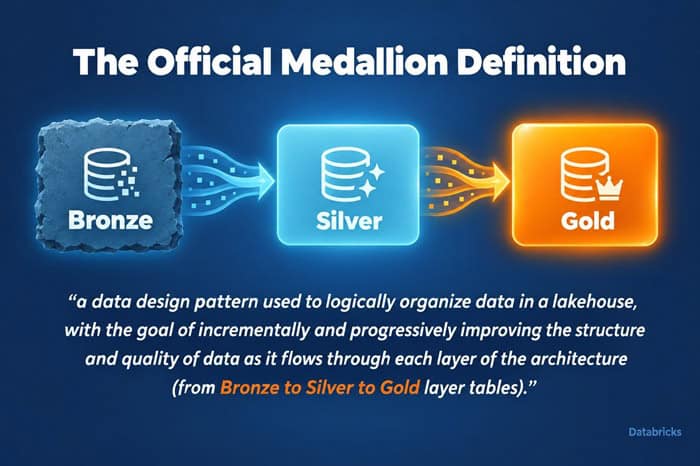
Medallion architecture is a data design pattern that organizes data in a lakehouse across three progressive layers, Bronze, Silver, and Gold, each representing a higher level of data quality and business readiness than the last.
Databricks officially defines it as “a data design pattern used to logically organize data in a lakehouse, with the goal of incrementally and progressively improving the structure and quality of data as it flows through each layer of the architecture (from Bronze to Silver to Gold layer tables).” Raw data lands in the bronze layer untouched. The silver layer cleanses and conforms it. The gold layer delivers aggregated, business-ready outputs for dashboards, AI models, and executive reporting.
This sequential refinement is also called multi-hop architecture, because data hops through each layer before reaching its final destination.
Most data quality problems are actually architecture problems. When raw data and production analytics share the same storage layer, errors compound, reprocessing is a nightmare, and nobody trusts the numbers. Medallion architecture solves that by giving every stage of data quality its own dedicated zone, with clear contracts between them.
What Is Medallion Architecture?
Like mentioned before medallion architecture is a structured, multi-hop framework for progressively refining data quality inside a data lakehouse, moving raw ingested records through cleansing and transformation stages until they reach an aggregated, analytics-ready state.
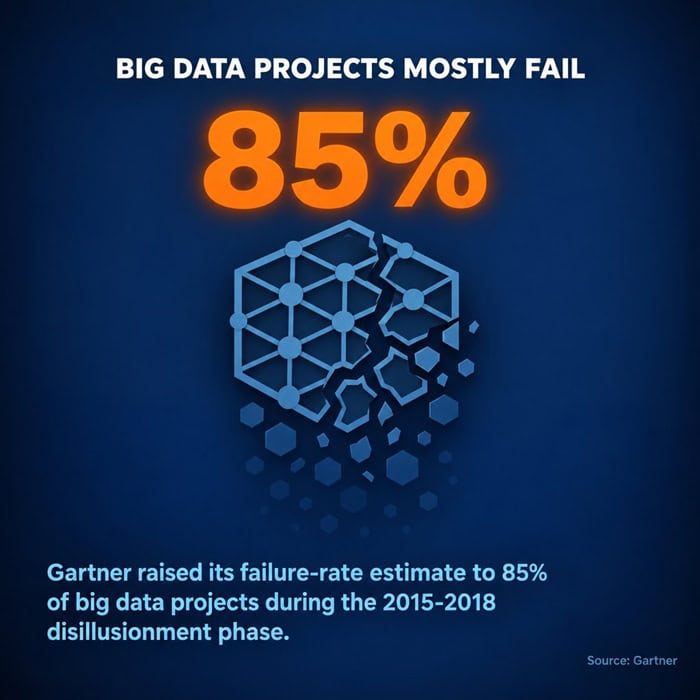
The architecture emerged as a direct response to a specific failure mode. Traditional data lakes stored everything but governed nothing. Research tracking Gartner’s Hype Cycle for big data documents how Gartner warned in 2014 that ungoverned lakes would become “data swamps,” and by the 2015-2018 disillusionment phase, Gartner raised its failure-rate estimate to 85% of big data projects.
Medallion architecture fixes the structure. It gives each data layer a distinct purpose, a defined quality contract, and a clear audience. Data engineers own the bronze layer. Analysts and data scientists work primarily in silver. Business leaders and dashboards consume gold.
The pattern also pairs naturally with ELT methodology, where data loads first and transforms in place, rather than the older ETL approach that required transformation before loading. In a medallion architecture, raw data ingestion into the bronze layer happens fast and unfiltered. Transformation logic runs afterward in the silver and gold layers, where compute is applied with purpose.
Of course, this isn’t a Databricks-only concept. The medallion architecture pattern applies across platforms including Microsoft Fabric, Snowflake, and Databricks, and works with open table formats like Apache Iceberg and Apache Hudi. The logic is format-agnostic, but the discipline is what matters.
The Three Layers of Medallion Architecture
Medallion architecture’s three layers, bronze, silver, and gold, form a sequential data quality pipeline where each layer feeds the next with progressively cleaner, more structured, and more business-relevant data.
The easiest way to picture it: bronze is your archive, silver is your workbench, and gold is your presentation layer. Each layer serves a different audience and carries different data quality expectations. None of them should be combined. When organizations collapse two layers together to save time, they almost always rebuild the separation later after debugging becomes impossible.
The table below summarizes the core characteristics of each layer:
| Layer | Data State | Primary Users | Key Operations | Data Quality Level |
|---|---|---|---|---|
| Bronze | Raw, unprocessed | Data engineers | Ingestion, metadata tagging, archiving | As-is from source |
| Silver | Cleansed, conformed | Data engineers, data scientists, analysts | Deduplication, validation, normalization | Trusted, consistent |
| Gold | Aggregated, business-ready | Business analysts, executives, AI models | Aggregation, star schema modeling, enrichment | Optimized for consumption |
Each layer runs as its own logical zone in the lakehouse. Data pipelines move records forward. Nothing moves backward during normal operations, though the bronze layer’s raw data preserves the ability to reprocess from the beginning if downstream logic changes.
Bronze Layer: Raw Data Ingestion
The bronze layer stores raw data exactly as it arrives from source systems, without transformation, filtering, or quality enforcement, making it the authoritative historical archive of everything the organization has ever ingested.
This is the most misunderstood layer. Teams new to medallion architecture sometimes want to clean data before it lands in bronze. Resist that instinct. The bronze layer’s value comes precisely from its completeness. When a downstream transformation rule changes six months from now, the bronze layer is where you reprocess from. If you filtered or transformed data before storage, that reprocessing option disappears.
What Goes Into the Bronze Layer
The bronze layer accepts data from any source: databases, APIs, streaming event systems, flat files, IoT sensors, ERP exports. In an energy company context, for example, that might mean raw SCADA readings, maintenance logs, and sensor telemetry arriving at different intervals from different systems. Nothing gets rejected at ingestion.
Typical data ingestion operations at the bronze layer include metadata tagging (adding source system name, ingestion timestamp, and batch ID), schema-on-read capture, and append-only writes. The bronze layer does not enforce schema on write. It captures whatever arrives.
Both batch ingestion and streaming ingestion are valid at the bronze layer. Delta Lake’s official documentation describes how its unified batch and streaming support, backed by ACID transactions via a file-based transaction log, allows bronze layer tables to accept both batch loads and real-time streams without separate infrastructure.
Why the Bronze Layer Exists
The bronze layer solves two problems at once: auditability and reprocessing. Every raw record is preserved with its original values. If a business rule changes, or a bug corrupts silver layer data, teams reprocess from bronze rather than re-extracting from source systems. That recovery path is only possible because bronze stayed untouched.
Data governance and regulatory compliance also depend on the bronze layer. In life sciences and manufacturing, regulators sometimes require proof that reported analytics trace back to original source records. Bronze provides that lineage. Without it, auditability collapses.
Silver Layer: Cleansed and Conformed Data
The silver layer applies data cleansing, deduplication, schema enforcement, and validation to bronze layer records, producing a trusted, conformed dataset that data scientists and analysts can query without worrying about data quality issues.
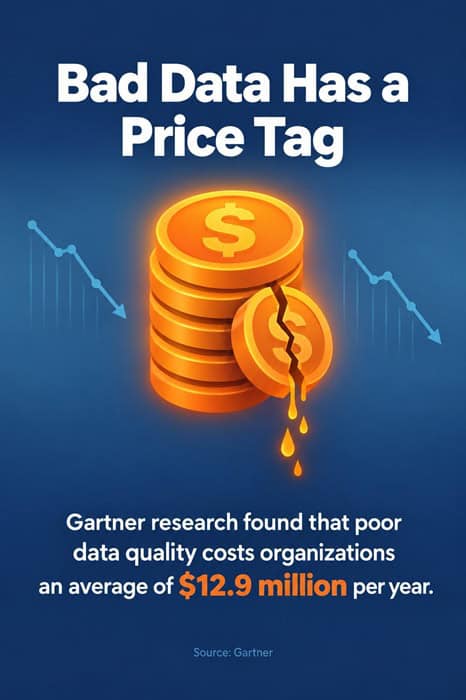
The cost of skipping this layer shows up fast. Gartner research found that poor data quality costs organizations an average of $12.9 million per year. That figure represents decisions made on bad numbers, AI models trained on dirty data, and analysts spending hours reconciling discrepancies instead of generating insight. The silver layer is where you stop that bleed.
Data Cleansing and Deduplication
Silver layer processing starts with data cleansing: removing null values that violate business rules, standardizing formats (dates, phone numbers, currency codes), and correcting structural errors inherited from source systems. A restaurant chain pulling POS data from dozens of locations will see inconsistent item naming, duplicate transaction IDs, and timezone mismatches. The silver layer resolves all of it.
Deduplication is one of the most operationally important steps in the silver layer. Source systems frequently emit duplicate records, especially in event-driven architectures where at-least-once delivery is guaranteed. The silver layer identifies and collapses duplicates using deterministic or probabilistic matching logic, depending on the data type.
Schema enforcement happens here too. Unlike the bronze layer’s schema-on-read approach, the silver layer enforces a defined schema on write. Records that don’t conform get routed to a quarantine table, not silently dropped which is important for auditability.
Normalization and Validation
After cleansing, the silver layer normalizes data across sources. If a manufacturing operation pulls machine data from three different vendors with three different unit conventions, normalization creates a single consistent representation. Every downstream consumer sees the same values in the same format.
Validation rules define what “trusted” means in context. A valid customer record might require a non-null email, a valid US state code, and an account creation date before today. Records passing validation flow to gold. Records failing validation flow to a monitoring queue for investigation.
Data transformation in the silver layer typically runs via Apache Spark jobs orchestrated through tools like Delta Live Tables or Apache Airflow. Incremental processing is the standard pattern: each run processes only records added since the last checkpoint, keeping compute costs manageable as data volumes grow.
Gold Layer: Business-Ready Analytics
The gold layer aggregates conformed silver layer data into dimensional models, summary tables, and domain-specific datasets optimized for dashboards, executive reporting, and AI model training, delivering the highest level of data quality in the medallion architecture.
The gold layer is where data stops being a technical asset and becomes a business asset. Everything upstream served the gold layer’s goal: giving business leaders, analysts, and AI systems data they can act on without second-guessing its accuracy.
Dimensional Modeling and Star Schema
Gold layer design typically follows Kimball-style dimensional modeling, organizing data into fact tables and dimension tables arranged in a star schema. A fact table might store sales transactions. Dimension tables store customers, products, stores, and dates. Business analysts run queries against this structure without touching raw data or silver layer joins.
Star schema at the gold layer produces significant query performance gains because the model is pre-joined and pre-aggregated. A Power BI report querying a gold layer sales fact table runs in seconds. The same report querying normalized silver layer tables might time out. That performance gap is the practical reason gold layer modeling exists.
Aggregation and Business-Specific Datasets
The gold layer typically contains multiple domain-specific datasets, not a single monolithic table. A food service company might maintain separate gold tables for guest experience metrics, supply chain performance, and labor efficiency. Each serves a different business function with different refresh cadences and different aggregation logic.
AI and ML workflows draw heavily from the gold layer. Survey data from Yellowbrick shows that 85% of lakehouse users are developing AI models or plan to. Gold layer data, clean, conformed, and domain-modeled, is what makes those AI initiatives viable rather than aspirational. Training a model on bronze layer raw data without medallion architecture’s intermediate cleansing produces unreliable outputs.
Time travel and ACID transaction support at the gold layer, enabled by formats like Delta Lake, allow teams to audit any prior state of a gold table. If a quarterly report needs to reflect data as it stood on the last day of the quarter, time travel queries against the gold layer deliver that without rebuilding from scratch.
Key Benefits of Medallion Architecture
Medallion architecture delivers five concrete operational benefits:
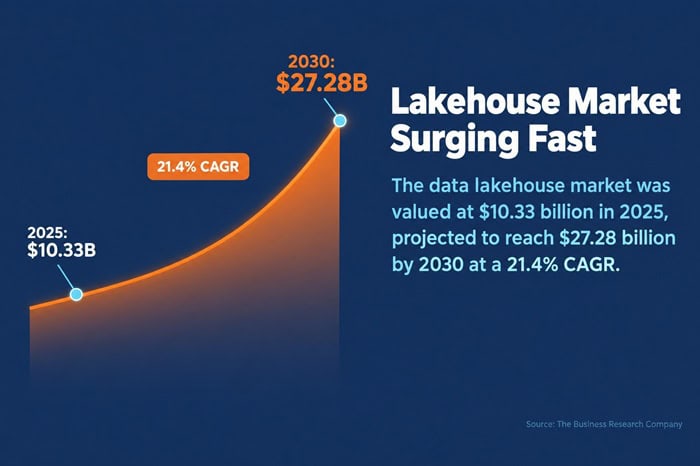
The data lakehouse market is growing fast precisely because these benefits compound. The Business Research Company’s global market report valued the data lakehouse market at $10.33 billion in 2025, projecting growth to $27.28 billion by 2030 at a 21.4% CAGR. That growth reflects real organizational demand for architectures that solve data quality at scale, not just store data cheaply.
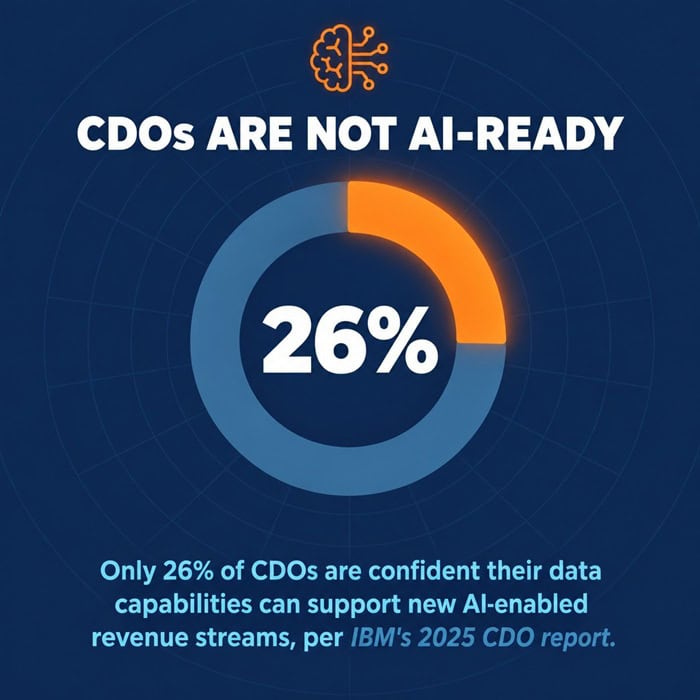
And yet most organizations still struggle to convert data investment into AI-ready capability. IBM’s 2025 CDO report found that only 26% of CDOs are confident their data capabilities can support new AI-enabled revenue streams. Medallion architecture directly addresses the structural gap behind that number.
The specific benefits worth calling out:
Common Challenges and How to Avoid Them
The four most common implementation failures in medallion architecture are layer collapse, gold layer overdesign, missing data quality enforcement at layer boundaries, and poor governance of bronze layer access.
Layer collapse is the most frequent. Teams under deadline pressure merge bronze and silver logic into a single pipeline to save time. The problem surfaces six months later when a data quality issue requires reprocessing, and the clean separation that would have made that straightforward no longer exists. Keep the layers physically and logically separate from day one. The short-term pressure to collapse them is never worth the long-term debugging cost.
Gold layer overdesign is the opposite failure. Teams spend months modeling a perfect dimensional schema before any business user has touched the data. Build the gold layer incrementally, starting with the highest-priority reporting domain and expanding outward as actual usage patterns clarify what’s needed.
Skipping automated data quality checks at the bronze-to-silver and silver-to-gold transitions is where data governance breaks down. Manual checks don’t scale. A data pipeline that passes bad data silently to the next layer undermines the entire data quality progression that medallion architecture promises. Automate the checks, log the failures, and alert on threshold breaches.
Bronze layer access controls matter more than most teams realize. If analysts query bronze directly because gold and silver aren’t ready yet, that habit becomes permanent. Raw data ingestion tables contain unvalidated, potentially sensitive records. Lock bronze to data engineers, expose silver to data scientists, and put gold in front of business users. That access model enforces the data quality contract that the architecture creates.
The multi-hop architecture also requires careful thought about latency. Streaming workloads that need near-real-time gold layer availability require pipeline orchestration that can propagate records from bronze through silver to gold within minutes. Batch-only pipelines with overnight silver and gold updates won’t serve those use cases. Design for your actual latency requirements before selecting orchestration tooling.
Medallion Architecture in the Broader Data Strategy
Medallion architecture is the structural foundation that connects raw data ingestion to AI-ready analytics, and it works best when paired with a data governance framework, a clear data ownership model, and a platform strategy aligned to the organization’s cloud environment.
Over 50% of data teams are now implementing lakehouse patterns according to data engineering benchmark data from Folio3. The pattern’s adoption reflects a broader shift: organizations moving away from patchwork data environments where lakes and warehouses operate in parallel, toward unified architectures where a single data foundation serves every workload from operational reporting to machine learning.
Data mesh architectures can coexist with medallion architecture. In a federated model, individual business domains own their own bronze-to-gold pipelines, while central governance enforces data quality standards and interoperability contracts at the silver and gold layers. The medallion architecture provides the layer structure; data mesh provides the ownership model.
For organizations in energy, life sciences, or manufacturing, where regulatory reporting and operational safety depend on data accuracy, medallion architecture isn’t an optional optimization. It’s the difference between a data foundation that can be audited and defended, and one that can’t. The bronze layer’s raw preservation satisfies audit requirements. The silver layer’s validation eliminates reporting errors. The gold layer’s modeling makes that accuracy accessible to the people who need it.
Getting the architecture right up front is faster than rebuilding a collapsed one later. If your organization is evaluating how to structure a data lakehouse or modernize an existing data pipeline, the medallion pattern gives you a blueprint that scales from a single department to the entire enterprise without redesign.
Ready to make your data ready for what’s next? Smartbridge works with mid-market and enterprise organizations to design and implement data foundations built for speed, clarity, and focus. Talk to our Data & Analytics team about where medallion architecture fits in your transformation roadmap.