

Clinical Data Management: Systems, Standards and Modernization
Clinical data management is what turns raw trial data into a clean, accurate, submission-ready dataset. This guide breaks down the CDM lifecycle, the systems and standards behind it, and the practices that help life sciences organizations improve data quality, reduce downstream issues, and support more reliable regulatory submissions.
Clinical data management (CDM) is the complete process of collecting, validating, storing, and preparing clinical trial data for regulatory submission, with the primary goal of producing a clean, accurate dataset that supports reliable statistical analysis and drug approval decisions.
CDM spans the full trial lifecycle, from Case Report Form (CRF) design and database build through electronic data capture (EDC), data validation, discrepancy management, medical coding, and database lock. It operates under strict regulatory frameworks including 21 CFR Part 11, Good Clinical Practice (GCP), and ICH guidelines, and relies on data standards such as CDISC’s SDTM and CDASH to make trial data submission-ready and interoperable.
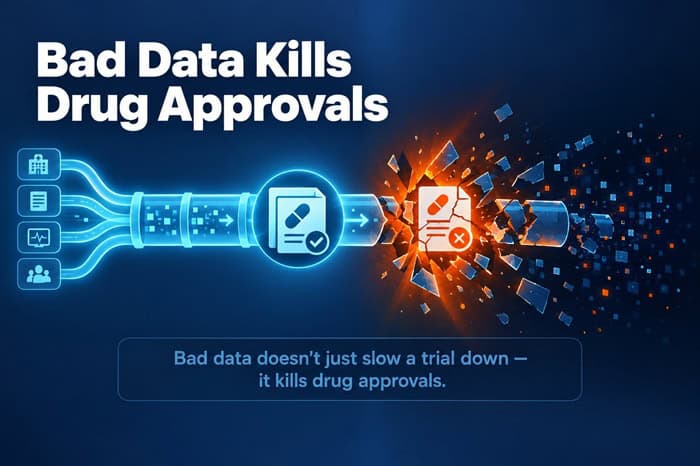
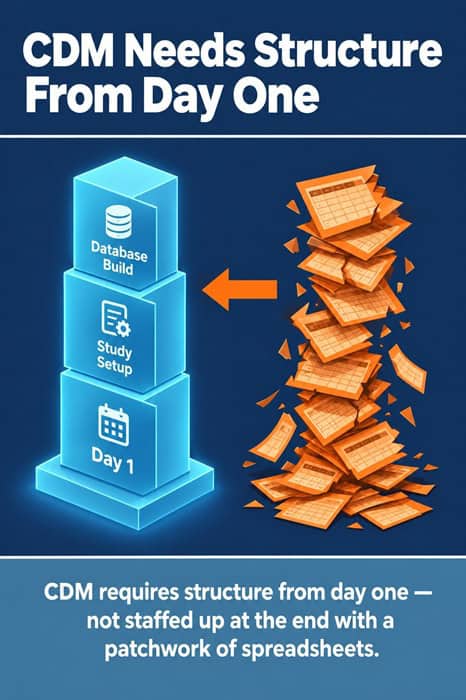
Bad data can slow a trial down and kill drug approvals. And yet, clinical data management is still the piece of the clinical research process that gets treated like an afterthought, and still expected to produce submission-quality data on a deadline. CDM works differently by requiring structure from day one. This guide covers the full picture: what CDM is, how the lifecycle runs, who does what, what tools are actually used, and how regulatory standards connect to every step.
What Clinical Data Management Does in a Clinical Trial
Like we mentioned before, clinical data management is the discipline responsible for ensuring that every data point collected during a clinical trial is accurate, complete, and audit-ready before it reaches a biostatistician or a regulatory agency. CDM bridges the gap between clinical operations and statistical analysis.
The work isn’t glamorous. Case Report Form (CRF) design, edit check programming, query resolution, Serious Adverse Event (SAE) reconciliation, database lock. But every one of those activities protects data integrity, and data integrity is what separates an approvable submission from a complete response letter. The FDA and EMA don’t accept guesses. CDM produces the chain of custody for the evidence that they do require.
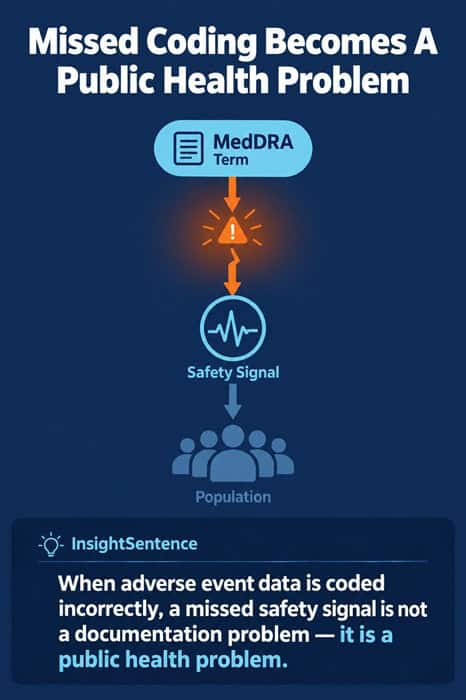
Clinical data management also connects directly to patient safety. When adverse event data is coded incorrectly, or a lab value slips through without a validation check, the downstream effect can be a missed safety signal. This can become a public health problem. CDM teams carry real accountability in every trial they touch.
For life sciences organizations running multiple concurrent trials, CDM is also a scale problem. Each study needs its own Data Management Plan, its own database, its own validation plan. Without a structured CDM function, that complexity creates exactly the kind of data environment that delays submissions and invites regulatory scrutiny.
The CDM Lifecycle: Study Setup, Conduct, and Closeout
The clinical data management lifecycle runs in three defined stages: study setup, study conduct, and study closeout, each with distinct deliverables and quality gates that must be completed before the next stage begins.
Study Setup: Building the Data Foundation
Setup is where CDM decisions either enable or constrain everything that follows. The Data Management Plan (DMP) is the first critical deliverable. The DMP documents how data will be collected, validated, coded, stored, and locked. It names the EDC system, defines data standards, assigns responsibilities, and sets timelines. A weak DMP creates ambiguity. Ambiguity creates queries. Queries delay database lock.
CRF design happens in parallel. Every Case Report Form, whether paper or electronic (eCRF), maps to specific data points the protocol requires. Good CRF design minimizes data entry errors by constraining inputs, using logical skip patterns, and including field-level instructions. Poor CRF design guarantees a high query rate, which means the CDM team spends the entire conduct phase cleaning up problems that could have been prevented.
The database build follows CRF design. The EDC system is configured to match the approved CRF structure, and edit checks are programmed to catch protocol deviations, out-of-range values, and logical inconsistencies at the point of entry. User Acceptance Testing (UAT) validates that the database and edit checks work as specified before the first patient is enrolled. Skipping or rushing UAT is one of the most common CDM mistakes, and it always costs more time later than it saves upfront.
Study Conduct: Data Collection and Cleaning
During the conduct phase, sites enter data into the EDC system, edit checks fire in real time, and the CDM team manages the resulting queries. A query is a discrepancy flag: the data entered doesn’t match what’s expected based on the protocol, the edit check logic, or internal consistency rules. Sites review queries, respond with corrections or clarifications, and CDM closes or escalates them.
This is also when external data reconciliation happens. Lab data, ECG data, and patient-reported outcome data come from vendors outside the EDC system. CDM reconciles those external datasets against the trial database to ensure consistency. Serious Adverse Event (SAE) reconciliation is a specific and critical part of this process. SAE data reported through pharmacovigilance systems must match what’s in the clinical database exactly. Discrepancies between the two create regulatory risk.
Medical coding runs throughout the conduct phase. Adverse events get coded using MedDRA (Medical Dictionary for Regulatory Activities). Concomitant medications get coded using the WHO Drug Dictionary. Coding accuracy matters because coded terms drive safety analyses. A coder who maps a broad term when a specific one applies can obscure a drug-related safety pattern that regulators need to see.
Study Closeout: Locking the Database
Closeout centers on database lock. Before lock, all outstanding queries must be resolved, all external data must be reconciled, all SAE discrepancies must be addressed, and a final quality review must confirm the dataset is clean. Medical coding review is completed. Protocol deviation listings are finalized. Then the database is locked, meaning no further changes can be made without a formal documented process.
After lock, the data is transferred to biostatistics for analysis, and CDM prepares CDISC-compliant submission datasets. SDTM (Study Data Tabulation Model) maps the raw trial data into a standardized structure the FDA and EMA can process. This is where CDM hands off to the regulatory submission process. A clean, well-documented database lock is the foundation of a clean regulatory package.
Key Processes That Define Data Quality in Clinical Research
Data quality in clinical data management depends on four interconnected processes: CRF design and annotation, data validation, discrepancy management, and medical coding. Each one is a point of control. Miss any of them, and you’re cleaning up the resulting mess at database lock, when time pressure is highest.
CRF Design and Annotation
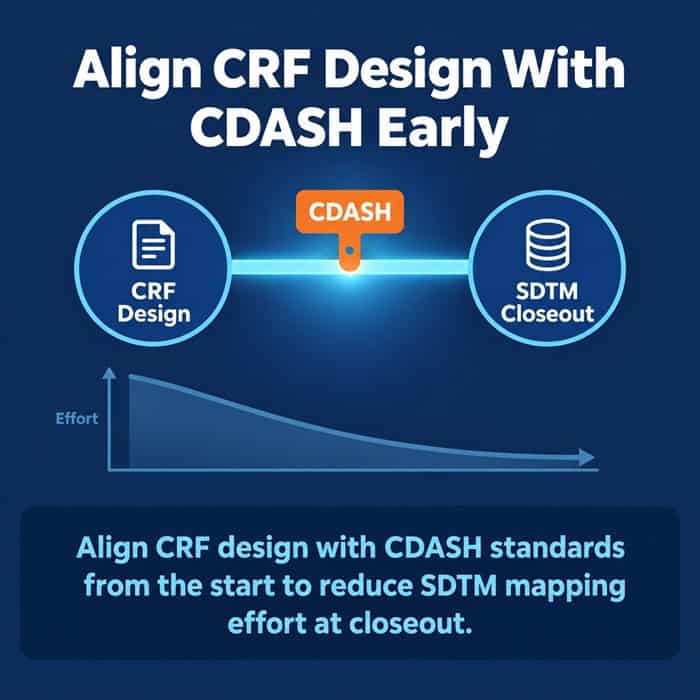
Case Report Form annotation is the process of linking each CRF field to its corresponding database variable. Annotated CRFs document the mapping between what the site sees and what the database stores, which is essential for audit purposes and CDISC alignment. For CDASH (Clinical Data Acquisition Standards Harmonization), annotation also connects data collection to submission-ready variables, reducing the transformation work required at the SDTM stage.
Every field on a CRF represents a decision: what data type, what validation rule, what skip logic. Those decisions compound. A trial with 200 CRF pages and poorly annotated fields is a documentation nightmare waiting to happen. Well-annotated CRFs make database build faster, UAT more precise, and submission dataset mapping more direct.
Data Validation and Edit Checks
Data validation is the systematic process of verifying that collected data meets predefined quality criteria. Edit checks are the automated rules programmed into the EDC system to perform that verification. They catch range violations, missing required fields, logical inconsistencies between fields, and protocol deviations in real time.
The data validation plan documents every edit check, its trigger condition, and the expected response. A well-designed validation plan reduces the manual query burden on the CDM team and catches errors before they propagate through the dataset. The goal isn’t to generate as many queries as possible. It’s to catch genuine data quality problems early enough to resolve them efficiently.
Discrepancy Management and Query Resolution
Discrepancy management is the structured process of identifying, tracking, and resolving data queries. Queries flow from CDM to the clinical site, the site responds, and CDM reviews the response. Every query and every response is captured in the EDC audit trail. That audit trail is a regulatory requirement under 21 CFR Part 11 and GCP.
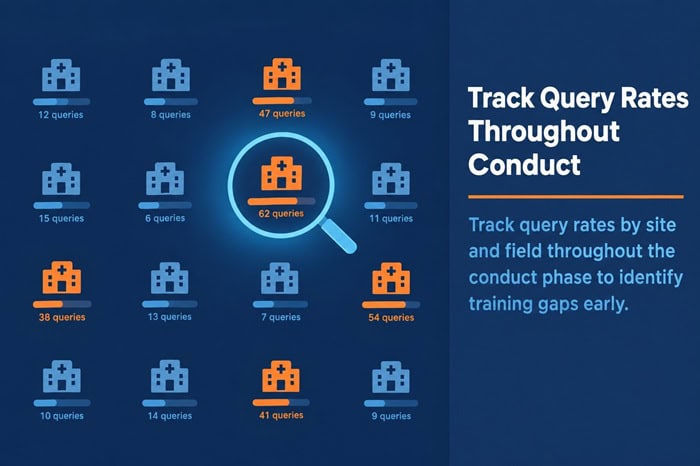
Query management metrics matter. High query rates at specific sites often signal data entry training issues or site-level protocol misunderstandings. CDM teams that track query volume by site and field can flag these patterns early and loop in clinical operations before a site becomes a data quality liability.
Roles and Responsibilities in a CDM Team
A clinical data management team is a cross-functional group with defined roles that span the full trial lifecycle, each carrying specific accountabilities for data quality and regulatory compliance.
The Clinical Data Manager is the central role. They own the DMP, coordinate database design, manage the validation plan, oversee query resolution, and drive the database lock process. They’re the person who has to say “no, the database is not ready to lock” when pressure is mounting from sponsors and timelines are slipping. That accountability requires both technical knowledge and organizational backbone.
The Database Programmer (or EDC Builder) translates the approved CRF design and edit check specifications into a functional database. They work in the EDC system, configure eCRFs, and program the validation rules. Their work has to pass UAT before the study goes live. One missed edit check at this stage creates queries for the entire conduct phase.
The Medical Coder codes adverse events in MedDRA and concomitant medications in the WHO Drug Dictionary. Coding accuracy requires clinical knowledge, familiarity with coding conventions, and attention to specificity. Coders who apply high-level preferred terms when lower-level specific terms exist reduce the signal quality of safety analyses.
Clinical Research Associates (CRAs) and Clinical Research Coordinators (CRCs) are the site-facing roles. CRAs monitor data quality at sites and are often the first to identify patterns that generate queries. CRCs enter data at the site level and respond to queries. Their training directly affects the upstream data quality that CDM teams receive.
Biostatisticians receive the locked database and perform statistical analysis. They work from the clean dataset CDM delivers. Any data quality issues that survive database lock become statistical analysis problems, and at that stage, they’re much harder and more expensive to address.
Regulatory Standards and Compliance in CDM
Clinical data management operates under a framework of regulatory standards that govern how data is collected, stored, modified, and submitted, with the primary objective of ensuring data integrity throughout the trial lifecycle.
21 CFR Part 11 and Electronic Records
21 CFR Part 11 is the FDA regulation that establishes requirements for electronic records and electronic signatures in clinical trials. Under 21 CFR Part 11, any electronic record used in a regulated trial must include a complete, computer-generated audit trail that captures who made a change, what the change was, and when it occurred. The regulation also requires that electronic signatures are unique to the individual, cannot be repudiated, and are linked to their respective electronic record.
EDC systems must be 21 CFR Part 11 compliant to be used in FDA-regulated trials. System validation is how organizations demonstrate that compliance. A CDM team operating without documented system validation is operating with regulatory exposure that can surface during an FDA inspection.
GCP and ICH Guidelines
Good Clinical Practice (GCP) is the international quality standard for clinical trial design, conduct, recording, and reporting, codified in ICH E6. GCP requires that clinical data be recorded, handled, and stored in ways that ensure accurate reporting, interpretation, and verification. Data integrity is explicit in GCP: every data point must be traceable to its source.
The ICH E6(R3) revision, which updated the GCP standard, places greater emphasis on risk-based approaches to data quality, including Risk-Based Quality Management (RBQM). RBQM shifts some quality oversight from 100% source data verification to targeted monitoring based on identified risk signals, which changes how CDM teams structure their query management and how CRAs prioritize site monitoring.
CDISC Standards: SDTM and CDASH
CDISC (Clinical Data Interchange Standards Consortium) standards are the data format requirements that FDA and EMA now mandate for regulatory submissions. SDTM organizes clinical trial data into a standardized tabular structure that regulatory reviewers can process consistently across submissions. CDASH provides standards for data collection, connecting the eCRF design to downstream SDTM mapping.
Organizations that build their CRFs and databases in CDASH-aligned formats from the start reduce the transformation work required to produce SDTM submission datasets. Organizations that ignore CDISC standards during setup spend significantly more time at closeout mapping non-standard data to SDTM domains, which delays submission timelines and creates additional quality review burden.
Good Clinical Data Management Practices (GCDMP)
The Society for Clinical Data Management (SCDM) publishes Good Clinical Data Management Practices (GCDMP), the industry-recognized guidance document for CDM best practices. GCDMP covers the full CDM lifecycle, from DMP creation through database lock, and provides specific guidance on CRF design, data validation, SAE reconciliation, and medical coding. GCDMP isn’t a regulatory requirement, but it represents the professional standard for CDM practice and is widely referenced in audit responses and inspection preparation.
Data Privacy, Security, and PHI Handling in CDM
Clinical data management handles some of the most sensitive personal data that exists: patient health information (PHI) and personally identifiable information (PII) collected during clinical trials, which requires strict controls for de-identification, access management, and data security.
HIPAA governs PHI handling in US-based trials. Clinical trial databases contain information that can identify individual patients, including dates, diagnoses, and demographic data. De-identification is the process of removing or obscuring identifying elements so that data can be shared for analysis without exposing patient identity. EDC systems must enforce role-based access controls so that only authorized personnel can view identified patient data.
Data security in CDM isn’t just about HIPAA compliance. Sponsor data is commercially sensitive. An EDC database for a Phase III oncology trial contains competitive intelligence worth protecting. Cloud-based EDC platforms have largely replaced on-premise systems, which shifts security responsibility toward the vendor but doesn’t eliminate the sponsor’s obligation to verify that the vendor’s controls meet regulatory and contractual requirements.
Data privacy regulations outside the US, including GDPR in the European Union, add additional requirements for data subjects’ rights, cross-border data transfer, and breach notification. Global trials require CDM teams to understand which regulations apply in each jurisdiction and how those requirements affect data collection, storage, and transfer protocols.
Challenges and Best Practices in Modern Clinical Data Management
Modern clinical data management faces a specific set of structural challenges: fragmented data sources, increasing study complexity, compressed timelines, and a growing regulatory expectation for real-time data quality oversight rather than end-of-study cleaning.
The fragmentation problem is real. A single clinical trial might collect data from an EDC system, central labs, wearables, electronic patient-reported outcomes (ePRO), pharmacy dispensing systems, and imaging vendors. Each external source arrives in a different format, on a different schedule, and requires reconciliation against the core trial database. CDM teams that don’t build reconciliation workflows into the setup phase spend the entire conduct period managing exceptions.
Risk-Based Quality Management, referenced in ICH E6(R3), is the framework that addresses this directly. RBQM identifies critical data and critical processes before the trial starts, focuses monitoring resources where data quality risk is highest, and uses centralized statistical monitoring to detect anomalies across sites. It’s a more rational approach to data quality oversight than blanket 100% verification, and it scales better as trial complexity increases.
Practical CDM Best Practices
The CDM teams that consistently deliver clean database locks on time share a few habits. They finalize the DMP before the first site is activated. They complete UAT rigorously and document it. They track query metrics by site from day one of the conduct phase, not just at the end. They maintain an active external data reconciliation log throughout the study rather than attempting to reconcile everything at closeout.
Medical coding accuracy deserves specific attention. MedDRA coding decisions made during the conduct phase directly affect safety narratives in the clinical study report. Coders working under time pressure at database lock are more likely to accept higher-level terms to close queries quickly. Building coding review into regular data quality cycles, not just closeout, produces more accurate and defensible safety coding.
The technology side is shifting. AI-assisted query management tools are beginning to enter the CDM space, promising to reduce manual query volume by predicting likely discrepancies before they generate formal queries. Natural language processing is being applied to narrative adverse event data to support
MedDRA coding. These tools don’t replace CDM expertise, but they do change where that expertise gets focused. The CDM professionals who will be most effective in the next decade are the ones who understand both the regulatory framework and the data infrastructure well enough to evaluate, configure, and govern these tools responsibly.
That’s exactly where life sciences organizations working with a strategic partner like Smartbridge gain an advantage. Integrating modern data infrastructure, intelligent automation, and regulatory-grade data governance isn’t a one-time project. It’s a continuous capability that requires both clinical domain knowledge and technical depth. Our life sciences practice works with organizations at the intersection of clinical operations and digital transformation, building data foundations that support both current trial requirements and the capabilities that come next.
The organizations that build structured, regulatory-grade CDM capabilities now are the ones that will move faster when trial volumes increase and submission timelines compress. Ready to make your clinical data ready for what’s next? Talk to a Smartbridge expert.