
Veeva Vault for Life Sciences: What It Does and Where It Fits
Veeva Vault runs clinical, regulatory, quality, safety and commercial applications on one validated platform. A plain guide to what each application family does, who owns it, and the 2029 CRM deadline and AI agent rollout shaping your roadmap.
Veeva Vault is a cloud content and data management platform for life sciences companies, running clinical, regulatory, quality, safety, medical and commercial applications on one validated system. Buyers, new hires and IT leaders need a plain account of what the platform does and where each piece fits.
For most leaders, the real choice sits one level up. You have to decide which application families to adopt, and in what order. Two dates sharpen that decision. Veeva will support its legacy Salesforce-based CRM until December 31, 2029. Veeva also scheduled its AI agent rollout to finish with Clinical Data in December 2026.
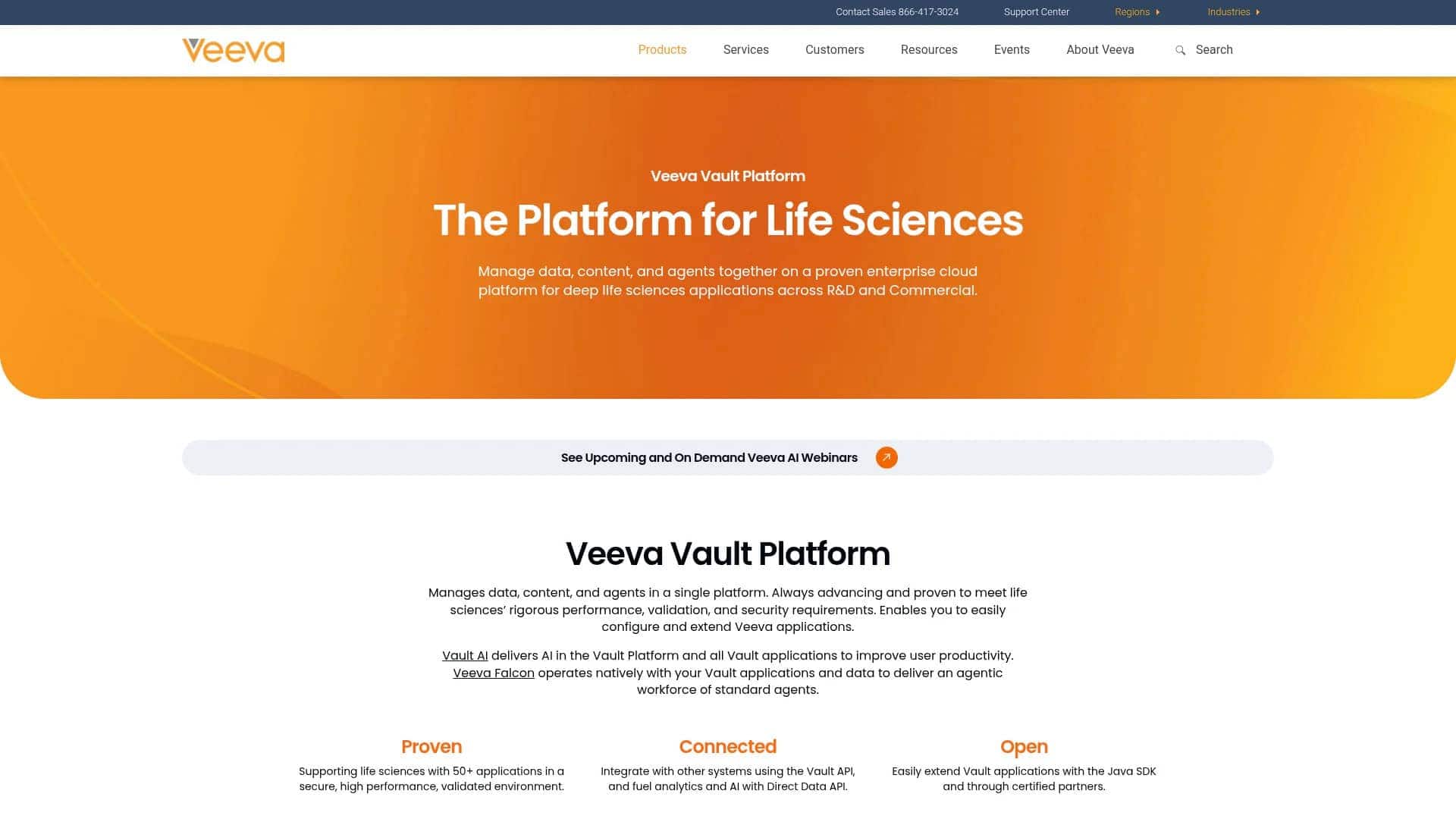
Veeva Vault Platform product page describing unified data, content and AI agents for life sciences
Veeva Vault Is One Validated Platform Carrying 50+ Applications
The first Vault application you configure sets the pattern for every one after it. Veeva describes the Vault Platform as one system that manages data, content and AI agents together. By Veeva’s own count, it supports 50+ applications in a validated environment across R&D and Commercial.
Vault manages the regulated records life sciences companies must control. On the R&D side, that means clinical trials, regulatory submissions, quality processes and product safety. On the Commercial side, it covers field sales, promotional content and medical engagement.
The practical consequence is reuse. Workflows, security roles and integrations built for one application give the second a familiar starting point. That cuts both ways. A poorly designed first Vault, with messy roles or naming, gets copied into every application after it, so design the first rollout as the data foundation for later modernization.
Every Vault Application Runs on the Same Core Platform
Admin skills learned in one Vault application carry into the next, because Quality, CRM and every other application are built from the same platform tools.
Documents, Binders and Workflows Behave the Same Everywhere
Documents are the base unit in every Vault, and each one carries its own version history. Binders group documents into a structured set, such as an electronic trial master file (eTMF) for a clinical study or a regulatory submission package. Workflows route content and records through review, approval and signature. Dashboards and search let teams check status and find content across the Vault.
When you evaluate a new application, find out how much of it is configuration of these shared tools and how much is new capability. That split tells you how much your existing admins can own without outside help.
Domains and Vaults Decide Who Sees What
Your domain structure is an early architecture decision that is hard to undo. A company can run one or more Vault domains, according to Veeva, and each domain holds one or more Vaults. Users can move between Vaults in the same domain without signing in again. Decide early how you will split Vaults across business units, regions or functions, because that split governs access and reporting later.
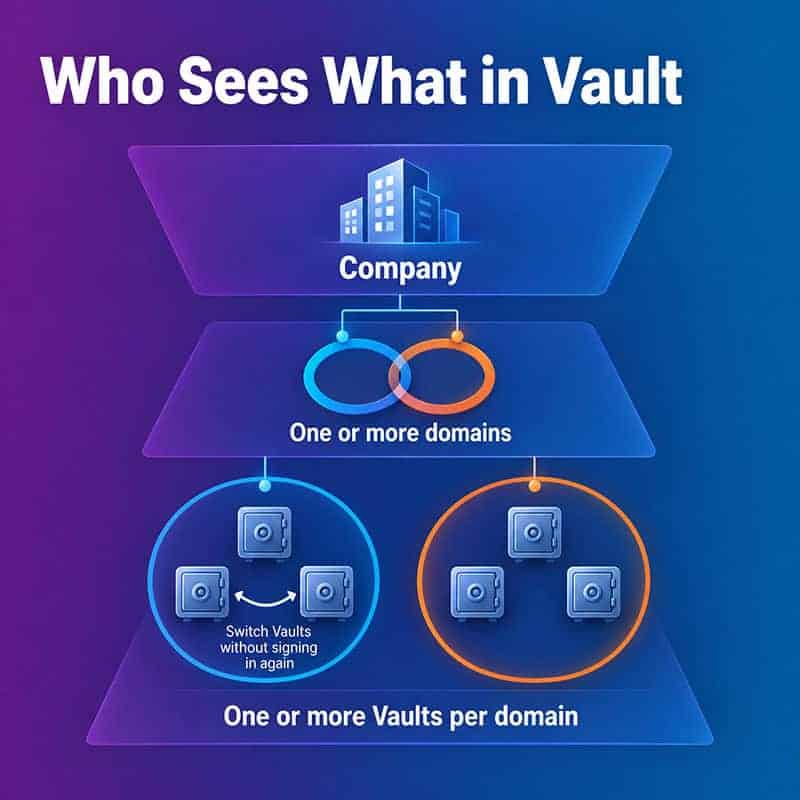
The domain split is hard to reverse later, so settle it before the first application goes live.
Veeva Runs Upgrades on a Shared Calendar
Veeva runs Vault as software-as-a-service and upgrades customers on its own release schedule. That removes the multi-year upgrade projects many on-premise systems carry. In their place, your team tests each release, a smaller job that recurs every few months.
Nine Vault Application Families and the Teams That Own Them
Vault’s applications fall into nine families, and each one maps to a distinct life sciences team. Ownership is the fastest way to read the portfolio. The table below shows what each family manages and who usually owns it.
| Application family | What it manages | Typical owner |
|---|---|---|
| Clinical Operations | Running trials, including eTMF | Clinical operations |
| Clinical Data | Trial data capture and cleaning (CDMS) | Clinical data management |
| RIM (Regulatory Information Management) | Submissions and registrations | Regulatory affairs |
| Safety | Adverse event cases | Pharmacovigilance |
| Quality | Quality documents and processes | Quality assurance |
| LIMS | Lab samples and test results | Quality control labs |
| Medical | Medical information and content | Medical affairs |
| CRM | Field engagement with healthcare professionals | Commercial operations |
| PromoMats | Promotional content review and approval | Marketing and brand teams |
Read the table against your org chart. Look for two teams in different families that swap documents by email today. That handoff is a strong candidate for an early Vault application, because both sides then work on the same platform.
Quality and lab families rarely stand alone. Deviations, lots and test results usually tie back to ERP and manufacturing systems, which is the same problem behind integrating an ERP with an eQMS in life sciences. Plan those connections before you sign, not after go-live.
Legacy Veeva CRM Support Now Ends December 31, 2029
Companies still on the Salesforce-based Veeva CRM now face a firm end date, and Veeva has moved that date earlier. Vault CRM is Veeva’s next-generation CRM, built on the Vault platform instead of Salesforce. Veeva has said it does not plan to renew its agreement to use the Salesforce platform.
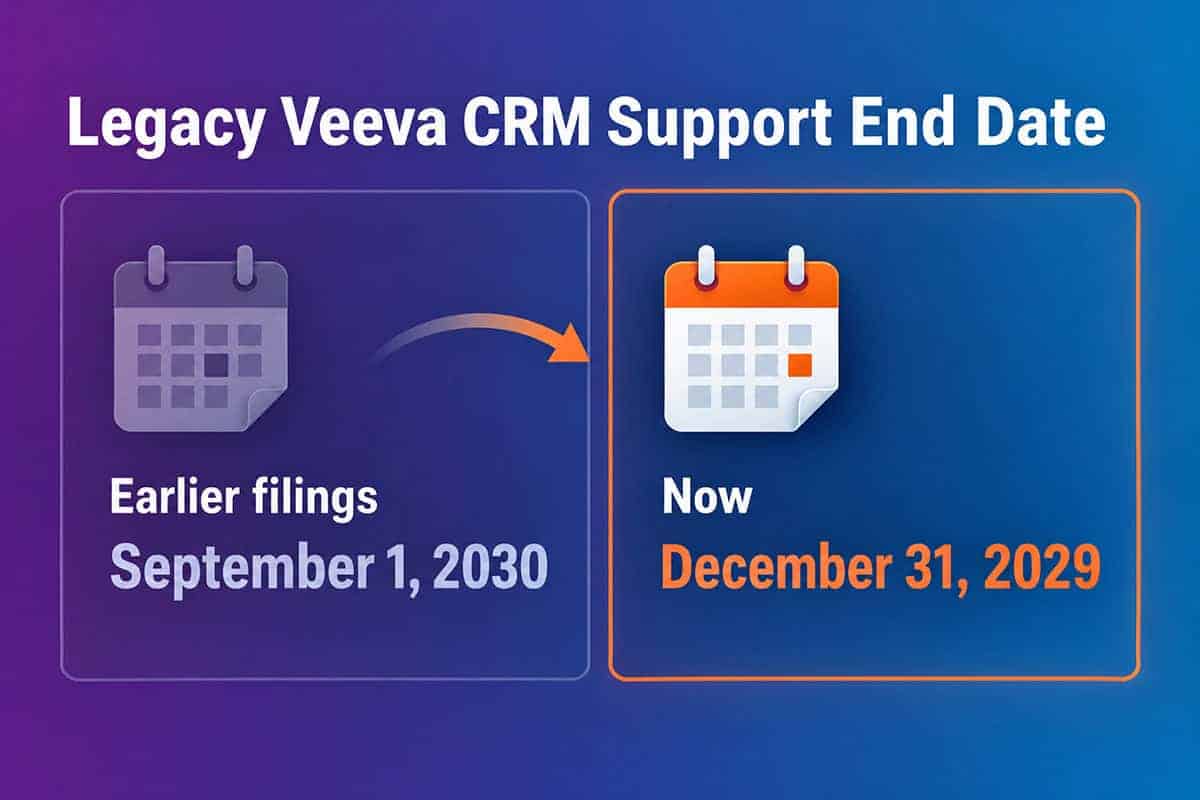
Moving the cutoff earlier removes about eight months, or roughly two release cycles, from any migration plan built around 2030.
Veeva now says it will support legacy Veeva CRM until December 31, 2029. Earlier filings gave September 1, 2030. Any roadmap built around 2030 has lost time. CRM migrations involve data, integrations, territory rules and user training. With three releases a year, the runway holds fewer release cycles than the calendar suggests.
Migration planning should give early attention to Engage content sharing and consent management. Consent records are customer data you cannot afford to lose or corrupt.
The deadline also reopens a platform question for some companies. A fair comparison of Veeva and Salesforce Life Sciences Cloud belongs early in that discussion, before migration scope is locked.
Vault Supports GxP Compliance, and Accountability Stays with You
Veeva Vault gives regulated companies a validated platform for GxP work, but accountability for compliance stays with the regulated company. GxP is shorthand for the good practice rules that govern regulated work, such as manufacturing and clinical practice.

Inspectors audit the regulated company, not its software vendor, so test evidence and procedures must be your own.
Two rules come up constantly. FDA’s 21 CFR Part 11 covers electronic records and electronic signatures in the US. Annex 11 of the EU GMP guidelines covers computerized systems. Validation work often includes installation qualification (IQ) and operational qualification (OQ), which confirm a system is installed correctly and works as specified.
Three misconceptions cause trouble. Buying Vault does not make a company Part 11 compliant. Vault supplies controls and validated releases, while your procedures, configuration, training and record-keeping decide compliance.
Veeva’s validation of its own software doesn’t remove your testing either. You still confirm your configuration behaves as intended, which is what sandbox access before each production upgrade is for.
Validation is also never a one-time project. Multiple releases a year mean impact assessments and test evidence need a refresh every cycle, so put ownership in writing for each Vault application.
Vault Upgrades Arrive on a Fixed Calendar, so Testing Is Routine
Vault applications upgrade on a fixed rhythm, and the teams that cope best treat release testing as standing work. Veeva documents three fully validated major releases a year for Vault CRM, one every four months. Each release reaches customer sandboxes two weeks before the production upgrade.
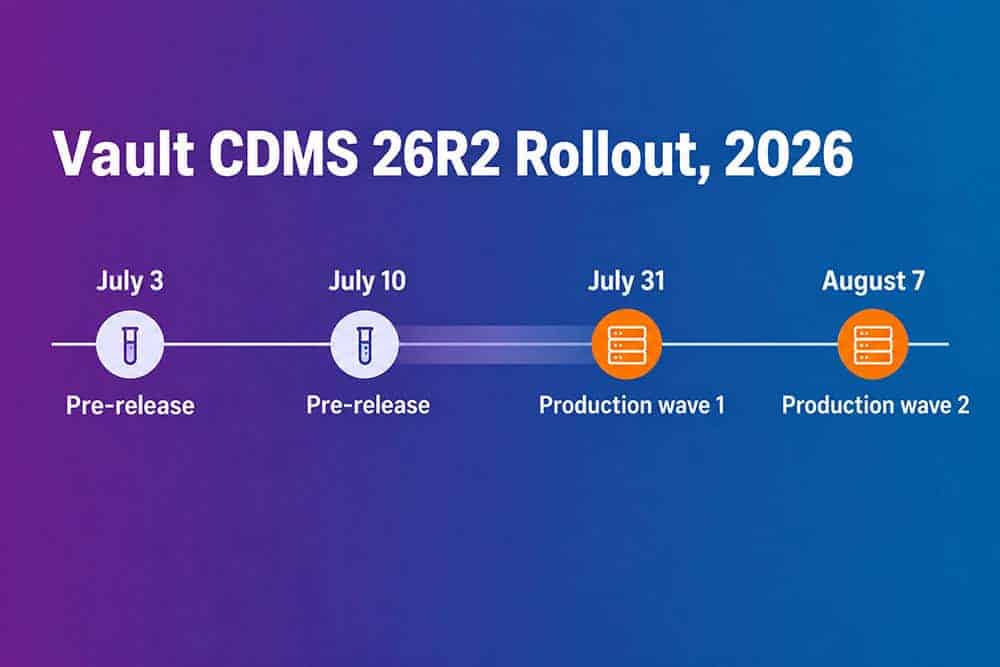
Knowing your wave assignment tells testers exactly when the sandbox window closes for your Vault.
Release names follow a year-and-number pattern, so 26R2 is the second general release of 2026. Rollouts happen in waves. Veeva staged Vault CDMS 26R2 with pre-release on July 3 and July 10, 2026. Production followed in two waves, on July 31 and August 7, 2026.
A standing release-readiness routine for each Vault application lets your team handle every upgrade with less guesswork.
Veeva AI Agents Are Rolling Out One Application at a Time
Veeva AI Agents reach each Vault application family on its own schedule, so the timing your team faces depends on which applications you run. In October 2025, Veeva published the planned rollout shown below.
| Application | Planned timing |
|---|---|
| Vault CRM | December 2025 |
| PromoMats | December 2025 |
| Safety | April 2026 |
| Quality | April 2026 |
| Clinical Operations | August 2026 |
| Regulatory | August 2026 |
| Medical | August 2026 |
| Clinical Data | December 2025 |
The first wave arrived on schedule. Veeva announced on December 3, 2025 that AI agents were available for Vault CRM and PromoMats. For the April and August 2026 waves, ask your Veeva account team which agents you can use in your current release.
Veeva is also building a separate product called Veeva Falcon, which it describes as an agentic labor platform for clinical, regulatory and safety work. In Veeva’s second-quarter fiscal 2027 results, Falcon had five early adopters and was on track for first go-lives in 2026. In the same quarter, Veeva acquired Copli and launched Veeva Falcon MLR, aimed at medical, legal and regulatory review.
Agents that draft, classify or route regulated content still sit inside validated processes. Settle how you will approach validating AI for GxP use before an agent touches a record an inspector might read.
Vault CRM Adoption Is Climbing, but the Biggest Migrations Lie Ahead
Veeva’s public numbers show a large, growing customer base and a CRM migration that is far from finished at the top of the market. Veeva’s fiscal year ends January 31, so fiscal 2027 runs from February 2026 to January 2027. The table separates results from forecasts and live customers from committed ones.
| Measure | Figure | Date | Type | Source |
|---|---|---|---|---|
| Total Veeva customers | 1,552 | Jan 31, 2026 | Result | Veeva 10-K |
| Commercial Solutions customers | 767 | Jan 31, 2026 | Result | Veeva 10-K |
| R&D and Quality customers | 1,196 | Jan 31, 2026 | Result | Veeva 10-K |
| Total revenue, fiscal 2026 | $3,195.3 million | Jan 31, 2026 | Result | Veeva |
| Total revenue, Q2 fiscal 2027 | $928.0 million | July 31, 2026 | Result | Veeva Q2 report |
| Revenue guidance, fiscal 2027 | $3,682M to $3,687M | Jan 31, 2027 | Forecast | Veeva guidance |
| Vault CRM live customers | More than 125 | Jan 31, 2026 | Live | Veeva Q4 report |
| Vault CRM live customers | More than 180 | Aug 26, 2026 | Live | Veeva Q2 results |
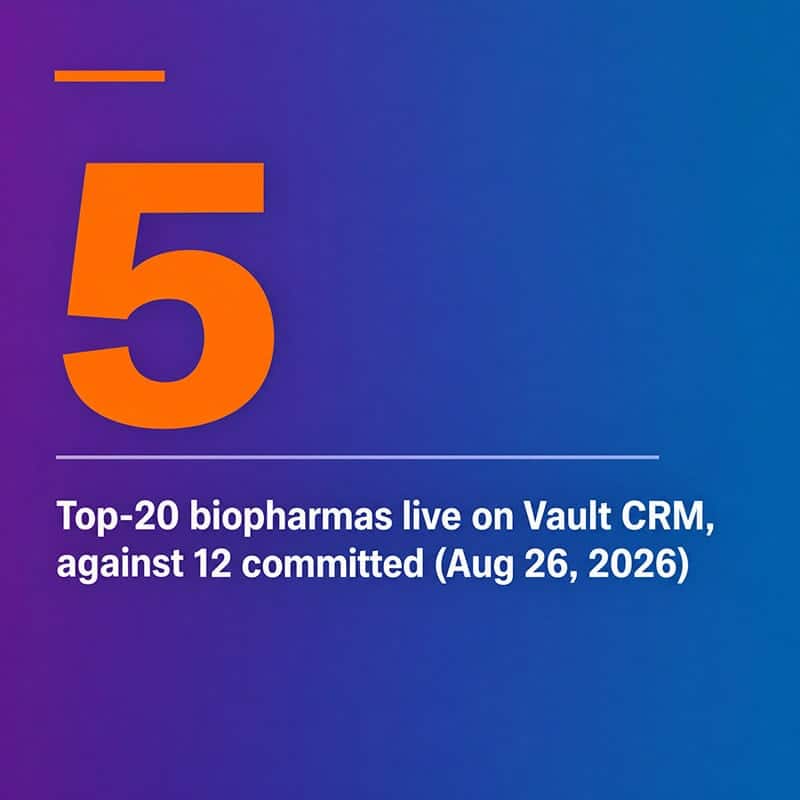
| Top-20 biopharmas live on Vault CRM | 5 | Aug 26, 2026 | Live | Veeva Q2 results |
| Top-20 biopharmas committed to Vault CRM | 12 | Aug 26, 2026 | Committed | Veeva Q2 results |
The customer counts cover all Veeva products, not only Vault. The two segments overlap, because some customers buy both. On growth, Veeva reported that fiscal 2026 revenue rose 16% year over year. Its Q2 fiscal 2027 revenue rose 18%.
The Vault CRM figures are the clearest public signal of migration pace. Live customers rose from more than 125 at the end of January 2026 to more than 180 by late August. Yet only five top-20 biopharmas were live, against 12 committed. Most of the largest, most complex migrations are still ahead, and they face the same 2029 cutoff as everyone else. Expect competition for experienced migration resources to tighten as that date approaches.
Signing in to Vault Starts with Your Company’s Domain or VeevaID
Most Vault sign-in and support questions get answered inside your own company first, because your Vault admin controls access. Work through these steps in order.
- 1Sign in with the Vault login your company provided. If your company uses single sign-on, start with your corporate login.
- 2Use VeevaID if you work in apps such as Study Portal, SiteVault or Study Training. VeevaID is Veeva’s identity provider for one login across those apps. Register from an admin invitation or sign up yourself at id.veeva.com.
- 3Switch between Vaults in the same domain from inside the app, without logging in again.
- 4Search the Vault Help site for how-to and configuration questions about each application.
- 5Contact your company’s Vault administrator for access, role and account problems.
Quick Answers
What Is Veeva Vault For?
Veeva Vault is for managing the regulated content, data and processes life sciences companies must control. It runs clinical, regulatory, quality, safety, medical and commercial applications on one validated cloud platform.
How Do I Contact Veeva Vault Customer Service?
Start with your company’s Vault administrator, who manages your account and access. For product how-to questions, use the Vault Help site. If you use apps like Study Portal or SiteVault, sign in through VeevaID at id.veeva.com.
When Does Legacy Veeva CRM Support End?
Veeva will support the Salesforce-based Veeva CRM until December 31, 2029. Earlier filings gave September 1, 2030.
Five Questions to Answer Before Your Next Vault Planning Meeting
Five answers will show where Vault fits in your plan for the next budget cycle. Work through them this week with your IT, quality and commercial leads. Choose the order deliberately, and you build with purpose, not patchwork.
- 1Which Vault application families do you run today, and which teams own them? Map each one against the table above.
- 2Are you still on Salesforce-based Veeva CRM? If so, put December 31, 2029 on the roadmap and plan backward from it.
- 3When do your teams test in sandbox? Name an owner for the two-week window before each production upgrade.
- 4Who owns validation for each Vault application? Write down the person and the procedure they follow every release.
- 5Which AI agent wave affects you first? Confirm with Veeva which agents are available in your current release.
Smartbridge can work with you as a strategic partner to turn those answers into a sequenced plan with measurable progress at each release. Talk to a Smartbridge expert about Veeva integration and migration.